


A solid flight sim yoke is the difference between nudging an airliner across a gray tarmac and actually feeling the aircraft in your hands. Whether you fly single-engine Cessnas in Microsoft Flight Simulator 2024, run DCS combat sorties, or split time across X-Plane, the right controller changes how every input lands. Most pilots start with a stick and later add a yoke once muscle memory and desk space both catch up. The picks below cover entry-level bundles, premium standalone yokes, rudder add-ons, and full cockpit rigs, so you can build the setup that matches how and where you fly.
The Main Contenders

Flight Sim Stuff Vernier Controls TPM

Logitech G Pro Flight Yoke + Rudder Bundle

Honeycomb Alpha Flight Controls Yoke & Switch Panel

Honeycomb Alpha Flight Controls Yoke (Renewed)

Thrustmaster TFRP Rudder Pedals

SimFab Modular Flight Simulator Cockpit (Black Seat)
Logitech G Saitek PRO Flight Throttle Quadrant

Logitech G PRO Flight Yoke System

Thrustmaster T16000M FCS Joystick
A Breakdown Of The Leading Choices
The Vernier Controls TPM sits in a different lane than the standalone yokes earlier on this list, focusing entirely on the engine-management side of flying. Vernier controls are the fine-adjustment levers pilots use to set propeller pitch and fuel-air mixture on real piston aircraft, and Flight Sim Stuff reproduces that behavior with twist knobs for small changes and a push/pull motion for bigger swings. You also get a separate throttle lever with a friction-lock nut you can spin down once the power setting is set.
Setup is genuinely plug-and-play on Windows and Mac, with no driver install required, and the unit works inside Microsoft Flight Simulator 2020/2024 plus X-Plane. Console users should skip this one since it does not pair with Xbox or PlayStation. For someone running a desk-mounted rig with a Logitech or Honeycomb yoke already in place, this fills a real gap that software sliders and hat-switches cannot match.
Strong Points
- Twist-and-pull vernier feel mirrors what general aviation pilots do in real cockpits, so muscle memory transfers directly into the sim
- Throttle friction lock lets you set a cruise power setting and forget it, instead of babysitting a loose lever
- No driver installation means you can move it between machines without a clean-up session
- Mac compatibility is unusual for this category and saves dual-platform pilots a separate purchase
Things To Consider
- Console users are completely out of luck since it has no Xbox or PlayStation support
- You will still need a separate yoke and rudder pedals since this only handles engine controls
Who It Suits Best
General aviation pilots in MSFS or X-Plane who want authentic prop, mixture, and throttle management alongside their existing yoke setup.
Consider Something Else When
Console-only simmers should look at the Thrustmaster TFRP Rudder Pedals instead, which actually supports Xbox and PlayStation.
Bundling the Logitech G Pro Flight Yoke with the matching Pro Flight Rudder Pedals gives you the two most important physical controls in a single box. The yoke itself is a long-standing workhorse for PC simmers, with a POV hat, 14 buttons, and a 3-position mode switch that, combined with the rudder pedal inputs, opens up a sizable pool of programmable commands. For pilots who mostly fly GA or airliner-style aircraft, this covers the main muscle-memory basics without forcing separate purchases.
The included pedals add differential toe brakes, which let you use one foot or both for finer braking control during taxi and rollout. Self-centering springs bring the rudder back to neutral smoothly, and the foot rests adjust to fit a range of leg lengths. Compared to the Vernier Controls TPM in the previous slot, this is a much more generalist package aimed at someone building a rig from scratch rather than expanding an existing one.
Where It Helps
- Yoke and pedals ship together, so you skip the awkward “I have a yoke but no rudder” phase that a lot of new simmers hit
- Differential toe brakes translate to real coordinated-rudder control during taxi and landing rollout
- Adjustable foot rests with non-slip surfaces make long sessions easier on the ankles
- Self-centering pedals with adjustable damping give consistent feedback across sessions
Worth Noting
- The yoke shaft is solid but not as heavy-duty as the Honeycomb Alpha’s steel setup covered later
- Desk clamp can flex on thinner tabletops, so a sturdy mount or cockpit frame is the safer move for heavier-handed pilots
Made For
New and intermediate PC simmers who want a complete yoke-plus-pedal foundation without piecing the rig together themselves.
Look Elsewhere When
Pilots chasing the smoothest possible feel should step up to the Honeycomb Alpha Flight Controls Yoke, which uses a true steel shaft and ball bearings.
The Honeycomb Alpha earned its reputation in the GA and airliner crowd for a reason, and the core of that reputation is the feel. A 180-degree yoke rotation runs through a solid steel shaft supported by two linear ball bearings, which means inputs stay smooth and consistent even after months of use. A dampened, self-centering mechanism with no center detent keeps the yoke predictable, and the minimal deadzone is what gives the Alpha its edge during small corrections in cruise or on approach.
Beyond the yoke, the integrated switch panel adds a main, alternator, avionics, and light switch alongside a 5-position ignition switch, so you can run startup procedures without keyboard shortcuts. Red LED backlighting on the switch panel keeps the controls readable during night flights without blasting your dark-adapted vision. Pilots stepping up from the Logitech Pro bundle in the previous slot usually notice the difference the moment they push the yoke side to side on short final.
The Good Stuff
- Steel shaft with linear ball bearings gives a smooth, premium feel that cheaper yokes struggle to match
- 180-degree rotation with minimal deadzone is well-suited to small, precise corrections during approach
- Built-in switch panel replaces several keyboard commands with proper toggle switches
- Red LED backlighting preserves night vision during dark-cockpit procedures
Trade Offs
- You still need separate rudder pedals, so the total cost climbs once you add the Thrustmaster TFRP or another set
- Clamp design is solid but tends to chew up a desk edge on thinner tabletops over time
Key Specs
Right Fit For
GA and airliner sim pilots who want a smooth, durable primary yoke and the convenience of a built-in switch panel for night flying.
Another Choice May Suit
Combat sim pilots running DCS modules will find the SimFab Modular Flight Simulator Cockpit a stronger match since it includes a full frame for mounting sticks and throttles.
This Renewed listing is the same Honeycomb Alpha yoke and switch panel combo covered just above, professionally inspected and cleaned before resale. The hardware itself is identical: the 180-degree steel-shaft yoke, integrated switch panel with main, alternator, avionics, and light controls, plus the 5-position ignition switch and red LED backlighting for night ops. If the standard Alpha is a stretch for the budget, this is the most direct way to get the same feel without giving up the build quality.
Accessories may not be original packaging, and you may receive a generic box, but the unit itself should perform the same as a new one out of the wrapper. For a first-time builder, the Renewed path opens the door to a high-end yoke that otherwise sits at a price point many simmers wait months to afford. Once it is in your hands, the experience is functionally indistinguishable from the standard retail version.
Practical Advantages
- Same steel-shaft and ball-bearing feel as the standard retail Alpha
- Lower entry cost makes a premium yoke reachable for budget-conscious simmers
- Professionally inspected and cleaned before resale by qualified vendors
Points To Note
- Accessories may not be original, and packaging is usually generic, so gifting or resale value takes a small hit
- You still need separate rudder pedals, which adds to the total system cost
Whose Shelf It Belongs On
First-time sim pilots who want the Honeycomb Alpha feel at a lower outlay and are comfortable with refurbished gear.
Skip It When
Pilots who want factory-sealed packaging or a full manufacturer warranty should go with the standard Honeycomb Alpha Flight Controls Yoke instead.
The Thrustmaster TFRP is the rudder pedal half of the equation, and the big selling point is right in the name: cross-platform support for PS5, Xbox, and PC. Console sim pilots finally have a path to proper foot control without resorting to adapters or third-party drivers. The unit uses a long-range rudder axis travel, which matters during coordinated turns where short-throw pedals feel twitchy and vague.
Compared to the Logitech rudder pedals bundled with the Pro Flight Yoke system earlier, the TFRP sits in a similar performance tier but opens the door to console users that Logitech does not. The pedals are an ideal match for Microsoft Flight Simulator on Xbox Series X, where the game itself supports rudder input natively. A self-centering action keeps the neutral position consistent, so your feet find home base without hunting for it.
What Works In Its Favor
- Cross-platform compatibility covers PS5, Xbox, and PC from a single purchase
- Long-range rudder axis travel gives smooth, predictable coordinated turns
- Self-centering mechanism keeps neutral easy to find during long flights
- Pairs especially well with MSFS on Xbox Series X for native rudder support
Honest Caveats
- Plastic construction feels lighter than the metal Logitech pedals covered earlier
- No included toe brakes, so dedicated braking control still requires a different add-on
Best Suited To
Console and PC sim pilots who want reliable rudder pedals without committing to a yoke-specific ecosystem.
Where A Sibling Pick Shines
PC simmers already invested in the Logitech Pro Flight ecosystem will find the rudder pedals in the Logitech G Pro Flight Yoke bundle a more cohesive match.
The SimFab Modular Cockpit is a different category of buy altogether: a full frame, foam seat, and mounting hardware designed to hold your existing flight controls in proper pilot position. The DCS edition is built around combat sim use, with provisions for a right-side stick, center-mounted cyclic, left-side throttle, and rudder pedals. Complete mounting hardware and wrenches ship with the unit, so assembly is part of the experience but does not require special tools.
The frame is designed to accept Thrustmaster Warthog, WinWing, VirPil, VKB, and similar premium controls, which is what most DCS pilots already own or are planning to buy. A modular design means the rig can be reconfigured for general aviation, space sim, or sim racing later, which protects your investment when your interests shift. The included foam seat features a removable insert so the same chassis can swap between center-stick and side-stick configurations.
Useful Highlights
- Full-size foam seat with sliders and recliner mimics a real cockpit seating position
- Modular design upgrades cleanly to general aviation, space sim, or sim racing later
- Mounting points cover Thrustmaster Warthog, WinWing, VirPil, and VKB controls out of the box
- Removable foam insert swaps between center-stick and side-stick seating
Practical Considerations
- Large footprint demands dedicated space, so it is not a great fit for small apartments or shared desks
- You still need to supply the actual stick, throttle, pedals, and rudder, which adds significantly to the total cost
Perfect Match For
DCS and serious module pilots who already own premium controls and want a proper cockpit frame to mount them in.
Swap It Out When
Casual simmers should start with a desk-mounted solution like the Logitech G PRO Flight Yoke System rather than committing to a full cockpit frame.
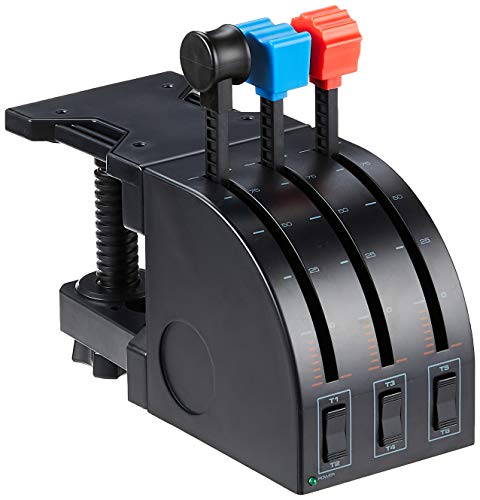
The Saitek PRO Flight Throttle Quadrant is built specifically to expand a Logitech Pro Flight rig, adding a dedicated three-axis lever setup on the left side of your desk. Three throttles cover multi-engine aircraft, and three two-way rocker switches add more programmable inputs for systems like flaps, gear, or trim. It slots in naturally next to the Logitech G PRO Flight Yoke System covered further down, giving you a complete quadrant-plus-yoke control surface.
The black finish matches the rest of the Saitek family, so a Pro Flight setup looks like a unified kit rather than a desk of mismatched hardware. For pilots flying the PMDG or LevelUp airliners in MSFS, having dedicated throttle axes for each engine is a meaningful workflow upgrade over hat-switch mappings. Setup is plug-and-play on Windows, with no extra drivers required for basic axis configuration.
Practical Pluses
- Three throttle axes cover twin- and multi-engine airliners with dedicated lever control
- Three two-way rocker switches add more programmable controls without cluttering the yoke
- Matches the Saitek/Logitech Pro Flight family aesthetic for a unified-looking rig
- Plug-and-play on Windows means basic setup takes minutes rather than hours
A Few Limitations
- Limited value if you do not already own a Logitech/Saitek Pro Flight Yoke as the anchor piece
- Plastic levers feel lighter than metal throttle quadrants from higher-tier builders
Who Should Grab It
Existing Logitech Pro Flight owners who want dedicated throttle axes for multi-engine airliner operations.
Not Your Match When
Pilots starting fresh should pair the Thrustmaster T16000M FCS Joystick with separate rudder pedals rather than building on the Saitek ecosystem.
The standalone Logitech G PRO Flight Yoke System is the version to buy if you want the same Saitek Pro Flight experience without the bundled rudder pedals. The yoke itself uses a stainless steel shaft with a two-position clamp, which holds up under aggressive maneuvers during combat-style flying. A POV hat, 14 button controls, and a 3-position mode switch combine to give you 75 programmable controls across the unit, which is more than most home simmers ever map.
A separate three-axis lever throttle ships in the box, so you have a complete single-engine cockpit without adding a separate quadrant purchase. An integrated USB 2.0 hub on the unit is genuinely handy for plugging in a headset cable or a stream deck without reaching for the back of your PC. Windows 10, 8.1, 7, XP, and Vista compatibility keeps older systems in play, though most pilots are running modern setups by 2026.
The Case For It
- 75 programmable controls cover nearly every cockpit system without keyboard shortcuts
- Stainless steel yoke shaft with two-position clamp handles aggressive inputs well
- Integrated USB 2.0 hub saves a desk port for headsets or accessories
- Three-axis throttle ships in the box, so the unit is a complete single-pilot solution
Potential Drawbacks
- You will still need rudder pedals for proper coordinated flight, which adds another purchase
- Plastic throttle levers feel less premium than the steel yoke above them
Feature Snapshot
Built With In Mind
Simmers who want maximum programmable control on a single unit and already plan to add their own rudder pedals.
Reach For A Different Pick When
Pilots who want smoother steering feel should consider the Honeycomb Alpha Flight Controls Yoke, which uses ball bearings rather than a sliding shaft.
The T16000M is technically a joystick rather than a yoke, but it earns its place on this list because combat sim pilots almost always fly with a stick, not a yoke, and the T16000M is one of the most-respected entry points in that category. The key tech here is H.E.A.R.T Hall Effect AccuRate Technology, a magnetic sensor system that delivers drift-free accuracy over time. Unlike potentiometer-based sticks that develop a dead spot in the center after months of use, the T16000M stays consistent.
The stick is fully ambidextrous, so left-handed pilots can flip the handedness without a separate purchase. Sixteen action buttons plus an eight-way directional hat give you enough programmable inputs to manage weapons, countermeasures, and radio panels in DCS. Pilots who graduate to a higher-end stick later can keep the T16000M as a throttle or a secondary control in a dual-stick space combat setup.
What It Does Well
- Hall effect sensor avoids the center deadzone that potentiometer sticks develop over time
- Fully ambidextrous design works equally well for left-handed pilots
- 16 buttons plus an 8-way hat cover combat and space sim workloads comfortably
- Small footprint fits on desks where a full yoke-and-throttle setup would feel cramped
Where It May Fall Short
- Joystick ergonomics feel wrong for fixed-wing GA pilots used to yoke handling
- Plastic base is fine on a desk but tends to slide during aggressive maneuvers without a mat
Who Will Love This
Combat and space sim pilots who prefer stick flying and want drift-free precision in a compact package.
A Better Fit Elsewhere
Fixed-wing GA pilots should reach for the Honeycomb Alpha Flight Controls Yoke, which matches yoke-style cockpit controls more naturally.
What To Weigh Before Choosing A Flight Sim Yoke
Mounting And Desk Space
Most yokes in this list use a desk clamp, and the clamp’s range matters more than people expect. Honeycomb’s clamp holds well on a 1.5-inch edge, while Logitech’s two-position clamp works best on a thicker, sturdier surface. If your desk is a thin IKEA tabletop, plan on a wheel-bolt mount or a dedicated cockpit frame like the SimFab rig above.
Yoke Rotation And Shaft Construction
A 180-degree rotation range mirrors real GA and airliner yokes, and a steel shaft with ball bearings, as found on the Honeycomb Alpha, keeps the feel consistent over years. Plastic shafts and sliding bushings are cheaper, but the wobble tends to creep in after heavy use. Combat sim pilots usually skip yokes entirely and go for a Hall effect stick like the T16000M.
Programmable Controls And Switch Panels
Counting buttons, hats, mode switches, and axes tells you how much of the cockpit you can map without keyboard shortcuts. The Logitech G PRO Flight Yoke System with 75 programmable controls is a heavyweight here. A built-in switch panel, like the one on the Honeycomb Alpha, replaces keyboard commands for master, alternator, avionics, and lights.
Pedals And Rudder Compatibility
Yokes alone do not give you proper coordinated flight. A self-centering rudder pedal set with adjustable damping, like the Logitech Pro Flight pedals in the bundle above or the cross-platform Thrustmaster TFRP, rounds out the rig. Console pilots on Xbox or PS5 should default to the TFRP since the Logitech rudder ecosystem stays PC-only.
Key Considerations Across These Picks
Pitfalls Shoppers Hit
First-timers often pair a yoke with a stick-style throttle or grab a flight stick expecting it to feel like a yoke, then end up with a rig that fights the aircraft they want to fly. Match the controller to the aircraft family: yokes for fixed-wing GA and airliners, sticks for combat and space sims. Another common miss is skipping rudder pedals because they feel redundant, then discovering that coordinated turns and crosswind landings become a fight against the sim’s torque modeling.
Where The Extra Money Goes
Premium yokes earn their price through shaft construction, sensor quality, and switch panel integration. The Honeycomb Alpha’s steel shaft and ball bearings keep the feel tight where cheaper yokes develop play, and the integrated switch panel with night-friendly red LEDs replaces several keyboard commands. Bundled ecosystems like the Logitech G PRO Flight Yoke System push the price up further by including 75 programmable controls, an integrated USB hub, and a three-axis throttle, so the cost reflects the amount of aircraft you can map to a single unit.
Frequently Asked Questions
Do I need a yoke or a joystick for flight sim?
It depends on what you fly. Yokes fit general aviation and airliner handling, since the real aircraft use yokes. Joysticks fit combat aircraft, helicopters, and space sims, which all use sticks in real life. Many simmers own both and switch based on the module.
Can I use a flight sim yoke on Xbox or PS5?
Some can, some cannot. The Thrustmaster TFRP Rudder Pedals work on PS5, Xbox, and PC. The Logitech G PRO Flight Yoke System is PC-only. The Honeycomb Alpha is also PC-only. Console simmers need to filter carefully before buying.
What does a Hall effect sensor do in a joystick?
A Hall effect sensor uses magnets to detect stick position rather than physical contact wipers, so it does not wear out or develop a center deadzone over time. The Thrustmaster T16000M uses this tech, which is why combat sim pilots trust it for long-term precision.
Do I need rudder pedals if I have a yoke?
Yes, for realistic flying. Yaw control is critical for coordinated turns, crosswind landings, and taxiing, and trying to handle rudder with a hat switch is rough on real-world procedure. A self-centering pedal set with toe brakes rounds out the rig properly.
How much desk space does a flight sim yoke need?
A basic yoke setup with a separate throttle and a small pedal set usually needs around 3 to 4 feet of desk depth. A full cockpit frame like the SimFab Modular Cockpit demands dedicated floor space and is harder to relocate. Measure before you commit to a clamp-based yoke if your desk runs shallow.
Closing Remarks
The right controller depends on what you fly, where you sit, and how much hardware you want to commit to. Yoke pilots chasing the smoothest feel should look at the Honeycomb Alpha, while console simmers will find the Thrustmaster TFRP the easiest on-ramp. Combat pilots running DCS modules get the most out of a full rig like the SimFab cockpit, and stick flyers stay happy with the T16000M’s Hall effect precision.



