


A proper rig changes how sim racing feels. Instead of a wheel clamped to a desk, a dedicated cockpit locks the wheel, pedals, seat, and screen into a single body, so braking hard doesn’t nudge the wheelbase and cornering forces stay consistent lap after lap. That kind of stability shows up immediately in consistency on track, especially across longer stints in Assetto Corsa, iRacing, or Gran Turismo.
The challenge is that cockpits range from folding stands you keep behind a couch to aluminum extrusion frames that anchor a direct-drive wheel and a triple-screen mount. The picks below cover both ends and the middle, with notes on compatibility, adjustability, and what each one trades away. Most of these are frames only, meaning the wheel, pedals, and seat are sold separately, so factor that into your build before settling on a chassis.
A Quick View Of The Lineup

Logitech G PRO Racing Wheel Direct Drive 11 Nm Force
Dardoo G29 Racing Simulator Cockpit with Seat

DIWANGUS Foldable Steel Sim Rig with Seat

DIWANGUS Aluminum Alloy Racing Simulator Cockpit with Monitor Mount

Conquer Racing Simulator Cockpit Wheel Stand and Shifter Mount

Marada Adjustable Racing Wheel Stand for Logitech/Thrustmaster

Marada Reinforced Stabilizing Racing Sim Cockpit Stand

Dardoo Racing Simulator Cockpit Frame Adjustable Wheel Stand
DIWANGUS Racing Simulator Cockpit with Seat and Monitor Mount

Dardoo G920 X Type Flight Racing Simulator Cockpit Frame
More Details On Our Top Picks
The Logitech G PRO Racing Wheel sits in a different category from the rest of this list. It’s a wheelbase and wheel face, not a frame, and it’s the one component that actually generates the road feel through your hands. Direct drive means the motor sits directly on the steering axis (no belt or gear reduction in between), which is why the steering response feels so immediate. The 11 Nm of peak torque is serious hardware, on par with mid-tier sim racing wheels that cost significantly more.
PC sim racers chasing a real steering feel get the most from this wheel. TRUEFORCE processes high-frequency audio cues from supported games, so engine vibration and road surface transitions come through the wheel, not just the speakers. Magnetic shift paddles with contactless hall-effect sensors (which read paddle position magnetically rather than through physical contact) give consistent trigger pulls lap after lap. You can swap to analog clutch paddles for race starts, and a small OLED screen on the wheel lets you flip between five saved profiles without alt-tabbing out of a session.
Standout Benefits
- Direct-drive torque at 11 Nm delivers strong, detailed force through the wheel
- TRUEFORCE adds fine-grained texture for supported PC sims
- Magnetic paddles resist wear from heavy downshifting
- Analog dual-clutch paddles support realistic race launches
- OLED display makes profile switching simple mid-session
Things To Consider
- PC-only, with no PlayStation compatibility out of the box
- You’ll still need a separate frame, seat, and pedals to use it
- Direct-drive motors are heavy, so the mounting frame must be rated for the load
Key Specs
Who It Suits Best
Hardcore PC sim racers who already own (or plan to build) a sturdy cockpit and want the steering feel to match their frame investment.
Where Another Pick Suits Better
The DIWANGUS Aluminum Alloy Racing Simulator Cockpit with Monitor Mount is a better starting point if you need a complete frame first and want to upgrade the wheel later.
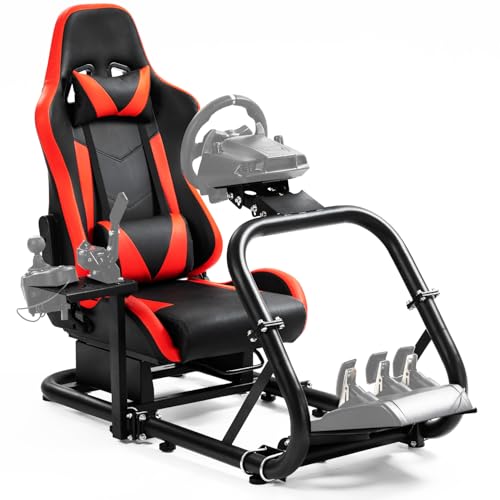
What stands out about the Dardoo G29 Racing Simulator Cockpit with Seat is the willingness to flex around a long driving session. Where the folding steel frame above focuses on being compact, this one leans into a thicker 50x50mm round-tube chassis with four-bolt flange joints, the kind of build you usually see on rigs that take real punishment. The included seat reclines from 90° to 180°, which is unusual for a cockpit at this level, and comes with both a neck pillow and lumbar support.
Endurance sim racers and anyone who spends more than an hour per session at a time get the most out of this layout. The recline range is helpful for break periods between stints, and the heavier tubing keeps the wheelbase stable under harder braking. Compatibility covers Logitech G25, G27, G920, G923, Thrustmaster T300RS, and Fanatec bases, which covers most mainstream wheel ecosystems. Note that the wheel, pedals, and handbrake are not included.
Real Benefits
- Thick round-tube steel frame stays planted under heavy braking
- Reclining seat supports long stints and quick rest breaks
- Included neck and lumbar cushions reduce fatigue on extended runs
- Broad wheel-base compatibility across Logitech, Thrustmaster, and Fanatec
Trade Offs
- Heavier frame is harder to reposition once set up
- No folding mechanism, so it claims a fixed footprint in the room
- Wheel, pedals, handbrake, and shifter all sold separately
Built With In Mind
Endurance sim racers and Gran Turismo or iRacing players who run long sessions and want a planted, supportive cockpit at home.
Skip It When
You’d be better served by the DIWANGUS Foldable Steel Sim Rig with Seat if you need to store the rig out of the way between sessions.
Sim racers in small apartments know the daily negotiation: a full cockpit takes over a room, and a clamped-to-desk wheel doesn’t deliver the same feel. The DIWANGUS Foldable Steel Sim Rig with Seat answers that tension directly. The seat folds down while your wheel and pedals stay mounted, so the whole frame stands upright for storage without you having to unbolt anything. You go from “driving position” to “stored in the corner” in about a minute.
Adjustment range is genuinely useful. The wheel deck tilts from roughly 20° to 30°, adjusts for height, and slides fore-and-aft, while the pedal plate covers distance and three-step tilt. The seat itself doesn’t recline or slide, so the geometry gets tuned around your body through the wheel and pedal adjustments. Compatibility includes Logitech, MOZA, and Thrustmaster ecosystems, which covers the most common wheel bases in this price range.
What Works In Its Favor
- Folding design keeps wheel and pedals mounted during storage
- Wide wheel-deck adjustment range fits a range of body sizes
- Three-step pedal tilt helps dial in a realistic driving posture
- Covers Logitech, MOZA, and Thrustmaster bases
Points To Keep In Mind
- Seat is fixed, so the wheel and pedals do all the geometry work
- Steel construction is heavier than aluminum extrusion rigs at similar sizes
Right Fit For
Apartment dwellers and renters who want a proper cockpit footprint but can’t commit the space to a permanent installation.
Look Elsewhere When
The DIWANGUS Aluminum Alloy Racing Simulator Cockpit with Monitor Mount is a better match if you want a lighter aluminum frame with a screen mount built in.
Aluminum extrusion cockpits used to be the realm of high-end custom builds, and the DIWANGUS Aluminum Alloy Racing Simulator Cockpit with Monitor Mount brings that construction style to a more accessible package. About 70% of the structural components use 3030 and 3060 aluminum-alloy profiles (standardized extrusion sizes used across sim-rig ecosystems), which is a different material story from the steel-tube frames earlier in this list. Aluminum is lighter, doesn’t rust, and accepts standard T-slot hardware for mounting accessories down the road.
The retractable frame is the second headline feature. The front and rear sections pull inward after a session, and the seatback folds to shrink the rig’s footprint for storage. The integrated monitor mount is the part that ties the build together, because a single-screen or triple-screen setup lands at eye level without needing a separate desk or stand. PS4, Xbox, and PC compatibility makes it friendly for shared households with multiple consoles.
The Helpful Details
- Aluminum profile frame is lighter and resists corrosion
- Integrated monitor mount keeps the screen at proper eye level
- Retractable frame reduces the rig’s footprint when not in use
- Standard T-slot hardware allows for future accessory upgrades
Worth Noting
- Aluminum extrusions can flex more than welded steel under hard direct-drive use
- Wheel, pedals, and seat may be sold separately depending on the listing bundle
Best Suited To
Console and PC racers who want a lighter, modular frame with a built-in monitor mount, and who plan to add accessories over time.
Another Choice May Suit
The Dardoo G29 Racing Simulator Cockpit with Seat is worth a look if you prefer a heavier steel frame and want the seat included in the box.
The Conquer Racing Simulator Cockpit is the entry point on this list, and it shows in the scope. It’s a wheel stand plus gear-shifter mount, designed to sit in front of a chair rather than replace one. The shifter mount is the detail that earns it a place here, because most budget stands leave you clamping the shifter to the wheel deck, which bends the throw geometry over time.
First-time cockpit shoppers who already own a wheel, pedals, and a decent office chair are the natural fit. Because the chair is separate, you can swap in a used recliner, a racing bucket, or whatever you have on hand, and the stand is light enough to slide into a closet between sessions. Just know that the stability ceiling is lower than the steel-tube frames in this roundup, so it’s a friendlier match for belt-driven or gear-driven wheels than direct-drive units.
Where It Delivers
- Dedicated shifter mount keeps the gear lever in a realistic position
- Standalone frame uses your existing chair, no replacement seat needed
- Lightweight enough to move and store between sessions
Some Limits To Know
- Stability is lower than full cockpits under heavy direct-drive torque
- Wheel and pedals are not included
Perfect Match For
Sim racers stepping up from a desk-clamped wheel who already have a chair and a basic Logitech or Thrustmaster setup.
A Better Fit Elsewhere
The Marada Adjustable Racing Wheel Stand is the better pick if you want a similar standalone frame with more pre-assembly out of the box.
The Marada Adjustable Racing Wheel Stand takes the same standalone-frame approach as the Conquer pick above and adds faster setup. Roughly 55% of the rig ships pre-assembled, which means most shoppers go from box to wheel-mounted in under half an hour rather than spending a Saturday sorting hardware. The steel-tube construction pairs with rubber feet to keep the stand planted under normal play loads.
Casual console racers running Logitech G920, G923, or Thrustmaster T300RS and T500RS wheels will find the compatibility list fits cleanly. The shifter position adjusts for angle and height, which is a nice touch for households where the rig gets used by more than one person. The honest read is that this is a budget-tier stand, so very high-torque direct-drive wheels will push its stability ceiling, but for belt-driven wheels on PS4 or Xbox, it does the job without complications.
Well-Handled Touches
- Pre-assembled design shortens the path from box to driving
- Adjustable shifter angle and height accommodate different drivers
- Rubber feet protect floors and reduce sliding
Soft Spots
- Steel-tube frame is less rigid than aluminum extrusion under heavy force feedback
- Wheel, pedals, handbrake, and shifter are not included
Made For
Console racers on PS4 or Xbox who want a budget-friendly upgrade from a desk setup without a long assembly project.
Reach For A Different Pick When
The Dardoo Racing Simulator Cockpit Frame is the better fit if you want a more adjustable stand with broader wheel-base compatibility.
The Marada Reinforced Stabilizing Racing Sim Cockpit Stand earns its name through the build. The frame is one-piece welded rather than bolted together, with a double-column support and a wider bracket structure under the wheel deck. Under heavy direct-drive braking, that weld is what keeps the wheelbase from rocking backward and throwing off your trail-braking inputs.
Owners of high-torque direct-drive wheels, especially Fanatec CSL DD and ClubSport DD bases, are the target. The wider bracket and reinforced column make a real difference when a 15 Nm or 20 Nm wheel snaps back to center at the end of a straight. It also accepts around 90% of aftermarket seats, so you can pair it with whatever racing bucket you already have. No wheel, pedals, handbrake, or shifter is included, so factor that into the build cost.
A Strong Showing
- One-piece welded frame resists flex under direct-drive torque
- Double-column wheel support keeps the base planted during heavy braking
- Broad seat compatibility supports most aftermarket racing buckets
Areas To Watch
- Welded construction makes the frame heavier and harder to ship back if it doesn’t fit
- Wheel, pedals, and seat are not included in the box
Who Should Grab It
Direct-drive wheel owners who want a frame that won’t shift under hard braking and are willing to source a separate seat.
Where A Sibling Pick Shines
The Dardoo G29 Racing Simulator Cockpit with Seat is the better match if you want the seat included and prefer a reclining layout.
The headline on the Dardoo Racing Simulator Cockpit Frame is the joint design. The frame uses a flange structure with four large screws at each major joint, which is a different approach from the one-piece welded construction of the Marada stand above. Bolted flanges make the rig more serviceable over time and easier to disassemble for a move, though they trade a little rigidity under very high torque.
Households with multiple drivers of different heights get the most from this rig, because the multi-position adjustment covers wheel angle, wheel height, pedal distance, and pedal angle. That kind of fit flexibility matters when the same rig needs to work for a 5’4″ driver and a 6’1″ driver back to back. Compatibility spans Logitech G27, G29, G920, G923, Thrustmaster T300, T500, and Fanatec bases, so the wheel side is covered for most mainstream builds. Wheel, pedals, handbrake, shifter, and seat are all sold separately.
Useful Strengths
- Flange-and-bolt joints are easier to service and disassemble than welds
- Multi-position wheel and pedal adjustment fits a wide range of driver heights
- Broad compatibility across Logitech, Thrustmaster, and Fanatec ecosystems
Honest Caveats
- Bolted joints can loosen over time and may need periodic retightening
- Wheel, pedals, seat, and accessories are not included
Whose Shelf It Belongs On
Multi-driver households who need a single rig that adjusts to different body sizes between sessions.
Not Your Match When
The Marada Reinforced Stabilizing Racing Sim Cockpit Stand is the better choice if you run a high-torque direct-drive wheel and want a welded frame.
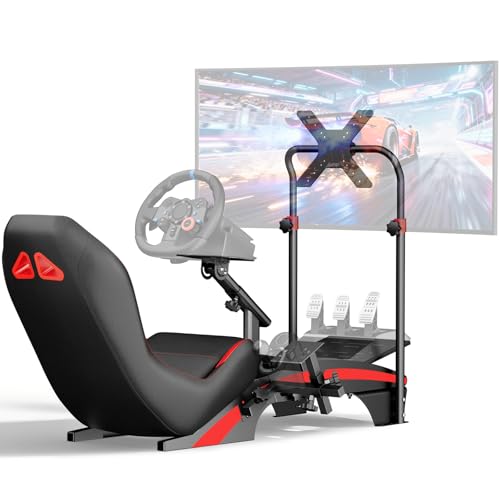
The DIWANGUS Racing Simulator Cockpit with Seat and Monitor Mount is the most complete build in this roundup. The Q235 steel frame, F1-style sponge-padded leather seat, wheel deck, pedal plate, and a display mount all arrive together, so a single purchase covers the structural side of the rig. Open-cockpit racing fans get the high-sided seat shape that supports an upright driving posture during long GT and prototype stints.
Sim racers who want one stop rather than a piecemeal build benefit most. The wheel deck adjusts for height, angle, and reach, the pedal plate tilts, and the monitor mount adjusts for both height and angle, so the entire cockpit can be dialed in around your body rather than the other way around. PS4 and PC compatibility covers the consoles most single-screen sim racers use. Wheel and pedals still need to be sourced separately.
Points In Its Favor
- Seat, monitor mount, and frame ship together for a complete rig foundation
- F1-style seat shape supports an upright, open-cockpit driving posture
- Wheel deck, pedal plate, and monitor mount all adjust for fit
Practical Considerations
- Wheel and pedals are not included, so factor those into the build
- The fixed F1-style seat is less versatile than a reclining GT-style seat for casual use
The Right Fit
Open-cockpit and prototype sim racers who want frame, seat, and monitor mount in one purchase and don’t mind sourcing the wheel and pedals separately.
Swap It Out When
The Dardoo G29 Racing Simulator Cockpit with Seat is a better fit if you want a reclining seat for varied driving positions and longer endurance sessions.
The Dardoo G920 X Type Frame takes a different visual approach from the rest of the roundup. The X-frame design with triangular bracing looks a little like a flight sim yoke mount, which is where the product name comes from, but it works just as well for racing wheels. The non-slip feet and triangular load path keep the stand planted during normal racing play, and the X geometry folds flat for storage between sessions.
Chair-based casual setups are the natural fit. You can roll up an office chair, gaming chair, or recliner, and the stand adapts around it. Compatibility covers Logitech G25, G27, G29, G923, and Thrustmaster T128X, T248, T300, and T458 wheels, which is a wider Thrustmaster list than most of the other stands in this roundup. The 80% pre-assembled design means setup is fast, with a few bolts and you’re driving. Wheel, pedals, handbrake, and shifter are not included.
Noteworthy Benefits
- X-frame design folds flat for storage in tight spaces
- Triangular bracing reduces unwanted sway under normal play loads
- Wide Thrustmaster compatibility covers recent wheels in that ecosystem
- High pre-assembly rate shortens time from box to driving
Factors To Consider
- Standalone frame relies on your existing chair for support
- Wheel, pedals, handbrake, and shifter are sold separately
Who Will Love This
Casual sim racers who already have a good chair and want a foldable, low-commitment cockpit stand for occasional sessions.
Consider Something Else When
The Marada Adjustable Racing Wheel Stand is the better match if you want a similar foldable design with broader shifter and pedal adjustment.
What To Weigh Before Choosing A Sim Rig Frame
A sim racing cockpit is the foundation everything else hangs off of, so the right choice depends as much on the wheel you own (or plan to buy) as on the frame itself. Direct-drive wheels with high torque output put real stress on a frame, and a budget steel stand will flex under braking, which shows up as inconsistent pedal feel and a wheel deck that rocks backward. Belt-driven and gear-driven wheels are far more forgiving and pair comfortably with lighter stands.
Compatibility deserves a close look before anything else. Wheel-base mounting patterns vary across Logitech, Thrustmaster, MOZA, and Fanatec, and a frame that fits a G920 won’t always fit a CSL DD without adapter plates. Most of the frames in this list state their compatibility in the product description, so cross-check the wheel model number before committing. Pedal plate spacing matters too: shorter drivers often need a closer pedal reach than the default mount provides.
Build material affects weight, feel, and longevity. Steel-tube frames are heavier and stiffer, which helps under hard direct-drive braking but makes the rig harder to move. Aluminum extrusion frames are lighter, accept standard T-slot hardware for future upgrades, and resist corrosion, but can flex more under very high torque. For most home setups running a mid-torque direct-drive or belt-driven wheel, either material works well.
Footprint and storage are the practical reality. Measure the room you have, including a comfortable buffer behind the seat for recline, and check the rig’s dimensions against that. Folding frames, like the DIWANGUS Foldable Steel Sim Rig and the Dardoo X Type, are the friendliest answer in smaller rooms. Permanent rigs reward you with a more planted feel but ask for a dedicated corner of the room.
Smart Choices To Make Before You Buy
Common Slip Ups When Picking A Frame
The most common mistake is buying a frame before locking in the wheel. Direct-drive bases are heavier and apply more force, so a frame rated for a G920 may not be rated for a CSL DD or a ClubSport DD. Check the wheel-base mounting pattern and the frame’s weight rating before ordering. Skipping this step often leads to returns or, worse, a frame that flexes under hard use.
Another trap is ignoring the seat. Many of the frames in this list ship without one, and the difference between a basic office chair and a proper racing bucket is felt after about thirty minutes of driving. If the frame doesn’t include a seat, budget for one separately, and check the seat-mounting pattern against the frame before you commit. The Dardoo G29 and DIWANGUS All-In-One picks are the easiest path if you want a seat in the box.
Where The Extra Money Goes In A Premium Rig
Higher-tier cockpits spend the money in three places: aluminum extrusion instead of steel tube, integrated monitor mounts, and broader adjustment range. Aluminum is lighter, doesn’t corrode, and accepts standard T-slot hardware for mounting accessories, which matters if you plan to add a handbrake, shifter, or button box over time. Integrated monitor mounts bring the screen to proper eye level, which is a real upgrade in immersion.
The adjustment range is what makes the upgrade worth it for shared households. A frame that adjusts for multiple driver heights, multiple wheel angles, and pedal reach is one rig that works for everyone, rather than a rig tuned to a single body. The honest read is that if you’re the only driver and you don’t plan to add accessories, a mid-tier frame is plenty. The upgrade pays off when the rig needs to grow with you.



