


A bass compressor sits between your fingers and the audience, quietly evening out volume swings so every note lands with the same weight. Whether you’re smoothing out fingerstyle passages in a home studio, taming a slappy funk line, or locking in low-end punch for a loud stage mix, the right pedal changes how your bass feels under the hand. This list covers nine stompboxes that span clean optical circuits, gritty analog limiters, multiband digital processing, and full studio-grade emulations, so you can match the tool to the gig instead of forcing your playing to fit the pedal.
The Leading Options At A Glance

Wampler Ego Compressor V2 Pedal

Universal Audio 1176 Compressor Limiter Pedal
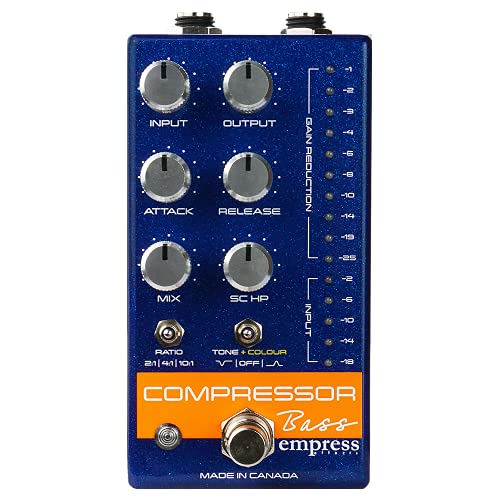
Empress Effects Bass Compressor Pedal

Xotic SP Compressor Pedal

Electro-Harmonix Tone Corset Compressor

BOSS CP-1X Compressor Pedal

Boss CS-3 Compressor/Sustainer Pedal

JOYO SCYLLA R-27 Bass Compressor

MXR Bass Compressor
What Each Pick Brings To The Table
The Wampler Ego Compressor V2 leans into transparency, which is exactly what most bass players want when they reach for compression in the first place. A dedicated blend control lets you mix the dry signal back in alongside the compressed output, so the pedal can add sustain and evenness without flattening your natural pick attack. On a P-Bass through a clean amp, the Ego tightens up the low end without making every note feel like it’s being choked.
That tone-blend approach makes the V2 a useful tool for both fingerstyle players who want subtle smoothing and slap players who need a little more grab on the peaks. Compared to the more colored choices further down this list, the Wampler sits closer to a “set and forget” utility. For session bassists tracking parts at home, it pulls double duty as a subtle always-on leveling tool or a more obvious effect when you push the controls harder.
Everyday Advantages
- Blend knob preserves natural attack while adding sustain
- Stays transparent at lower settings, useful for studio tracking
- Handles passive and active basses without losing low-end weight
- Compact footprint fits crowded boards with ease
Worth Noting
- Owners commonly report the small knobs feel a little delicate for repeated live tweaking
- True-bypass routing means the un-compressed tone changes when the pedal is engaged
Who It Suits Best
Intermediate bassists and session players who want transparent leveling with the option to dial in more obvious squash when the song calls for it.
A Better Fit Elsewhere
Bassists chasing a vintage Ross-style squash will likely prefer the Xotic SP Compressor Pedal, which leans further into colored compression.
The 1176 name carries serious weight, and this stompbox version is built on Universal Audio’s UAFX engine, which means you’re getting a digital emulation of one of the most recorded studio compressors of all time. FET-style compression (a fast, aggressive circuit type known for adding harmonic grit) has a distinct personality: it grabs the signal quickly, adds a subtle midrange forward push, and makes bass lines feel glued to the mix. The “all-buttons-in” trick famous on the hardware is here too, so you can push the pedal into obvious squash when you want it.
This is a colored compressor, not a transparent one, and that is the entire point. On a clean studio recording of a Jazz Bass, the 1176 pedal adds a sense of weight and presence that most analog pedals can’t match. Compared to the Wampler Ego’s blend-utility approach, the Universal Audio leans fully into character. It belongs on a board where the player wants the compression itself to be part of the bass tone.
What It Does Well
- Emulates a legendary FET circuit with convincing harmonic color
- Fast attack response works well for slap and pick-driven styles
- Robust metal chassis built for daily gigging and travel
- Studio-style presets let you recall settings between sessions
Trade Offs
- Premium pricing puts it well above most analog pedal options
- Power-hungry digital circuit, so cable management and supply choice matter
- Colored character may not suit players wanting invisible leveling
Feature Snapshot
Right Fit For
Tone-conscious bassists and home recordists who want the 1176’s distinctive FET sound without committing to a full rack unit.
Reach For A Different Pick When
Players on a tighter budget who want analog character should look at the Xotic SP Compressor Pedal instead.
The Empress Effects Bass Compressor was designed from the ground up with low-end in mind, and the control set reflects that. Attack, release, ratio, threshold, makeup gain, mix, and sidechain high-pass filter are all laid out on the face, which is a lot of knobs by pedalboard standards. That high-pass sidechain option is genuinely useful on bass because it keeps the compressor from pumping in time with every low note you play.
What the Empress gives you is a full studio-style compressor with parallel mix capabilities in a single stompbox. Compared to the simpler four-knob Tone Corset from Electro-Harmonix, the Empress invites more experimentation. For bassists who like to sculpt a specific response curve, this is one of the most flexible choices on the list. The honest read is that the depth comes with a learning curve, and beginners may not use half the controls at first.
Points In Its Favor
- Sidechain high-pass filter prevents low-end pumping on bass
- Parallel mix knob blends dry signal for natural attack
- Multiple ratio settings cover subtle to obvious compression
- Visual gain-reduction feedback helps with precise tweaking
Points To Keep In Mind
- Knob density may feel overwhelming at first
- Premium pricing reflects the feature set
- Smaller enclosure footprint can crowd adjacent pedals
Quick Facts
Built With In Mind
Intermediate and advanced bassists who want detailed control over how the compressor reacts to their instrument’s lowest frequencies.
Where A Sibling Pick Shines
Players who only need basic leveling with minimal menu-diving will find the Electro-Harmonix Tone Corset Compressor easier to dial in.
The Xotic SP is one of those pedals that shows up on a remarkable number of professional boards for a reason. It’s based on the Ross compressor circuit, a design that defined transparent studio compression in the 1970s, and adds a few modern conveniences like a three-position compression mode switch and a variable blend control. On bass, it leans toward adding a touch of harmonic sparkle along with the leveling, which gives notes a little extra edge in a mix.
Where the SP really wins is the ease of dialing in a usable sound. Most players can land on a great setting in under a minute, which is not always the case with the more complex Empress. Compared to the Universal Audio 1176’s bold studio character, the Xotic sits much closer to a clean utility compressor. For the bassist who wants one pedal to handle light smoothing during verses and heavier squashing during choruses, the mode switch makes that jump easy.
Where It Delivers
- Ross-style transparency with a hint of harmonic edge
- Three-position mode switch adapts to different playing styles
- Internal dip switches let you fine-tune beyond the front panel
- Compact mini housing saves space on a crowded board
A Few Limitations
- Mini enclosure can feel cramped for players with large fingers
- Internal dip switches require opening the pedal to access
Feature Card
Made For
Players who want a versatile, easy-to-use compressor that handles both subtle leveling and obvious squash on a single pedal.
Look Elsewhere When
Bassists wanting full studio-grade control should step up to the Empress Effects Bass Compressor Pedal instead.
The Tone Corset keeps things refreshingly simple with four controls: sustain, attack, blend, and volume. The attack knob behaves a little differently than most, with clockwise rotation slowing the response so more of your initial pick attack comes through. That detail matters on bass because fast attack settings can swallow the transient of a thumb-slap, while slow attack settings preserve the percussive bite that defines the style.
The blend knob is the star of the show for bassists who want a parallel compression setup without carrying a second unit. True bypass switching keeps the un-engaged tone completely untouched, which is something to think about if you have a long cable run or true-bypass-friendly signal chain. Compared to the more layered Empress, the Tone Corset stays out of the way, and that simplicity is the point.
Key Advantages
- Four-knob layout covers the essentials without overwhelming
- Blend control supports parallel compression on bass
- True-bypass switching preserves dry tone when off
- Analog circuit adds gentle character without digital artifacts
Some Limits To Know
- No sidechain filter, so low notes can trigger heavier compression
- Limited ratio adjustment compared to the Empress
Whose Shelf It Belongs On
Bassists who want a straightforward analog compressor that handles the basics without requiring deep menu-diving.
Swap It Out When
Players needing a sidechain filter to keep the low end from pumping should look at the Empress Effects Bass Compressor Pedal instead.
BOSS built the CP-1X around their MDP (Multi-Dimensional Processing) technology, which is a fancy way of saying the pedal analyzes your signal in multiple frequency ranges and time domains at the same time. The result is a compressor that adapts to what you play, so a soft fingered passage gets different treatment than a hard-slapped run. For bass, that translates into dynamics control that feels less like a blanket effect and more like the amp itself is responding to your hand.
The CP-1X is also one of the few pedals on this list that uses intelligent processing to avoid the “muddy” sound that compressed low frequencies can develop. Compared to the analog warmth of the Xotic SP, the BOSS leans clinical and precise. That suits players who want a compressor to disappear into the signal chain while still doing real work. It’s also a good match for recording direct because the multiband approach keeps the low-end definition intact in a dense mix.
What Makes Sense
- Multiband processing responds differently to soft and hard playing
- Smart circuitry helps preserve low-end clarity on bass
- 14 onboard presets let you recall tones between songs
- BOSS build quality holds up to heavy gigging
Potential Compromises
- Digital character may feel less “musical” to analog purists
- Higher learning curve to understand the multi-band behavior
- Premium pricing for the BOSS compact line
Best Suited To
Tech-friendly bassists and direct-recording players who want adaptive dynamics control without a rack of outboard gear.
Not Your Match When
Players who prefer the warm, slightly colored character of analog compression will be happier with the Xotic SP Compressor Pedal.
The CS-3 is one of the longest-running compressor pedals in production, and BOSS’s reputation for tank-like build quality is well earned here. Four controls cover level, tone, attack, and sustain, which gives you enough range to handle most playing situations without overcomplicating the signal chain. The tone control is a useful addition because compression can sometimes darken a bass signal, and this knob lets you dial brightness back in.
For a bassist just starting to experiment with compression, the CS-3 is often the gateway pedal. It’s not as transparent as the Wampler Ego, and it doesn’t have the multiband intelligence of the CP-1X, but it does the basic job at a price that leaves room in the budget for other pedals. Compared to the JOYO SCYLLA further down this list, the BOSS costs more, but the build and the long-term reliability tend to justify the difference for gigging musicians.
A Strong Showing
- Road-ready BOSS chassis handles drops and transport
- Tone knob compensates for high-end loss under heavy compression
- Wide gain range covers subtle to obvious sustain
- Standard 9V operation works with most power supplies
Soft Spots
- Older analog design can dull high frequencies on some setups
- No blend control, so dry signal is always mixed by the circuit
Who Should Grab It
Beginner bassists and gigging players who want a durable, affordable compressor that simply works without fuss.
Consider Something Else When
Players wanting parallel compression or studio-style control will be better served by the Empress Effects Bass Compressor Pedal.
The SCYLLA R-27 brings a genuine optical compression circuit to a price point that makes it accessible for home players and beginners. Optical compressors use a light-dependent resistor to control gain reduction, which produces a smooth, musical response that is more forgiving than hard-knee designs. On bass, that means the pedal reacts to your playing without feeling like it’s clamping down on every peak.
The control set covers attack, release, ratio, and tone, which is a generous feature list at this price. The bypass switch keeps the dry signal intact when the pedal is off, useful for players with long pedal chains. Compared to the BOSS CS-3, the JOYO offers a more “vintage” optical character at a lower cost, though the build and long-term durability tend not to match BOSS standards. For a bassist exploring compression for the first time, this is a sensible place to start.
The Value In It
- Optical circuit produces smooth, musical compression
- Four-knob layout covers the essential parameters
- True bypass keeps the un-engaged tone clean
- Entry-level pricing makes it accessible for new players
Areas To Watch
- Build quality doesn’t match higher-tier BOSS or MXR options
- Optical circuit response can feel slow for fast slap passages
- Documentation and customer support are limited compared to major brands
Technical Highlights
Perfect Match For
Home players and beginners who want to learn how compression shapes bass tone without committing to a premium price.
Skip It When
Gigging bassists needing road-tested reliability will be better served by the MXR Bass Compressor or the BOSS CS-3.
The MXR Bass Compressor is one of the more studio-flavored options on this list, with a control set that includes attack, release, ratio, input, and output. That’s enough to recreate most of the dynamics curves you’d dial in on a rack compressor, but in a pedal that sits comfortably on a board. The CHT (Constant Headroom Technology) circuitry gives the pedal extra clean headroom, which means it doesn’t add unwanted grit even when you push the input hard.
On a passive P-Bass or a jazz box, the MXR delivers transparent compression that doesn’t color the low end in an obvious way. Compared to the Universal Audio 1176, the MXR is much more “invisible” in the signal chain, and that’s a feature rather than a limitation for many players. For the gigging bassist who needs a versatile tool that handles subtle limiting and heavier squash, this pedal covers both jobs with the same control set.
Advantages To Know
- Five-knob control set covers the full dynamics curve
- Constant headroom technology keeps the signal clean at high input
- Transparent character works well in front of any bass amp
- Sturdy MXR chassis built for daily stage use
Honest Caveats
- No blend control for parallel compression
- Higher knob count means more setup time before a session
Important Details
Who Will Love This
Working bassists and tone-conscious players who want a full set of dynamics tools in a pedal-friendly format.
Where Another Pick Suits Better
Players seeking vintage FET character and harmonically rich compression will prefer the Universal Audio 1176 Compressor Limiter Pedal.
How To Pick The Right Compressor For Your Bass
Match The Circuit To Your Style
Compression circuits fall into a few broad families, and each one reacts to your playing differently. Optical designs like the JOYO SCYLLA produce smooth, musical gain reduction that feels forgiving. FET circuits like the Universal Audio 1176 grab the signal quickly and add harmonic character. Analog voltage-controlled designs like the Xotic SP and Wampler Ego lean toward transparency, while digital multiband processors like the BOSS CP-1X adapt in real time to your playing dynamics. For most bassists, the choice starts with whether you want the compressor to be invisible or to be part of your tone.
Look For The Controls You Actually Need
A four-knob pedal like the Electro-Harmonix Tone Corset or Boss CS-3 is enough for most players, covering the basics of threshold, attack, and output. Step up to a five- or six-knob layout like the MXR Bass Compressor or the Empress Effects Bass Compressor when you want ratio control, release timing, or a sidechain high-pass filter. The sidechain filter is worth the upgrade for bass because it prevents the compressor from pumping in time with every low note you play.
Think About True Bypass And Signal Chain Position
True bypass keeps the dry tone completely untouched when the pedal is off, which matters on long cable runs and in signal chains with multiple true-bypass pedals. Buffered bypass keeps the signal strong through long chains but adds a buffer circuit to the signal. Most bass players put their compressor first in the chain, right after the tuner, so the dynamics control shapes the signal before any overdrive or EQ.
Key Considerations Across These Picks
Where Shoppers Go Wrong
The most common mistake is buying a compressor based on the number of knobs alone, then getting buried in controls you never use. A simpler four-knob pedal like the Boss CS-3 often produces better results in the hands of a beginner than a six-knob Empress that never gets dialed in properly. Another trap is ignoring the sidechain high-pass filter, which matters more on bass than on guitar because the lowest notes can otherwise dominate the compressor’s detection circuit.
Where The Extra Money Goes
Higher-tier models like the Universal Audio 1176 Compressor Limiter Pedal cost more because they emulate specific studio circuits with proprietary digital engines, not because they handle more “compression” than cheaper pedals. The Empress Effects Bass Compressor costs more because of the sidechain filter and parallel mix capabilities that cheaper pedals skip. When the upgrade is justified, it’s because the additional controls match a specific playing style or recording need, not because the pedal is “better” in a general sense.
Frequently Asked Questions
What Does A Bass Compressor Actually Do?
A compressor evens out the volume difference between your loudest and softest notes, so quiet passages don’t get lost and loud passages don’t peak. On bass, this helps your note consistency sit more evenly in a mix, especially when playing fingerstyle where dynamics vary widely between passages.
Should I Put A Compressor Before Or After My Overdrive?
Compressors almost always go first in the signal chain, right after the tuner. Placing it before overdrive means the overdrive reacts to a leveled signal, which produces more predictable distortion. Placing it after overdrive can create unwanted pumping artifacts when the distortion spikes trigger heavy compression.
Do I Need A Blend Control On A Bass Compressor?
A blend (or mix) control lets you blend the dry signal back in alongside the compressed output, which preserves your natural pick attack and dynamic feel. Players who want subtle leveling benefit from a blend, while players chasing obvious “squashed” sustain may not need it. The Wampler Ego, Xotic SP, and Electro-Harmonix Tone Corset all include blend controls.
Are Optical Compressors Better For Bass?
Optical compressors (like the JOYO SCYLLA) tend to produce a smooth, musical response that is well-suited to bass because the lowest notes don’t trigger harsh gain reduction. FET and digital designs can also work well, but the optical approach is often the most forgiving for low-frequency signals, which is part of why optical designs have been studio staples for decades.
How Much Compression Is Too Much?
A good starting point is to set the threshold so the gain-reduction meter shows 3-6 dB of reduction on your hardest hits, then adjust from there. More than that and you’ll start to lose dynamic expression, which is the soul of a good bass line. The honest read is that “too much” is usually obvious to the player, so trust your ears and back off if the signal starts to feel lifeless.
Bottom Line
The right bass compressor depends on whether you want transparent leveling, vintage character, or studio-grade control. The Wampler Ego and Xotic SP are reliable all-rounders for most players, while the Empress and MXR Bass Compressor reward those who want detailed control. The Universal Audio 1176 stands apart as a premium character pedal, and the JOYO SCYLLA gives home players a way in without overspending. Match the pedal to your playing style, and the right one will feel like a natural extension of your hands.



