


A real sim racing setup doesn’t require selling off your console. Plenty of sturdy, adjustable cockpits land well under the flagship tier, and the gap in feel between them and the costly rigs has shrunk. You trade some polish, mostly seat padding and clever mounting, but the core experience stays intact: a planted wheel base, pedals that don’t skate across the floor, and a screen you can actually see during a four-wheel slide through Eau Rouge.
This list sorts eight budget racing cockpits by what they actually deliver: frame stiffness, monitor compatibility, wheel-mount flexibility, and how they handle the rough edges of apartment living. Some fold flat. Some bolt to your floor. A few arrive as bare frames. All of them work with the popular Logitech, Thrustmaster, and Fanatec wheels that most newcomers already own.
A Fast Comparison Of The Options

DIWANGUS Racing Simulator Cockpit

Dardoo Racing Simulator Cockpit with Triple Monitor Stand
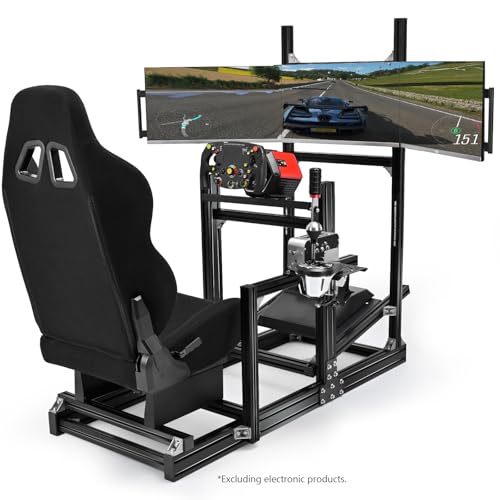
Anman Aluminum Profile Racing Sim Cockpit with Triple TV Mount
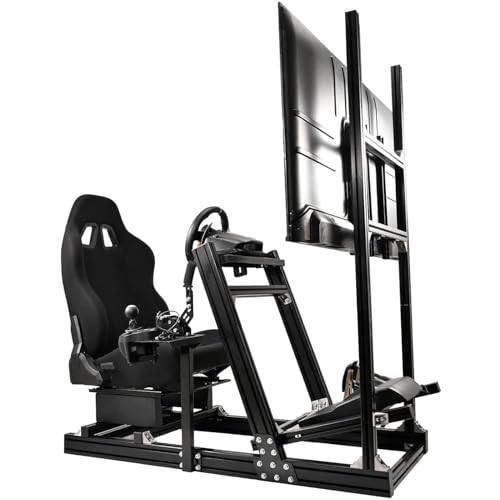
Marada Aluminum 8040 Profile Racing Simulator Cockpit

Likeem Racing Simulator Cockpit Stand with Elite Series Seats

Playseat Evolution Pro Sim Racing Cockpit (Actifit)

Playseat Challenge Racing Simulator Cockpit (Foldable)
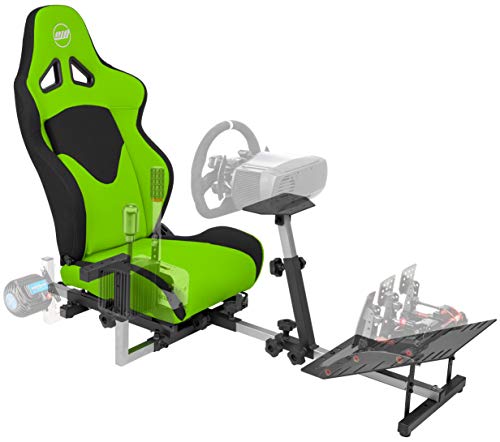
OpenWheeler GEN3 Racing Wheel Simulator Stand (Green Seat)
A Closer Look At Each Pick
Entry into sim racing should feel cheap to set up, not cheap to use, and the DIWANGUS Racing Simulator Cockpit threads that needle. The frame accepts the wheel bases and pedal sets most newcomers already own, and the basic geometry puts the wheel roughly where a real car puts it. If you commute home and want to log laps before dinner, this keeps the barrier low without forcing you to wrestle a flat-pack puzzle.
It targets legacy consoles and current PlayStation hardware, which covers a wide slice of the casual sim audience. Where the Dardoo triple-screen option suits an immersive battlestation, this one suits someone who just wants a stable place to mount a Logitech G29 and a single monitor.
Why It Works Well
- Compatible with the Logitech G-series and Thrustmaster bases that fill most starter setups
- Plays nicely with both PlayStation consoles and PC, so switching rooms doesn’t mean swapping rigs
- Compact footprint compared to the triple-monitor options further down this list
- Lower entry cost leaves budget for a wheel and pedal set you actually want
Points To Keep In Mind
- No included seat in some configurations, so factor in a separate chair or gaming seat
- Monitor mount is not as flexible as the Anman or Marada profiles
Best Suited To
First-time sim racers running a single screen and a mid-tier wheel-and-pedal set who want a stable frame without a complex build.
Look Elsewhere When
Triple-monitor immersion is your goal, in which case the Dardoo Racing Simulator Cockpit is a stronger starting point.
Three screens transform a sim from a game into a wraparound view, and the Dardoo Racing Simulator Cockpit is built around that experience. Its vertical support column is reinforced with 50mm thickened steel tubing, which matters when three 24-inch or 32-inch panels start cantilevering out from the frame. Owners commonly report that the rig stays planted even when the force feedback gets aggressive.
Wheel compatibility runs deep: Logitech G29, G920, and G923, plus Thrustmaster T300RS and Fanatec CSL-DD bases, all find a home here. The catch, as with the DIWANGUS entry above, is that wheel, pedals, and shifter are not part of the package, so you bring your own electronics.
Everyday Perks
- Vertical column design resists the flex that cheaper cockpit frames show under hard braking
- Supports up to three 24-inch or 32-inch monitors for genuine panoramic sight lines
- Wheel-mount plate is broadly compatible with major entry-level and mid-tier bases
- Black seat included, so the rig is closer to turnkey than the bare-frame competitors
Trade-Offs To Consider
- Full triple-monitor build requires a serious GPU to push the extra pixels
- Larger footprint means it won’t vanish into a closet when friends visit
- Direct-drive wheel bases will need extra bracing compared to the Marada profile frame
Key Specs
Made For
Sim racers chasing triple-screen immersion on a budget who already own a compatible wheel and pedal set.
Skip It When
You run a direct-drive wheel like the Fanatec DD1 or DD2, since the Marada Aluminum 8040 Profile Racing Simulator Cockpit handles that torque class better.
Aluminum extrusion frames, the kind built from 2020 or 4040 profile, borrow directly from industrial furniture and machine enclosures, and the Anman Aluminum Profile Racing Sim Cockpit leans into that DNA. The integrated support bar at the wheel-mount position stiffens the chassis in exactly the spot where force feedback torque tries to twist the frame. Long term, this kind of construction is more modular than welded steel, so you can re-add accessories without drilling.
The triple TV mount is the headline feature, accepting up to three screens in an all-in-one configuration. Compared to the Dardoo cockpit, the aluminum T-slot rails give you finer adjustment, but the build complexity is a touch higher, so plan on a longer first-time assembly.
Useful Strengths
- Aluminum profile chassis resists corrosion and allows accessory reconfiguration down the road
- Integrated handle-position support bar stiffens the wheel mount against twisting
- Triple TV mount design gives a clean, single-piece aesthetic versus three separate arms
- Black seat ships in the box, so the cockpit feels closer to ready-to-race
Honest Caveats
- First-time assembly is more involved than the OpenWheeler or Playseat options
- Full triple-monitor weight demands careful anchoring on carpet
Who It Suits Best
Builders planning a long-term rig who like the idea of swapping brackets and accessories on an aluminum extrusion frame rather than a welded tube.
Not Your Match When
You want a fast, foldable setup for a small apartment, since the Playseat Challenge Racing Simulator Cockpit folds down in seconds.
Direct-drive wheel bases, where the motor sits right on the steering column instead of in a separate housing, generate serious torque. The Marada Aluminum 8040 Profile Racing Simulator Cockpit is engineered for that punishment. The 8040 extrusion, heavier and stiffer than the 2020 profile common on entry frames, gives the rig the mass and rigidity to keep a 15 or 20 Nm wheel base honest.
Non-slip pads on the feet add to that planted feeling, and the integrated monitor bracket covers displays from 24 up to 70 inches with standard VESA (Video Electronics Standards Association) mounting patterns. The Anman cockpit above handles triple screens, but the Marada is the smarter buy when your wheel base is a Fanatec or Moza direct-drive unit.
Features That Help
- 8040 aluminum profile frame handles direct-drive torque without twisting
- Non-slip foot pads keep the rig planted on smooth apartment floors
- Monitor bracket covers 24″ to 70″ displays with full VESA support
- Up/down and front/back screen adjustment lets you dial in proper eye-line geometry
Worth Noting
- Heavier to move than the foldable Playseat options
- Single-monitor bracket only, so triple-screen builds require a separate upgrade
Key Specs
Right Fit For
Direct-drive wheel owners running Fanatec or Moza bases who need a frame that won’t twist or walk under aggressive force feedback.
Where Another Pick Suits Better
You want a triple-screen setup out of the box, in which case the Dardoo Racing Simulator Cockpit ships with a triple monitor stand included.
Seat design is where a lot of budget cockpits cut corners, and the Likeem Racing Simulator Cockpit Stand attacks that head-on. The Elite Series racing seat has deeper side bolsters than the flat office-chair-style seats most budget rigs ship with, which actually matters when you’re wrestling through a long endurance stint and don’t want to slide across the cushion under cornering loads.
Compatibility is broad: Logitech G29, G920, and G923, plus Thrustmaster T80 and T300 bases, along with Fanatec wheels. Wheel, pedals, and shifter are not included, so this is a frame-and-seat package for someone who already owns the electronics.
Practical Pluses
- Deep-bucket seat holds you in place through long cornering loads
- Adjustable wheel stand accommodates a wide range of driver heights
- Works with both Logitech and Thrustmaster ecosystems on console and PC
- One of the better seat packages at this price point
Less-Strong Areas
- No bundled monitor mount, so display mounting needs a separate purchase
- Frame is steel rather than aluminum profile, so future reconfiguration is more limited than the Anman cockpit
Perfect Match For
GT and touring car enthusiasts who care about seat support during long sessions and who already own a wheel and pedal set.
Consider Something Else When
You want a fully integrated cockpit with monitor mount in one box, since the Dardoo or Anman options include monitor support out of the box.
Playseat has been in this category long enough that “Playseat” and “racing cockpit” are nearly synonyms, and the Playseat Evolution Pro Sim Racing Cockpit is the upgraded version of the long-running Evolution. It’s positioned at the higher end of the budget tier, but the head stabilizers, refined seat materials, and overall finish put it above most generic frames in feel. If you want a polished, branded experience without jumping to a flagship rig, this is the natural step up.
Compatibility is broad: PC and console, and effectively every steering wheel and pedal set on the market. Where the OpenWheeler GEN3 prioritizes plug-and-play simplicity, the Evolution Pro goes for adjustment depth and a more tailored driving position.
Key Advantages
- Licensed Playseat build with upgraded materials over the original Evolution
- Head stabilizers help during long, immersive sessions
- Accepts essentially every wheel and pedal set on the market
- Highly adjustable seat and wheel mount for a tailored driving position
Things To Consider
- Sits at the top of the budget range, so you pay for the brand and refinement
- Stock availability has been spotty in some regions
Key Specs
Whose Shelf It Belongs On
Console sim racers and PC enthusiasts who want a polished, branded cockpit with broad compatibility and are willing to spend toward the top of the budget range.
Reach For A Different Pick When
Storage space is the main constraint, since the Playseat Challenge Racing Simulator Cockpit folds flat and stows behind a door.
Most racing cockpits assume you have a spare room, a basement, or a tolerant partner. The Playseat Challenge Racing Simulator Cockpit assumes you have a closet. At roughly 8.5 kg, it folds into a flat package that leans against a wall or tucks under a bed, and the same hinge that lets it fold also gives you a usable seat position when it’s open.
Adjustability covers both F1-style and GT-style seating, which is unusual at this size. The trade-off is rigidity: a small foldable frame will never feel as planted as the Marada 8040 aluminum rig, but for a sim racer in a studio apartment, the ability to put the whole thing away in thirty seconds is worth the compromise.
Practical Advantages
- Folds flat for apartment storage in roughly thirty seconds
- Lightweight at about 8.5 kg, so moving it between rooms is a one-person job
- Supports F1 and GT seating positions through a shared adjustment rail
- Works with PC and console, and the wheel base compatibility list is wide
Small Caveats
- Foldable frame flexes more than a rigid cockpit like the Marada 8040
- No monitor mount, so your display still needs a desk or a separate stand
Built With In Mind
Studio apartment dwellers and anyone who needs the cockpit to disappear between sessions.
Swap It Out When
You have a dedicated space and want maximum stiffness, in which case the Marada Aluminum 8040 Profile Racing Simulator Cockpit delivers a much more planted feel.
The OpenWheeler GEN3 Racing Wheel Simulator Stand arrives assembled in the sense that all mounting hardware and tools are in the box, and the rig is genuinely ready to use once you bolt your wheel to the plate. SimFab designs, manufactures, and assembles these in the USA, which is rare in this price tier and tends to mean tighter tolerances on the wheel-mount plate.
The frame is compact and easy to move or store away, the green seat is a fun visual break from black-on-black, and the wheel base compatibility list covers Logitech G923, G29, G920, plus Thrustmaster and Fanatec wheels on Xbox One, PS4, and PC. Electronic controls and shifter mounts are sold separately, so this is a stand-plus-seat package for someone bringing their own peripherals.
A Few Strong Suits
- USA-assembled build with all hardware and tools included in the box
- Ready to use once your wheel is bolted to the plate, no lengthy assembly
- Compact frame that moves and stores easily compared to a full triple-monitor rig
- Broad wheel base compatibility across Logitech, Thrustmaster, and Fanatec on PC and console
Where It Is Less Suited
- No included monitor mount, so display placement still depends on your desk or a separate arm
- Shifter and handbrake mounts are optional add-ons rather than included
Key Specs
The Right Fit
Sim racers who want a ready-out-of-box cockpit with broad wheel compatibility and minimal assembly fuss.
A Better Fit Elsewhere
You want a triple-monitor setup in one package, since the Dardoo Racing Simulator Cockpit ships with a triple monitor stand integrated into the frame.
What To Weigh Before Choosing a Budget Racing Cockpit
Frame Stiffness and Material
The biggest predictor of how a cockpit feels in use is what the frame is made of and how thick the tubes or extrusions are. Steel tube frames in the 40 to 50mm range, like the Dardoo cockpit’s reinforced column, stay rigid under force feedback from belt-driven wheels. Aluminum profile frames, especially 8040 extrusion, step up another level and handle direct-drive bases. Cheaper 2020 aluminum extrusions feel lighter and easier to move, but they flex more under heavy braking. For apartment floors, non-slip pads on the feet keep the rig from walking forward when you trail-brake into a hairpin.
Wheel Base and Pedal Compatibility
Before picking a cockpit, confirm the frame lists your specific wheel base. Logitech G29, G920, and G923, Thrustmaster T300RS and TX, and Fanatec CSL and DD bases are the common targets. Direct-drive bases need a frame rated for the extra torque, which is where the Marada 8040 cockpit earns its place. Most frames do not include the wheel, pedals, or shifter, so the cockpit is one part of a system rather than a turnkey package.
Monitor Mounting and Footprint
A triple-monitor stand, like the one built into the Dardoo and Anman cockpits, transforms immersion but triples the desk space the rig occupies. Single-monitor brackets, including the Marada’s adjustable arm, are flexible but require you to bring your own display setup. Foldable frames like the Playseat Challenge have no monitor mount at all, since the assumption is you’ll wheel the rig out, place it in front of a TV, and fold it away afterward.
Seat, Adjustability, and Long Sessions
Seat design is the easiest place to feel the budget tradeoff. Deep-bucket seats with side bolsters, like the Elite Series seat on the Likeem cockpit, keep you planted through long cornering loads. Flatter office-chair-style seats work for shorter sessions but let you slide around under braking. Adjustability of the wheel plate and pedal plate matters more than raw seat comfort for drivers of different heights, and most of the frames here offer at least basic fore-aft pedal reach adjustment.
Key Considerations Across These Picks
Pitfalls Shoppers Hit
The most common misstep is buying a cockpit that lists your wheel base but is not actually rated for its torque. Belt-driven and gear-driven wheels are forgiving, but direct-drive bases in the 15 to 20 Nm range will twist a budget frame over time. Another slip is underestimating the floor space a triple-monitor rig requires, since the footprint grows fast once the side screens are in place. A third is treating the cockpit as a turnkey product, when in reality the wheel, pedals, and shifter are almost always separate line items on the bill.
Where The Extra Money Goes
The jump from a basic cockpit to the Playseat Evolution Pro or a premium direct-drive frame mostly buys three things: stiffer frame construction, better seat materials, and broader adjustment range. Those matter most if you sim race for more than an hour at a stretch, or if you plan to upgrade your wheel base down the road. Casual racers running a Logitech G29 on a single monitor will find the mid-tier budget options more than adequate, and the extra cash is better spent on a better wheel or a larger screen.
Frequently Asked Questions
Do budget racing cockpits work with direct-drive wheels?
Only the stiffer aluminum profile frames, like the Marada 8040 cockpit, are genuinely rated for direct-drive torque. Cheaper steel and 2020 aluminum frames can twist or walk under high torque over time, so pairing a direct-drive base with a budget frame is risky.
Can you fold a budget racing cockpit for storage?
Only a few can. The Playseat Challenge is the standout foldable design in this list, and it stows flat against a wall. Most other budget frames are rigid and need a dedicated space.
Do these cockpits come with a seat?
It depends on the model. The Dardoo, Anman, Likeem, Playseat Evolution Pro, and OpenWheeler packages include a seat, while the DIWANGUS and Marada frames often ship as bare rigs with a separate seat purchase.
Will a budget cockpit fit on carpet?
Most include non-slip pads on the feet that work on both hard floors and carpet. For high-torque direct-drive setups, a hard floor or a mounted plywood base is the safer choice.
Are triple-monitor mounts worth the extra cost?
If you have a graphics card that can push three screens and a room to spare, the immersion jump is significant. In a small apartment or with a mid-tier GPU, a single ultrawide or a large 4K display is often the smarter spend.
Bottom Line
Your wheel base, your room, and your storage constraints do most of the decision-making here. Run a Logitech G29 in a small apartment, the Playseat Challenge is hard to beat. Chase triple-screen immersion, the Dardoo cockpit ships ready for it. Build a long-term direct-drive rig, the Marada 8040 aluminum frame is the right anchor. Pick the cockpit that matches the wheel and space you already have, and the rest of the upgrade path tends to take care of itself.



