


Building an arcade cabinet is a satisfying rabbit hole, and the buttons are the part your fingers feel every second you’re playing. Cheap ones feel mushy, click at the wrong moment, or wear out within a year. Good ones stay crisp after thousands of matches, and they make every game feel closer to the real thing. Whether you’re wiring up a two-player MAME build, refreshing a worn Mad Catz fight stick, or buying a ready-made tabletop unit, the right arcade buttons change how long you keep coming back. The six picks below cover pure components, full DIY kits, encoders, and a plug-and-play machine for anyone who’d rather just play than solder.
The Shortlist At A Glance

Sanwa 12 pcs OBSF-30 Original Push Button 30mm

Sanwa JLF-TP-8YT Joystick + OBSF-30 Push Button Bundle (White)

BEYEE 2-Player Zero Delay USB Encoder for PC and Raspberry Pi

Reyann Zero Delay Arcade USB Encoder for MAME and PC
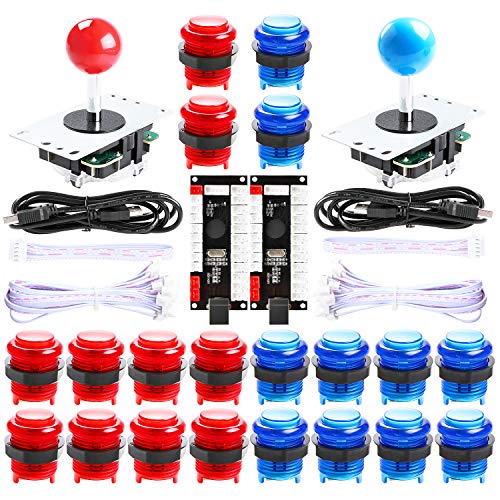
Hikig 2-Player LED Arcade Buttons and Joysticks DIY Kit

Doc and Pies Arcade Factory Classic Home Arcade Machine (Green)
What Each Pick Brings To The Table
Sanwa is the name serious cabinet builders keep coming back to, and the OBSF-30 30mm snap-in button is the reason. Made in Japan, it carries the same action you’ll find in most Japanese arcade cabinets, which means a smooth, low-profile press that resets fast and barely whispers. You can drop these into a custom control panel, a Hori stick, or a Mad Catz TE and get that quiet, consistent feel without modifying the housing.
Each button uses a non-clicking leaf micro switch (a tiny internal spring-and-contact mechanism that registers an input the moment the button closes), so the activation is silent compared with clicky knock-offs. For most fighting game players, the difference shows up in the third round of a long set: the buttons stay accurate, your timing stays sharp, and the panel keeps feeling new.
Useful Highlights
- Smooth, quiet actuation that holds up during long tournament sessions
- Snap-in design fits standard 30mm panel holes for fast cabinet work
- 3,000,000-cycle rating means years of daily play before wear becomes a worry
- Non-clicking leaf micro switch gives a clean, distraction-free press
- Plays nicely with Hori and Mad Catz fight sticks if you’re upgrading parts
Worth Noting
- Doesn’t include a joystick, so it’s only the button half of a full build
- Authentic Sanwa pricing runs higher than off-brand alternatives
Key Product Details
Right Fit For
Tournament-minded cabinet builders who want the same Japanese feel found in real arcades and don’t mind paying for the long-term quality.
Skip It When
You’d rather build in one step, in which case the Sanwa JLF-TP-8YT Joystick + OBSF-30 Push Button Bundle Kit (Pick 2) bundles the joystick and the buttons in a single order.
Where Pick 1 is just the buttons, this Sanwa bundle pairs the same OBSF-30 buttons with a JLF-TP-8YT joystick, the gold-standard lever for fighting games. The stick is the one you’ll find inside most premium fight pads, and the bundle solves a very common shopping problem: matching parts that were designed to work together but sold separately.
You also get real flexibility. The JLF’s restrictor gate (the plastic insert inside the joystick that limits the lever to up/down/left/right or adds diagonals) can be flipped between 4-way and 8-way operation, so classic shooters and modern fighters both feel right. The ball top is swappable, the spring tension is firm, and the return-to-center is the reliable snap players expect from a tournament-grade stick.
Useful Touches
- Joystick and buttons sourced from the same Sanwa lineup, so compatibility is guaranteed
- Restrictor gate swaps between 4-way and 8-way for genre flexibility
- Snap-in buttons make panel work fast for first-time builders
- Switchable ball top in white ties the look together without extra purchases
- Solid return-to-center helps with precise diagonal inputs in fighters
Trade Offs
- Limited to 8 buttons, so a two-player setup will need a second order or extras on hand
- Designed for panels up to 5mm thick, which is standard but worth measuring before drilling
Whose Shelf It Belongs On
Anyone upgrading a Hori or Mad Catz Tournament Edition fight stick, or wiring up a custom stick for Street Fighter and Tekken sessions.
Reach For A Different Pick When
You’re going bigger than a single-player stick, in which case the Hikig 2-Player LED Arcade Buttons and Joysticks DIY Kit (Pick 5) is purpose-built for a two-player panel with the wiring harness included.
Most first-time cabinet owners underestimate how much time the encoder eats. A zero-delay encoder is the small board that translates physical button presses into instant keyboard or joystick signals for your computer, and “zero delay” means no perceptible lag between press and on-screen action. The BEYEE board handles two players, plugs straight into a PC, MAME setup, or Raspberry Pi, and accepts standard 4.8mm terminal connections, which is the same fitting used by HAPP-style joysticks and buttons.
For most DIYers, the appeal is simplicity. There’s no driver hunt, no firmware flashing, no GPIO (general-purpose input/output pins on a Raspberry Pi) juggling. You wire the buttons and sticks to the board, plug USB into your computer, and the operating system sees a generic game controller. That removes the single biggest friction point in cabinet building.
The Good Stuff
- Two-player support right out of the box without extra boards
- Plug-and-play with Windows, MAME, and Raspberry Pi reduces setup time
- Standard 4.8mm terminals accept HAPP-style joysticks and buttons widely
- Cost-effective compared with multi-board controller alternatives
Room For Improvement
- Doesn’t include the joystick or buttons, just the brain in the middle
- Some users find the included wiring harness on the shorter side for larger cabinets
Made For
Two-player MAME cabinet builders who already have joysticks and buttons picked out and need a clean USB bridge to the computer.
Consider Something Else When
You’d rather skip the wiring entirely, in which case the Hikig 2-Player LED Arcade Buttons and Joysticks DIY Kit (Pick 5) pairs the encoder, sticks, and buttons in a single box.
The Reyann encoder has been the go-to budget board for hobby builders for years, and it shows up in countless Reddit builds and YouTube tutorials. It’s a zero-delay USB board, supports the same 4.8mm terminal connections as the BEYEE, and works with both American-style joysticks and HAPP buttons. The single-board layout keeps wiring simple, which matters when you’re threading 16+ button lines through a cabinet.
For most people building a first MAME cabinet on a tight budget, the Reyann is the safer starter choice. It’s been around long enough that troubleshooting tips are easy to find, and the compatibility list is broad enough that mismatched parts are rarely the problem.
Good Reasons To Consider
- Long-running community favorite with abundant tutorials for new builders
- Works with PC, MAME, and Raspberry Pi without driver installs
- Supports 4.8mm terminal buttons and joysticks, the most common DIY standard
- Single-board design cuts down on cable clutter inside the cabinet
Points To Keep In Mind
- Single-player by default, so a two-player setup needs two boards or the BEYEE alternative above
- Plastic terminal blocks can crack if you over-tighten during wiring
Best Suited To
First-time cabinet builders on a budget who want a forgiving board with plenty of community troubleshooting behind it.
Not Your Match When
You’re wiring up a two-player panel in one shot, in which case the BEYEE 2-Player Zero Delay USB Encoder (Pick 3) is purpose-built for the job.
If you want the cabinet to look as good as it plays, Hikig’s 2-player kit takes a lot of the hard work out. You get two joysticks, 20 LED-illuminated buttons in red and blue, and a zero-delay USB encoder all in one box, which means one order, one delivery, and one wiring diagram to follow. The plastic housings are heat-resistant, and the LED rings inside each button light up as soon as the board powers on.
It’s the most beginner-friendly complete kit in this list, and the visual payoff is real. For most living-room builders, glowing buttons turn a DIY project into something that actually feels finished.
The Helpful Details
- Full two-player kit: joysticks, 20 LED buttons, and encoder in one box
- Compatible with MAME, Windows, and Raspberry Pi builds
- Heat-resistant plastic housings help in cabinets with limited airflow
- Red and blue color split gives a clean two-player visual distinction
Honest Caveats
- Buttons and sticks sit below Sanwa feel, which is the trade-off for an all-in-one kit
- LED wiring adds an extra step beyond a standard button install
Feature Snapshot
Who Will Love This
Visual-focused DIY builders who want a complete two-player panel without sourcing parts from three different orders.
Where Another Pick Suits Better
Tournament players chasing the Sanwa feel should grab the Sanwa 12 pcs OBSF-30 Original Push Button 30mm (Pick 1) for authentic action, even though the build will take longer.
For anyone who skips past solder fumes and MDF dust, the Doc and Pies tabletop unit is a finished machine with 412 classic games already loaded. It comes with a 19-inch LCD screen, full-size buttons and joystick, and runs in free-play mode out of the box. Setup is essentially “plug it in, pick a game, start playing.”
It works as a bartop or tabletop, and the retro artwork gives it a real-arcade feel without the cabinet footprint. For most casual buyers, this is the answer to “I want to play Pac-Man tonight, not in three weekends.”
Positive Points
- 412 pre-loaded games mean zero setup, accounts, or firmware work
- 19-inch LCD gives a comfortable viewing size for two players
- Functions as bartop or tabletop to match your space
- Free-play mode skips the credit mechanic and gets to the games
A Few Limitations
- No modular parts, so you can’t swap buttons or sticks later the way you could with the Sanwa or Hikig kits
- Heavier than a typical bartop, around 50 pounds, which matters if you move it often
Perfect Match For
Anyone who wants the nostalgia without the build, especially apartment dwellers without room for a full-size cabinet.
Look Elsewhere When
You’d actually enjoy the build process, because the Hikig 2-Player LED Arcade Buttons and Joysticks DIY Kit (Pick 5) gives you the same 1980s game library feel with the satisfaction of wiring it yourself.
How To Pick The Right Arcade Buttons For Your Build
The right button depends on the cabinet you have, the games you play, and how much tinkering you actually enjoy. Most buyers fall into three groups, and the answer changes for each.
Decide Between Parts, Kits, Or A Ready-Made Machine
If you already own a fight stick or cabinet, individual Sanwa OBSF-30 buttons (Pick 1) drop straight into existing 30mm holes and restore that quiet, tournament feel. The Sanwa JLF-TP-8YT bundle (Pick 2) covers the same upgrade plus the joystick, which is the most common pairing for fighting games. Hobbyists starting from scratch usually do better with a complete kit like the Hikig LED set (Pick 5), which includes the sticks, buttons, and encoder in one order. And anyone who’d rather just play should skip the build entirely with the Doc and Pies tabletop unit (Pick 6).
Match The Encoder To Your Player Count
The encoder is the part most first-time builders forget to budget for, and the wrong one means re-wiring later. A single-player setup can use the Reyann board (Pick 4) without trouble. Two-player builds benefit from a board designed for it, like the BEYEE 2-Player encoder (Pick 3), which trims the wiring and avoids doubling up on hardware.
Pay Attention To Terminal Size And Panel Thickness
Most HAPP-style and Sanwa-compatible buttons use 4.8mm wire terminals, which is why every encoder in this list shares that standard. Panel thickness matters more for joysticks than buttons. The Sanwa JLF, for example, fits steel or plastic control panels up to 5mm thick, so measure before you drill and order accordingly.
Think About Sound, Feel, And Long-Term Wear
A non-clicking leaf micro switch feels smoother and stays quiet during late-night sessions, which is a real consideration for shared walls. For most players logging long hours, a 3,000,000-cycle rated button (like the Sanwa OBSF-30) outlasts bargain alternatives by years. The honest read is that cheap buttons feel fine in week one and start to drift in month six, so the upgrade is worth it for anyone who plays more than occasionally.
Key Considerations Across These Picks
Where Shoppers Go Wrong
The most common mistake is buying buttons and joysticks without confirming the terminal size, then realizing the wiring harness doesn’t fit. Another slip is overlooking the encoder entirely, which leaves you with a beautiful control panel and no way to talk to the computer. Measure your panel thickness, count your players, and check that the encoder supports the games you actually want to run before you place an order.
When Paying More Pays Off
Higher-tier buttons like the Sanwa OBSF-30 cost more upfront, but the leaf micro switch and 3,000,000-cycle rating show up in daily feel and multi-year durability. For most people, the upgrade pays off whenever a button keeps its crisp press long after a cheaper alternative has gone mushy. The honest trade-off is that casual players who rarely fire up a cabinet may not notice the difference, so the value depends on how often you’re pressing the buttons.



