


Analog arcade joysticks cover a surprising range of territory, from full replacement ball tops on a home MAME cabinet to wireless pad-style controllers styled after the original SNK arcade layout. Some shoppers are wiring up a bartop build, some are chasing a specific clicky feel for fighting games, and others just want a familiar lever for retro emulators on a modern TV. The picks below lean into the practical side of that spectrum: parts, kits, controllers, and adapters that solve common problems without overcomplicating the build.
The Leading Options At A Glance

uxcell Joystick Ball Top Handle Rocker Round Head Arcade Game DIY Parts Replacement (Red, 2 Pack)

lasenersm 2 Pieces 35mm Round Joystick Balltop Handle (Blue, Red)

Sanwa JLF-TP-8YT Joystick + OBSF-30 Push Button Bundle Kit (White)
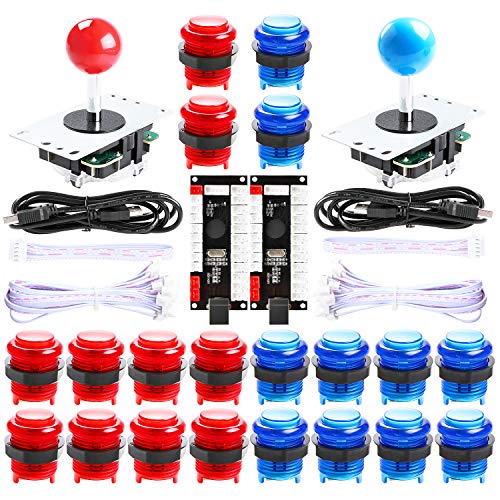
Hikig 2-Player LED Arcade Buttons and Joysticks DIY Kit (Red + Blue)

8Bitdo NEOGEO Wireless Controller (Black Edition)

8Bitdo SN30 Pro Bluetooth Controller, Hall Effect Joystick (Jade Green)
Sanwa JLF-TP-8YT Joystick (Red Ball Top)

8Bitdo Sn30 Pro+ Bluetooth Gamepad (Black)

Arcade Joystick Replacement Top, Black Flight Stick Style (JS19/JS12)

Brook Super Converter for PS Classic and PS2
The Picks, Examined More Closely
Starting with the simplest part on the list: a pair of 35mm ball-top joystick handles sized for the standard M6 threaded shaft found on most arcade joysticks. The round profile is the classic Japanese-style shape, the kind that fits naturally under a closed fist for long sessions of Street Fighter or Neo Geo titles. Two pieces ship in the box, which means a single order covers both players on a two-player control panel.
The whole point here is replacement and color matching, not high-end feel. Builders with scratched or yellowed originals, or anyone picking a new color scheme for a refresh, get exactly what they need without paying for the joystick shaft and switch underneath. Where the lasenersm pair later on offers the same basic idea, this uxcell set leans on the M6 standard fitting, which is worth confirming against your existing shaft before ordering.
Useful Highlights
- 35mm ball-top diameter matches the classic Japanese arcade feel for most hands.
- M6 threaded shaft fits the majority of standard arcade joysticks already in cabinets.
- Two-pack ships with two red handles, useful for symmetric two-player panels.
- Straightforward swap for damaged or worn tops without replacing the full joystick.
- Seven color options across the wider uxcell range help match themed cabinet builds.
Worth Noting
- Plastic body construction means the top may not feel as solid as metal alternatives under heavy play.
- Color is the only included option in this listing, so a single second-hand handle in a different color means another order.
Quick Facts
Whose Shelf It Belongs On
Cabinet builders refreshing a tired panel, or anyone replacing a cracked ball top on a standard M6 Japanese-style joystick.
Where Another Pick Suits Better
The Sanwa JLF-TP-8YT Joystick (Red Ball Top) is a smarter pick when the whole stick, switch, and top need to be upgraded together rather than just the handle.
The lasenersm pair is the direct competitor to uxcell’s red-only set, and the key difference is color variety in a single order. You get one blue and one red ball top, both 35mm and both threaded M6, which is convenient for two-player cabinets where you want to color-code player one and player two without buying two separate listings.
Construction is plastic over a metal core, the same combo you see on entry-level Japanese-style replacements. Compared to the uxcell option above, the trade-off is consistency, since each set ships with two different colors. If you specifically want a matched red pair, the uxcell listing is the cleaner pick. If you want instant color coding, this one solves that without extra shopping.
A Few Highlights
- Two distinct colors in one order simplify player-one and player-two coding.
- 35mm ball-top diameter fits the standard M6 joystick shaft found in most home cabinets.
- Plastic and metal combo keeps the top light enough for long sessions without hand fatigue.
- Round shape gives a familiar grip for anyone who grew up on Japanese arcade hardware.
Honest Caveats
- Plastic shell can show scuffs faster than solid metal handles during heavy tournament-style play.
- Only two color choices per pack, so themed multi-color builds need more than one order.
Best Suited To
Two-player builders who want a quick color-coded refresh and already have working M6 joystick shafts underneath.
Skip It When
Home bartop owners wiring up a full kit from scratch should reach for the Hikig 2-Player LED kit instead, since it bundles the joysticks, buttons, and encoder together.
This is the bundle serious fight stick builders tend to gravitate toward. The JLF-TP-8YT is Sanwa’s most popular joystick, the same one you’ll find in most Japanese arcade cabinets and in countless tournament-level fight sticks. The OBSF-30 buttons use a micro switch design that gives a quiet, smooth, and noticeably firm press without the loud click of older concave designs.
The mount depth tops out at 5mm of panel thickness, which covers the vast majority of wood, plastic, and steel control panels in home builds. The stick switches between 4-way and 8-way operation by swapping an internal restrictor gate, useful for classic games that demand precise cardinal directions. Compared to the single-stick Sanwa option further down, this kit adds the eight OBSF-30 buttons you need for a complete player-one layout.
Noteworthy Benefits
- Sanwa JLF series is the de facto standard for fight stick builds, meaning replacement parts and community support are easy to find.
- 4-way to 8-way restrictor swap lets one joystick cover both classic and modern fighting games.
- OBSF-30 micro-switch buttons give consistent, smooth actuation without the loud click of older button types.
- Snap-in button installation simplifies wiring and lets you replace a single button without disassembling the whole panel.
- Mounting compatibility with Hori and MadCatz fight stick shells makes retrofit projects straightforward.
Points To Keep In Mind
- Color in this listing is white, so dark-themed cabinets will want a different button set.
- 5mm panel thickness limit rules out thicker wooden panels without modification.
Feature Snapshot
Who Should Grab It
Tournament-level fighting game players and dedicated home builders who want authentic Sanwa hardware in a single order.
Consider Something Else When
Casual retro fans wiring a Raspberry Pi MAME box may find the Hikig 2-Player LED kit easier, since it includes the encoder and USB interface needed for a plug-and-play PC build.
The Hikig kit is the closest thing on this list to a turnkey bartop project. Inside the box you get two joysticks, twenty illuminated buttons in red and blue, a USB zero-delay encoder board, and the cables needed to connect everything to a Windows PC, a Raspberry Pi, or a MAME build. The included encoder means there is no soldering iron required for the basic wiring, which is a real advantage for first-time cabinet builders.
Compared to the Sanwa bundle above, this kit is bulkier and the components lean more toward hobbyist than tournament grade. The trade-off is value, since twenty buttons and two sticks at this price point is hard to match. For anyone wiring up a two-player MAME cabinet from scratch, the kit gives a complete parts list in one order rather than chasing components across multiple listings.
Positive Points
- Complete two-player kit ships with joysticks, buttons, encoder, and cables for one project.
- LED buttons add underglow without separate lighting work, useful for themed cabinet builds.
- USB zero-delay encoder plugs straight into a PC or Pi without custom driver work.
- Button and joystick color split between red and blue makes player one and two obvious at a glance.
Factors To Consider
- Plastic construction under heavy use tends to feel less crisp than metal-shafted alternatives.
- LED wiring adds an extra power step compared to non-illuminated button kits.
Key Specs
The Right Fit
First-time MAME bartop builders who want every two-player component in one box and a USB plug-and-play setup.
Another Choice May Suit
Fight stick enthusiasts chasing genuine Japanese feel should still step up to the Sanwa JLF-TP-8YT bundle for the stick and switch quality.
Leaving the cabinet parts behind for a moment, the 8Bitdo NEOGEO controller is the official SNK-licensed reimagining of the original arcade stick-style gamepad. The click-style joystick is the headliner, since the original NEOGEO controller was known for its tactile, almost mechanical feel that no analog stick really matches. Modern additions include bumpers, Turbo functions, and a button layout swap, all of which the original hardware never had.
Connectivity covers the bases: 2.4G wireless for Windows and the NEOGEO mini, plus Bluetooth for Android, and wired USB for the rest. Where the Sanwa joysticks above target cabinet builders, this controller targets couch players who want the original feel without dragging a full arcade panel into the living room. Compared to the SN30 Pro and SN30 Pro+ later in this list, the NEOGEO version is the most authentic throwback.
What Works In Its Favor
- Click-style joystick closely mirrors the original SNK NEOGEO arcade stick feel.
- Official SNK licensing covers the original aesthetic, color scheme, and button layout.
- Three-way connectivity: Bluetooth for Android, 2.4G for NEOGEO mini and Windows, plus USB for everything else.
- Turbo and layout swap add modern conveniences the original hardware never offered.
Less Ideal Details
- Click-style joystick takes getting used to for anyone who grew up on analog gamepads.
- No native console support beyond the NEOGEO mini, so PS5 and Switch users need an adapter.
Feature Card
Built With In Mind
NEOGEO fans, retro collectors, and anyone who wants the SNK arcade feel in a controller small enough for a TV tray.
Look Elsewhere When
Multi-platform gamers who want a single pad to cover Switch, Steam, and Android should consider the 8Bitdo Sn30 Pro+ instead, since it has broader cross-platform support.
The SN30 Pro with a Hall Effect joystick is the modern fix for the one thing that used to plague older 8Bitdo pads: stick drift. Hall effect sensors read stick position magnetically rather than via physical contact, so the wear that causes drift on standard potentiometer sticks essentially disappears. The Jade Green shell also gives the controller a distinctive look compared to the usual black and gray.
On the compatibility side, you get the typical 8Bitdo spread across Switch, Windows, macOS, Android, and Steam. The SN30 layout is closer to the original Super Nintendo face button arrangement than a modern Xbox pad, which retro fans tend to love and modern FPS players sometimes find cramped. Compared to the NEOGEO controller above, this is the all-rounder for daily use, not the themed throwback.
A Favorable Mix
- Hall effect joystick significantly reduces stick drift compared to older SN30 Pro revisions.
- Jade Green color stands out from the typical black and gray controller crowd.
- Broad cross-platform support covers Switch, Windows, macOS, Android, and Steam in one pad.
- Compact SNES-style button layout is comfortable for long retro sessions and platformers.
Trade-Offs To Consider
- SNES-style face button layout can feel cramped for players used to modern asymmetric gamepads.
- Smaller body than a full-size Xbox pad may be less comfortable for users with larger hands.
Perfect Match For
Retro fans and Switch players who want a compact, drift-resistant pad for long emulator sessions.
Swap It Out When
Gamers who want rumble and motion controls for modern titles should look at the 8Bitdo Sn30 Pro+ instead, which adds those features in a similar form factor.
The bare Sanwa JLF-TP-8YT is the same stick found in the bundle above, just without the eight OBSF-30 buttons. For cabinet builders who already have working buttons or who want to mix and match button colors, buying the stick alone is often the more flexible move. The red ball top is removable, so a swap to yellow, white, or black is a simple unscrew job.
Real-world feel is the reason Sanwa dominates the high end. The spring tension sits in a sweet spot where the stick returns to center quickly without feeling twitchy, and the microswitch actuation is crisp without being loud. Compared to the Hikig kit’s bundled sticks, this one is a clear step up in precision, and compared to the smaller 35mm ball top options, it has the same standard feel as tournament hardware.
Real-World Strengths
- Genuine Sanwa JLF series is the most widely supported arcade joystick among fighting game communities.
- 4-way to 8-way restrictor gate swap makes one stick cover classic and modern arcade games.
- Solid return-to-center spring reduces accidental inputs during long play sessions.
- Panel compatibility with most Hori and MadCatz shells simplifies retrofit projects.
A Few Limitations
- 5mm panel thickness limit rules out thicker wooden bartop builds without routing.
- Stick only, no buttons, so a full rebuild requires ordering buttons separately.
Who Will Love This
Cabinet purists and tournament-oriented fight stick builders who want the standard Japanese arcade feel without extras they don’t need.
Reach For A Different Pick When
First-timers wiring a complete MAME cabinet should grab the Sanwa JLF-TP-8YT bundle, which adds the OBSF-30 buttons needed for a full player-one layout.
The Sn30 Pro+ is the larger, fuller-featured sibling of the SN30 Pro covered earlier. It keeps the same SNES-style face button layout but adds rumble vibration, motion controls, USB-C charging, and adjustable hair-trigger shoulder buttons. The joystick sensitivity is also adjustable through 8Bitdo’s companion software, which matters for emulators where dead zones vary from system to system.
Where the NEOGEO controller targets a specific themed experience, the Pro+ tries to be the daily driver for anyone bouncing between Switch, Windows, Android, macOS, Steam, and Raspberry Pi. Bluetooth handles most of that, and the optional 2.4G dongle covers Windows machines that need a more stable link. Compared to the SN30 Pro with Hall Effect joystick above, the Pro+ trades drift resistance for richer feature support.
Useful Touches
- USB-C charging simplifies cable swaps across modern device ecosystems.
- Adjustable hair-trigger shoulder buttons help with rapid-fire input in shooters.
- Motion controls expand the controller’s usefulness for Switch titles that require gyro aiming.
- Custom button mapping through 8Bitdo software lets you tune the layout per emulator.
Where It May Fall Short
- Standard analog joystick is more prone to drift than the Hall Effect version found in the SN30 Pro.
- Companion software adds a learning step for users who just want plug-and-play mapping.
Who Should Grab It
Multi-platform gamers who want one pad for Switch, Steam, and emulator use, and who appreciate rumble and motion controls.
Where Another Pick Suits Better
Anyone worried about long-term stick drift should consider the 8Bitdo SN30 Pro with Hall Effect joystick, which addresses the wear issue directly.
This is a niche but very specific pick: a flight stick-style replacement top for RetroArcade.us JS19 and JS12 joystick shafts. Where the uxcell and lasenersm ball tops earlier are round, this one is a taller bat handle shape, around 51mm tall with a 17mm diameter. That shape favors precision pulling motions over palm rests, which is why flight stick handles remain popular for certain arcade genres.
Compatibility is the catch. The 6mm thread matches the JS19 and JS12 series, but it is not a universal M6 standard. Owners of standard Japanese-style joysticks from Sanwa or Seimitsu should look at the round ball top options above instead. For JS19 and JS12 owners, though, this fills a hard-to-find gap and avoids replacing the whole stick just to change the handle shape.
Notable Gains
- Bat handle shape suits pulling motions in flight sims and certain shmups.
- 51mm height and 17mm diameter offer a more precise grip than round ball tops.
- Black finish blends into most themed arcade cabinets without clashing.
- Saves replacing the full joystick when only the handle shape needs to change.
Some Limits To Know
- Only fits the RetroArcade.us JS19 and JS12 series, not standard Japanese M6 shafts.
- Specialty niche, so it is not a useful general-purpose replacement for cabinet builders with mixed hardware.
Made For
Existing owners of RetroArcade.us JS19 or JS12 joysticks who want to swap a ball top for a flight stick-style handle.
Skip It When
Builders using standard Sanwa or Seimitsu M6 shafts should grab the uxcell ball top pair instead, since the thread and fit are made for that hardware.
Closing the list with a different kind of joystick accessory: an adapter. The Brook Super Converter lets modern controllers, including Switch Pro, Xbox One, PS3, PS4, and PS5 pads, talk to older PlayStation hardware, specifically the PS Classic mini-console and the original PS2. The whole point is to use the controllers you already own on hardware that shipped with limited or awkward stock pads.
One important note: each converter handles one controller at a time, and Brook explicitly recommends checking their compatibility list before ordering, since not every third-party arcade stick is supported. Vibration feedback passes through, but headsets and chat audio do not. Compared to the 8Bitdo controllers earlier, this is the bridge rather than the pad itself.
Everyday Wins
- Works with most modern pads including Switch Pro, Xbox One, and PS3 through PS5 controllers.
- Auto-registration of PS3 and PS4 controllers after a one-time USB setup simplifies first pairing.
- Compact USB-sized form factor plugs in without blocking adjacent ports on most consoles.
- Vibration passthrough preserves rumble in supported games on PS Classic and PS2.
Where It Is Less Suited
- Only supports one controller at a time, so two-player setups need two converters.
- Not every third-party arcade stick or wheel is on the supported list, which means a compatibility check is required first.
The Right Fit
PS Classic and PS2 owners who want to use modern controllers without hunting down original hardware.
Consider Something Else When
Players building a modern fight stick for current consoles will get more from the Sanwa JLF-TP-8YT bundle, which is built for direct current-generation use.
Choosing Joysticks That Actually Fit Your Build
Arcade joystick shopping tends to split into two camps: cabinet builders and couch players. The right pick for each camp looks very different, and knowing which camp you fall into before ordering saves a lot of return shipping.
Mounting and Panel Thickness
The single most overlooked spec in this category is panel thickness compatibility. Most Japanese-style joysticks, including the Sanwa JLF series, top out at around 5mm of metal or plastic panel. Wood bartops, even thin plywood, often exceed that. Builders using hardwood need to either route the underside or look for sticks rated for thicker panels. Mismeasuring this spec is the fastest way to discover your joystick mount sits crooked on install day.
Thread Standards and Handle Swaps
Almost every standard ball top in this category uses an M6 thread, which is convenient for mixing and matching. The RetroArcade.us flight stick top is a notable exception, with a 6mm thread that fits the JS19 and JS12 series specifically. If you plan to swap tops across different joystick brands, check the thread spec on the product page first, since a 0.1mm difference can mean a top that simply will not seat.
Connectivity Choices for Couch Play
For TV and emulator use, connectivity often matters more than joystick feel. The 8Bitdo NEOGEO controller handles Windows and Android natively but needs a 2.4G dongle for some setups. The Sn30 Pro+ covers nearly every modern platform over Bluetooth, and the SN30 Pro with Hall Effect sticks adds drift resistance. For older consoles like the PS Classic and PS2, an adapter like the Brook Super Converter is the only realistic way to bring modern pads into the mix.
When to Spend Up on Real Sanwa Hardware
The Sanwa JLF series costs more than generic kit joysticks, and the upgrade shows up most clearly in switch feel and return-to-center precision. For casual MAME play, a Hikig kit is honestly enough. For anyone serious about fighting games or planning to use the stick in a public tournament setting, the Sanwa JLF-TP-8YT is a meaningful step up.
Key Considerations Across These Picks
Mistakes Worth Dodging
The most common slip-up in this category is buying joystick components without confirming the encoder or wiring solution. A bare Sanwa JLF stick does nothing on its own without a USB encoder board, and a Hikig kit with LED buttons needs a powered USB port or extra wiring for the lights. The second common trap is treating all 35mm ball tops as interchangeable, which is usually true for thread, but the colors and plastic blends vary enough that two sets from different brands can look mismatched on the same panel.
Where The Extra Money Goes
Higher-tier joystick options like the Sanwa JLF series and 8Bitdo’s Hall Effect sticks cost more because of the internal switch and sensor quality. The microswitches inside a Sanwa JLF are rated for millions of actuations and snap back consistently, while cheaper switches in budget kits can develop mushy return behavior within months of regular play. Hall effect sensors cost more than standard potentiometers, but they eliminate the stick drift that has become the most common reason modern pads end up in drawers. For casual play, the budget tier is genuinely fine. For anyone logging heavy hours, the upgrade tends to pay off in longevity rather than raw feel on day one.
Frequently Asked Questions
What joystick do most arcade cabinets actually use?
The vast majority of Japanese arcade cabinets run Sanwa or Seimitsu joysticks, with Sanwa’s JLF series being the most common in modern fighting game setups. Both brands use the M6 thread standard for ball top compatibility, which is why so many third-party handles on the market fit them.
Are analog arcade joysticks and gamepad sticks the same thing?
No, they are quite different. An analog arcade joystick outputs digital directional signals, meaning on or off for each of the four or eight directions. A gamepad analog stick outputs a continuous range of motion, which is why driving games feel so different on a console pad compared to an arcade wheel. The 8Bitdo controllers on this list use analog sticks for gamepad play, while the Sanwa and Hikig sticks are digital outputs for arcade games.
How do you stop a joystick from drifting?
For traditional potentiometer-based sticks, drift is a wear issue and there is no permanent fix beyond replacing the sensor. The most reliable solution is to buy a stick with Hall Effect sensors, like the 8Bitdo SN30 Pro, since those read stick position magnetically and have no contact surfaces to wear out. For arcade-style sticks, drift is less of a concern because the inputs are digital rather than analog.
Can a Sanwa joystick fit a non-Japanese cabinet?
In most cases, yes. The Sanwa JLF series uses a standard mounting pattern and the M6 ball top thread, which lines up with the majority of hobbyist and aftermarket arcade builds. The main constraint is the 5mm panel thickness limit, which rules out thicker wooden tops without modification.
Do I need a separate encoder to use an arcade joystick on a PC?
Yes, in almost every case. A bare arcade joystick outputs switch closures, which a PC cannot read directly. You need a USB encoder board to translate those closures into keyboard or gamepad inputs, which is why the Hikig kit includes a zero-delay encoder and the Sanwa bundles do not.
Closing Remarks
The right pick comes down to whether you are building a cabinet, replacing a worn part, or just chasing a specific feel for couch play. Cabinet builders should start with the Sanwa or Hikig options depending on budget and button needs. Couch players are well served by the 8Bitdo trio, with the Brook adapter covering older consoles. Either way, matching the joystick to the panel and the encoder to the platform avoids the kind of mid-build frustration no product page warns you about.



