


There’s a particular joy in pressing a familiar face button and feeling muscle memory from a quarter-century ago kick in. The 8 Bit Controllers market has quietly grown into something serious, covering everything from wireless remakes of 16-bit classics to competition-grade arcade parts and modern multi-platform gamepads. You might be dusting off an original SNES, building a bartop arcade, or just want a Switch controller that doesn’t feel generic. The picks below cover that whole range, mixing legacy hardware remakes, modern Bluetooth pads, and a few specialty tools for fighting-game enthusiasts and DIY builders.
Your Options, Compared

8Bitdo Sn30 2.4G Wireless Gamepad (Transparent Edition)

8Bitdo N30 2.4G Wireless Gamepad (Transparent Edition)

Retro-Bit SEGA Genesis 8-Button USB Wired Controller (Black)

8Bitdo Ultimate 2 Bluetooth Controller TMR Joysticks (Black)

Sanwa JLF-TP-8YT Joystick + OBSF-30 Push Button Bundle (White)

8Bitdo Ultimate 2 Bluetooth Controller TMR Joysticks (Lemon Yellow)

8Bitdo Pro 3 Bluetooth Controller (Gray) – TMR Joysticks

8Bitdo All-Button Arcade Wireless Controller for Switch & Windows
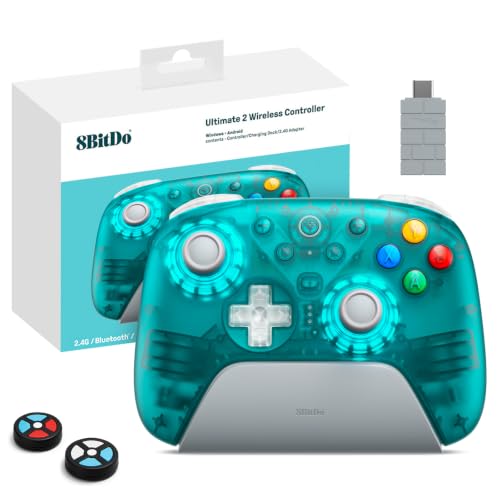
8Bitdo Ultimate 2 Wireless 2.4G Controller (Transparent Blue)

8Bitdo Ultimate 2 Bluetooth Controller TMR Joysticks (White)
What Each Pick Brings To The Table
The 8Bitdo Sn30 leans hard into nostalgia without dragging the experience back to 1993. It’s a wireless remake of the classic SNES/SFC face button layout, paired with a small 2.4G dongle that talks directly to the pad. That means no Bluetooth pairing headaches on the original console, which is genuinely useful if the only TV in your retro corner is shared.
For a Sunday afternoon replay of Super Metroid or Chrono Trigger, the feel lands right. The face buttons have that familiar shallow click, and the see-through shell is a nice callback to the transparent consoles that surfaced late in the SNES run. Owners of original hardware will get the most out of this, and the rechargeable battery (charged over USB) means no more AA stockpile.
Useful Touches
- 2.4G wireless dongle pairs with original SNES/SFC consoles without complicated setup menus
- Rechargeable internal battery removes the recurring cost of disposable AAs
- Translucent shell gives it a distinct look on a crowded shelf
- Compact footprint suits smaller hands and tight entertainment centers
Things To Consider
- Tied to the included 2.4G receiver, so it doesn’t double as a modern Switch or PC pad
- Wide thumbs may find the shoulder button placement cramped during long sessions
Made For
Collectors and hobbyists who still run original SNES or SFC hardware and want a wireless pad that feels period-correct.
Look Elsewhere When
You mostly game on modern hardware, where the 8Bitdo Ultimate 2 Bluetooth Controller TMR Joysticks (Black) is a much better fit thanks to its broader platform support.
The 8Bitdo N30 picks up where the Sn30 leaves off, but aimed squarely at the older sibling. It’s built for the original NES, with a rectangular silhouette that mirrors the classic brick. The see-through shell matches the aesthetic of the 8Bitdo Sn30 2.4G Wireless Gamepad (Transparent Edition) above, which makes them feel like a matched pair on a shelf.
What makes this one interesting is the inclusion of turbo on the A and B buttons, useful for the run-and-gun shooters that defined the NES era. A dedicated home button also opens the Analogue NT Mini menu wirelessly, a small touch that Analogue owners will appreciate. The pad runs on its own rechargeable battery and does not use Bluetooth, so it’s strictly a legacy-console tool.
What It Does Well
- Dedicated turbo A and B buttons cut finger fatigue during long Contra or Metal Slug sessions
- Home button integration with the Analogue NT Mini saves menu diving
- Rectangular form factor matches the original NES D-pad feel
- Rechargeable battery keeps maintenance low
Worth Noting
- No Bluetooth means it won’t work on modern devices without a receiver
- D-pad only setup (no second analog stick) limits its usefulness outside NES titles
Right Fit For
NES purists and Analogue NT Mini owners who want a wireless pad that stays true to the original layout.
Skip It When
You mainly play modern games, where the 8Bitdo Pro 3 Bluetooth Controller (Gray) covers more platforms with far more flexibility.
The Retro-Bit Genesis pad fills a specific gap: the original 3-button Genesis controller couldn’t keep up with the fighting games of the late 90s, and the 6-button became the de facto standard. This one goes to 8 buttons, officially licensed, with a long USB cable that suits a couch-bound retro setup just as well as a desk-bound emulation rig.
Where it pulls ahead of the 8Bitdo retro remakes is compatibility. It works on the Sega Genesis Mini, Nintendo Switch, Switch 2, PC, Mac, Steam, RetroPie, and Raspberry Pi, so you can rotate it between emulators and modern consoles without swapping gear. Holding START for five seconds switches between D-Input and X-Input, which matters more than you’d think on PC. The new L/R shoulder buttons add some modern ergonomics without ruining the silhouette.
Good Reasons To Consider
- Officially licensed SEGA build, so you know the button spacing matches the original intent
- Works across Genesis Mini, Switch, PC, Mac, and most emulation platforms
- Switchable D-Input and X-Input without software tweaks
- Extra shoulder buttons give modern fighting games a comfortable place to live
Trade Offs
- Wired-only, so a cluttered living room cable run may bother some users
- Wide body may feel bulky compared to modern compact pads like the 8Bitdo All-Button Arcade Wireless Controller
Quick Facts
Who It Suits Best
Retro console owners and PC emulators who want one reliable wired pad to cover Genesis, fighting games, and indie titles.
Swap It Out When
You want wireless freedom on a modern Switch setup, in which case the 8Bitdo Ultimate 2 Bluetooth Controller TMR Joysticks (Black) is a stronger daily carry.
The Ultimate 2 in Black is the one most people will end up happy with, and for good reason. It runs on TMR joysticks (tunneling magnetoresistance, a step up from standard Hall effect sticks for finer precision and longer life) and talks to just about everything. Switch via Bluetooth, 2.4G, or wired USB, and Windows over 2.4G or wired. The RGB ring around each stick is decorative but does give the pad a bit of personality on a desk.
For Switch 2 support you need to update to the latest firmware, which is the kind of small hoop that catches first-time users off guard. Once that’s done, the rest feels effortless. Compared to the wired Retro-Bit Genesis pad reviewed earlier, this is a much better fit for modern multi-platform setups, and the build quality feels a tier up from the entry-level 8Bitdo remakes.
Positive Points
- TMR joysticks deliver high sensitivity and reportedly longer life than standard Hall effect sticks
- Tri-mode connectivity (Bluetooth, 2.4G, USB-C) handles Switch and Windows from one device
- Customizable RGB ring lets you tune the look to your setup
- Hall effect triggers and rumble round out the premium feel
Room For Improvement
- Switch 2 compatibility requires a firmware update on first use
- Premium pricing puts it above casual weekend use for some shoppers
Best Suited To
Switch and PC owners who split time between casual and competitive play and want a polished all-rounder.
Consider Something Else When
You mainly play fighting games, where the 8Bitdo All-Button Arcade Wireless Controller for Switch/Switch 2 & Windows is purpose-built.
The Sanwa bundle is a different kind of 8-bit controller. Rather than a finished pad, it’s a joystick and eight pushbuttons built into a single kit, aimed squarely at arcade cabinet builders and modders. Sanwa has been the gold standard in Japanese arcades for decades, and the JLF-TP-8YT joystick has a smooth, well-balanced throw with a switchable restrictor plate that flips between 4-way and 8-way operation.
The OBSF-30 buttons use non-clicking micro switches, so they feel fast and quiet, and snap into a control panel up to 5mm thick. The kit fits most Hori and MadCatz fight sticks, which makes it a sensible upgrade path for anyone whose old stick is starting to feel loose. For first-time builders, expect to spend an evening with a screwdriver and a wiring harness before anything lights up.
The Good Stuff
- Sanwa components are widely considered the benchmark for arcade feel
- Switchable 4-way and 8-way restrictor plate suits both classic and modern fighting games
- Snap-in button installation and quiet micro switches keep the build simple
- Eight buttons in the kit cover the standard six-button plus extras for modern layouts
Honest Caveats
- Requires a control panel, wiring, and encoder to become a working gamepad, so it’s not plug-and-play
- Joystick dust covers are not included, so owners commonly report buying a dust cover separately for long-term reliability
Whose Shelf It Belongs On
DIY builders and competitive fighting-game players comfortable with a soldering iron or a screwdriver.
Reach For A Different Pick When
You want a finished wireless pad to grab off the shelf, where the 8Bitdo Ultimate 2 Bluetooth Controller TMR Joysticks (Black) is a far easier starting point.
The Lemon Yellow Ultimate 2 shares nearly every internal component with the Black version reviewed earlier, with one obvious difference: the color. That sounds trivial until you set it next to a stack of black pads on a coffee table, where it actually stands out. The same TMR joysticks, Hall effect triggers, and tri-mode connectivity carry over, so you don’t trade performance for aesthetics.
It also keeps the customizable RGB ring around the sticks, which pairs nicely with the bright shell. The trade-off is purely cosmetic: yellow shows fingerprints and smudges more readily than darker finishes, and the bright color may not blend with minimalist setups. Owners typically wipe it down occasionally to keep the finish looking fresh.
Features That Help
- Same TMR joystick internals as the Black variant, no compromise on precision
- Bright shell makes the pad easy to find between couch cushions
- RGB ring lighting adds a visual cue during dim-room play
Points To Note
- Glossy yellow finish picks up fingerprints and palm oils more visibly than matte dark options
- Color choice may not suit every desk or living room aesthetic
Who Should Grab It
Style-focused Switch and PC players who want flagship performance in a finish that pops.
Not Your Match When
You prefer a more understated look, in which case the 8Bitdo Ultimate 2 Bluetooth Controller TMR Joysticks (White) reviewed later keeps things low-key.
The Pro 3 is 8Bitdo’s flagship Bluetooth pad, and the one that pushes hardest into premium territory. Beyond the TMR joysticks, the headline feature is the swappable magnetic faceplate and stick caps, which let you swap the look and feel without tools. That sounds gimmicky until you start tinkering with different stick heights for fighting games versus platformers.
Platform support is broader than the Ultimate 2, with seamless switching between Switch 1 and 2, Windows PC, Apple devices, SteamOS, and Android. Profiles can switch automatically depending on the platform, which removes a step from the routine. Compared to the Ultimate 2 Wireless 2.4G Controller (Transparent Blue) covered later, this is the better choice for someone who genuinely rotates between a Switch, a Mac, and a Steam Deck.
Key Advantages
- Universal multi-platform compatibility with automatic profile switching
- Swappable magnetic parts let you tune the feel for different game genres
- TMR joysticks share the precision and durability of the Ultimate 2 line
- Premium build materials justify the price for daily-use players
A Few Limitations
- Sits at the top of the price range, so casual users may not need the extras
- Spare magnetic parts sold separately, raising the long-term cost if you like swapping
Who Will Love This
Multi-device users who genuinely bounce between Switch, PC, Mac, and mobile, and want one premium pad to handle all of it.
A Better Fit Elsewhere
You mainly game on PC, where the 8Bitdo Ultimate 2 Wireless 2.4G Controller (Transparent Blue) is more focused and slightly less expensive.
The 8Bitdo All-Button Arcade Controller is the most specialized entry on this list. It drops the joystick entirely in favor of a leverless design with a precise quad-movement button layout, which is the layout that serious Street Fighter and Tekken players have moved to in the last few years. Inputs are faster and more accurate, and the pad itself is almost absurdly thin at about 1.6cm, roughly a third of the depth of a traditional arcade stick.
It also folds, with magnetic feet that snap up to a comfortable typing angle, and the buttons are programmable across four slots. There’s a tournament lock to lock down your layout, and SOCD cleaning (Simultaneous Opposing Cardinal Directions, a term for the cleaning logic that prevents left+right from registering as a neutral) for clean inputs in ranked play. It’s not the pad for casual platformers, but for fighting games it’s a serious tool.
Everyday Wins
- Leverless design with quad-movement layout delivers faster, more consistent inputs in fighting games
- Folds flat, roughly A4-sized, and slips into a bag with no fuss
- Programmable buttons and tournament lock support competitive play
- Tri-mode connectivity covers Switch, Switch 2, and Windows
Possible Compromises
- Specialized layout feels awkward for platformers, RPGs, and shooters
- Learning curve is real if you’ve only used analog sticks
Perfect Match For
Competitive fighting-game players who already know the leverless layout and want a portable option for tournaments and ranked play.
Not Your Match When
You mostly play single-player adventures, where the 8Bitdo Ultimate 2 Bluetooth Controller TMR Joysticks (Black) is a more versatile companion.
The Transparent Blue Ultimate 2 ditches Bluetooth for a dedicated 2.4G wireless connection on Windows and adds Bluetooth for Android. The 1000Hz polling rate (the frequency at which the controller reports its position to the host, where higher numbers mean smoother input) on both 2.4G and wired connections is the headline, since that’s the kind of spec that competitive PC players actually care about. TMR joysticks and Hall effect triggers carry over from the rest of the Ultimate 2 line.
Where the other Ultimate 2 variants aim for Switch first, this one clearly tilts toward PC and Android. That makes it the more focused pick if your main rig is a desktop tower, and the transparent shell matches the look of the 8Bitdo Sn30 2.4G Wireless Gamepad (Transparent Edition) reviewed at the top of this list. It also has mode-switching on the fly, which is helpful when you bounce between Steam and a phone.
Bright Spots
- 1000Hz polling rate over 2.4G and wired is a tangible spec advantage for PC players
- TMR joysticks offer stronger sensitivity and reportedly reduced stick drift over time
- Hall effect triggers and mode switching cover modern PC and Android games cleanly
Soft Spots
- Doesn’t include Bluetooth for Switch, so console players should look at the standard Ultimate 2 instead
- Transparent shell may show internal dust over time, depending on your cleaning habits
Built With In Mind
PC and Android gamers who want a high-polling wireless pad for competitive play.
Look Elsewhere When
You need a single pad for both Switch and PC, in which case the 8Bitdo Ultimate 2 Bluetooth Controller TMR Joysticks (Black) is the more balanced option.
The White Ultimate 2 closes out the lineup with the same internals as the Black and Lemon Yellow variants, wrapped in a clean white shell. It’s a quietly confident pad that sits well in a minimalist setup where a black controller would dominate. The TMR joysticks, Hall effect triggers, and tri-mode connectivity all carry over without compromise.
Compared to the bolder finishes, the white shell is the most discreet. It’s also slightly more maintenance-heavy in practice, since white surfaces tend to show grime faster, especially around the analog sticks. A quick wipe every couple of weeks keeps it looking fresh. The Switch 2 firmware caveat applies here as well, so first-time users should plan a short setup window before they start playing.
A Strong Showing
- Identical TMR joystick performance to the rest of the Ultimate 2 family
- White shell fits clean, minimalist setups without shouting for attention
- Tri-mode connectivity covers Switch, PC, and wired use
Less Ideal Details
- White finish shows grime around the sticks faster than darker shells, so plan on occasional cleaning
- Same Switch 2 firmware step applies to first-time setup
The Right Fit
Players who want flagship performance in a clean, understated finish that complements a tidy desk or entertainment center.
Where Another Pick Suits Better
You want the look to make a statement, in which case the 8Bitdo Ultimate 2 Bluetooth Controller TMR Joysticks (Lemon Yellow) delivers more personality.
What Matters Most When Choosing 8 Bit Controllers
Match The Controller To The System You Actually Play
The single biggest decision is whether you need a legacy-console tool or a modern multi-platform pad. If your main system is an original SNES, NES, or Genesis, dedicated wireless remakes like the 8Bitdo Sn30 and N30 make life easier than a Bluetooth-only pad. Modern Switch and PC players should look at the Ultimate 2 line or the Pro 3 for broader support.
Fighting-game specialists live in a third category. Leverless arcade pads and full Sanwa kits are built for tournament play and feel awkward outside that niche. Knowing which side of the line you fall on prevents overspending on features you won’t use.
Joystick And Trigger Technology
TMR and Hall effect sensors (magnetic sensing technologies that track stick and trigger position without physical contact, reducing wear and stick drift over time) have quietly become the expectation in premium pads. The Ultimate 2 and Pro 3 lines all use TMR joysticks, which is a meaningful upgrade for longevity. Older potentiometer-based sticks (the traditional analog sensors that physically wear as the stick moves) drift more often, so pay attention to the sensor type before comparing prices.
Hall effect triggers matter for racing and shooters where analog input depth changes the feel. The differences are subtle for casual play but obvious once you spend a few hours in a game that leans into them.
Wired Versus Wireless And Polling Rate
Wired pads still win on input lag and reliability, which is why the Retro-Bit Genesis controller is a sensible emulator pick. Wireless has caught up, and the Ultimate 2 Wireless 2.4G Controller hits a 1000Hz polling rate that competitive PC players notice. Bluetooth is the most convenient but tends to top out at lower polling rates, which is fine for most genres.
For Switch play, tri-mode connectivity (Bluetooth, 2.4G, and wired) is the most flexible setup. You can use wireless on the couch, drop to wired for a tournament, and not think about it.
Form Factor And Long Session Comfort
Pad weight, grip texture, and shoulder button placement matter more than people expect. Wider retro-style pads can feel bulky compared to compact modern controllers. Leverless arcade pads are a different world entirely and reward players who commit to the layout.
Think about the longest session you’d realistically play, and consider the size of your hands. Reviews describe the Ultimate 2 as a comfortable middle ground, while the leverless arcade controller rewards shorter, intense bursts typical of ranked fighting games.
Key Considerations Across These Picks
Pitfalls Shoppers Hit
The most common slip-up is buying a Bluetooth pad for an original SNES or NES and expecting it to work. Legacy consoles don’t speak Bluetooth, and you need a 2.4G wireless remake or the original wired pad for the system to recognize the controller. Check the connection type before anything else.
Another recurring issue is ignoring firmware requirements. Some Ultimate 2 variants need a firmware update for Switch 2 compatibility, and skipping that step leaves you with a pad that pairs but misbehaves. A short setup window up front prevents frustration later.
Where The Extra Money Goes
The premium tier earns its price through sensor quality, multi-platform support, and build materials. TMR joysticks and Hall effect triggers add real longevity, which matters if you game daily. The Pro 3 adds swappable magnetic parts and broader platform support, which is worth it only if you actually use those features.
For casual play, the standard Ultimate 2 line is the more honest value. Paying more is worth it when you can name the specific feature you’ll use. If the upgrade pitch is vague, the cheaper option usually wins.
Frequently Asked Questions
Do 8 Bit Controllers work on original hardware?
Only if the pad is built for that specific console. The 8Bitdo Sn30 and N30 include 2.4G receivers that pair with original SNES and NES hardware respectively. Bluetooth-only pads will not connect without an adapter.
What is TMR and why does it matter?
TMR stands for tunneling magnetoresistance, a magnetic sensing technology used in premium analog sticks. It tracks position without physical contact, which reduces wear and stick drift over time compared to traditional potentiometer-based sticks.
Can one pad really cover Switch, PC, and Android?
The Ultimate 2 line and the Pro 3 support multiple platforms through a mix of Bluetooth, 2.4G, and wired USB. Switching is usually a button press or a profile swap, though some platforms require a quick mode toggle in the companion software.
Is a leverless arcade pad hard to learn?
There’s a real adjustment period if you’ve only used analog sticks, especially for movement-heavy games. Fighting games actually feel more responsive once you adapt, since the buttons register faster and more consistently than a joystick lever.
Are wired retro controllers still relevant?
Yes, especially for emulators and original consoles. Wired connections avoid battery management entirely and tend to have the lowest input lag, which is why pads like the Retro-Bit Genesis 8-Button remain popular among serious retro players.
Closing Remarks
The right 8 Bit Controller really comes down to which system you spend the most time on. Original console owners will get the most from the wireless retro remakes, modern multi-platform players should anchor on the Ultimate 2 line, and competitive fighting-game enthusiasts have a purpose-built option in the leverless arcade pad. Pick the one that matches your actual setup rather than the most feature-packed option on the shelf, and you’ll be happier with the choice in six months.



