


Mobile games have grown up. What used to be casual tap-and-swipe titles now includes shooters, racers, and MOBAs that genuinely benefit from physical sticks and triggers. Touch screens are fine for puzzles, but anyone logging hours in competitive or fast-paced games knows the difference a real controller makes. The picks below cover everything from clip-on gamepads built for travel to full-sized gamepads that double as living room controllers. You’ll find options for iPhone, Android, Switch, and PC, with different connections and form factors depending on how you play.
How The Shortlist Stacks Up

Morostron Wireless Controller for PC and Steam Games (Black)
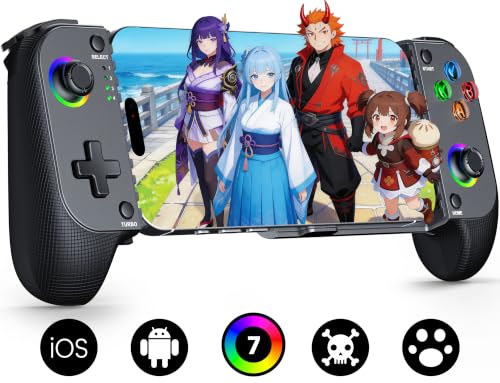
Mocagen MC1 Phone Controller (Black)

abxylute S8 Lite Type-C Mobile Gaming Controller

8Bitdo Ultimate 2C Wireless Controller (Dark Blue)

Mocagen MC1 Phone Controller with Turbo

Mocagen MC1 Phone Controller (Blue)

AOC PC Controller with Hall Sticks
The Picks, Examined More Closely
The Morostron Wireless Controller is the most overstuffed option on this list, and that’s its selling point. It carries a small interactive screen, Hall-effect sticks, RGB lighting, and a 1200mAh battery that should handle long sessions between top-ups. Bluetooth, a wireless adapter, and a wired mode cover connection preferences, and it pairs with Switch, Switch 2, iOS, Android, and PC.
Where it fits best is at a desk or a couch, not crammed in a jacket pocket. The interactive screen is a novelty, but it surfaces quick settings without alt-tabbing, which streamers and tinkerers may appreciate. If you mostly play one or two devices, simpler picks like the Mocagen MC1 stay more compact.
Where It Helps
- Three connection modes make swapping between PC, phone, and Switch straightforward.
- Hall-effect sticks resist the stick drift that plagues older controllers after heavy use.
- The 1200mAh battery should outlast shorter sessions without constant top-ups.
- Onboard interactive screen surfaces settings without dropping out of a game.
Trade Offs
- The Switch wake-up function isn’t supported, so waking a docked Switch with the controller won’t work.
- Bulkier than a clip-on pad, making it less travel-friendly for daily commutes.
- RGB and screen features can drain battery faster if left on by default.
Key Product Details
Who It Suits Best
Multi-platform households and streamers who switch between PC, Switch, and a phone on the same controller will get the most out of it.
Where Another Pick Suits Better
Travelers who want a pocket-friendly pad for a phone alone should look at the Mocagen MC1, which trims the size and the feature set.
The Mocagen MC1 stretches across a phone on each side, turning the screen into a handheld console. Hall-effect joysticks (sensors that read stick position magnetically instead of with a physical contact pad) rate at a 5-million-cycle lifespan, roughly 2.5× longer than the carbon-film sticks on most budget pads, and the electromagnetic design means no drift creeping in after a year of daily play.
Comfort gets attention too. The grip uses a laser-engraved texture that resists slipping during sweaty sessions, and the button layout keeps your thumbs in a natural arc. Case-friendly clamping means you won’t need to strip your phone out of its protective case every time you play.
Points In Its Favor
- 5M-cycle Hall sticks should outlast the standard carbon-film alternatives on most budget pads.
- Ergonomic grip with engraved texture reduces hand fatigue during long sessions.
- Case-friendly clamp fits most phones without removing the case first.
Honest Caveats
- Stretches wider than a phone, so it doesn’t slip into a pocket the way a phone alone does.
- Bluetooth pairing means a small setup step each time you connect a new device.
Best Suited To
Mobile gamers with long daily sessions who care about hand comfort and stick longevity will appreciate the build.
Look Elsewhere When
Anyone who mostly plays wired on a desk may prefer the abxylute S8 Lite, which uses USB-C and skips Bluetooth’s occasional hiccups.
The abxylute S8 Lite skips wireless entirely. A USB-C cable plugs straight into a phone or tablet, and the gamepad is recognized immediately with no pairing screens or app installs. That direct connection removes any Bluetooth latency, which competitive shooters and rhythm game players tend to notice first.
It fits iPhone 15/16/17 series, iPad Mini 6/7, and Android phones and tablets up to 216mm long, and the layout includes Hall joysticks, Hall triggers, and customizable buttons for remapping. A pass-through charging port keeps the phone topped up while you play, which is the kind of small detail that turns a “fine” pad into a “great” one for marathon sessions.
Where It Delivers
- Wired USB-C connection drops the latency floor that Bluetooth pads can’t quite hit.
- Hall sticks and Hall triggers (analog triggers that measure pull distance magnetically) give precise control in shooters and racers.
- Pass-through charging keeps the phone powered during long sessions.
- Customizable button mapping adapts the pad to different game layouts.
Points To Note
- The cable restricts movement, so this is a sit-down pad, not a couch-lounging one.
- No wireless mode means swapping to a TV setup requires a different pad.
Feature Snapshot
Right Fit For
Competitive mobile players and anyone who notices even small input delays in shooters or rhythm games will get the cleanest experience from a wired pad.
Skip It When
Those who game on a TV or move around the room should consider the 8Bitdo Ultimate 2C, which supports Bluetooth and a 2.4GHz wireless dongle.
The 8Bitdo Ultimate 2C trades a phone-clamp form for a full-sized gamepad shape, and it sits comfortably in your hands. It targets Windows 10+ PCs and Android 9.0+ devices, with a 2.4GHz wireless dongle for PC, Bluetooth for Android, and a wired mode if you prefer zero-latency play. A mode switch on top swaps between the two connection types without rebooting.
Under the hood, Hall-effect joysticks and triggers keep drift at bay, and a 1000Hz polling rate (how often the controller reports its input to the device, per second) over 2.4GHz and wired connections gives PC players a noticeably snappier feel. Extra R4/L4 back buttons let you map in-game actions without lifting your thumbs, and a turbo function handles rapid-fire automatically. Owners commonly report that 8Bitdo’s firmware updates over time add features, so the controller you buy today tends to grow into more functionality later.
Strong Points
- 1000Hz polling rate gives PC and Android a near-instant feel during fast input.
- Hall-effect sticks and triggers resist the drift that older controllers fall victim to.
- R4/L4 back buttons and turbo function expand the input vocabulary without extra software.
- Mode switch between Bluetooth, 2.4GHz, and wired covers most setups.
Where It May Fall Short
- Full gamepad size means it won’t clamp onto a phone, so you’ll need a stand for mobile play.
- Firmware updates occasionally change button behavior, requiring a short relearning period.
Who Should Grab It
PC gamers who also own an Android phone or tablet will use both connection types regularly, getting strong mileage from the dual-mode design.
A Better Fit Elsewhere
Anyone gaming on a phone in transit will find the Mocagen MC1’s clamp design more convenient than a separate stand-and-gamepad setup.
This is the turbo-equipped version of the Mocagen MC1, and that one addition reshapes the pad’s target audience. The same Hall-effect sticks, ergonomic grip, and case-friendly clamp from the standard MC1 carry over, butturbo buttons let you toggle rapid-fire on or off for any action button. For arcade-style shooters, classic platformers, and retro compilations, that turns a quick-flick thumb into a hands-free spray.
Connection stays Bluetooth, and pairing is straightforward the first time. From then on, the controller reconnects automatically when you power it on near a previously paired device, so you won’t re-run setup every session.
Positive Takeaways
- Turbo function adds rapid-fire without thumb strain, useful in shooters and arcade titles.
- Same Hall-effect sticks and ergonomic grip as the standard MC1 for comfort and longevity.
- Auto-reconnect after the first pairing cuts setup friction down to one button press.
Factors To Consider
- Turbo is the main differentiator, so users who don’t need rapid-fire will find the standard MC1 better value.
- Stretches wider than the phone itself, so it doesn’t fit a slim jacket pocket.
Technical Highlights
Who Will Love This
Retro and arcade game fans, plus anyone who plays action titles where rapid-fire mashing wears out a thumb.
Consider Something Else When
For pure competitive shooters on a desk, the abxylute S8 Lite’s wired USB-C connection edges out Bluetooth on latency.
The blue Mocagen MC1 keeps the same core hardware as the black version, with the same Hall-effect sticks, ergonomic grip, and case-friendly clamp, but the finish changes the look. The dark blue color reads more “personal accessory” than “gaming peripheral,” which matters to people who carry the pad in a bag or use it in shared spaces.
Functionally, expect the same Bluetooth pairing process, the same low-latency feel for casual mobile games, and the same comfortable grip during longer sessions. The color choice is the only meaningful difference.
Everyday Wins
- Distinctive blue finish stands out from the standard black pads on the market.
- Same Hall-effect sticks and ergonomic grip as the rest of the MC1 family.
- Case-friendly clamp fits most phones without removing a protective case.
Points To Keep In Mind
- Functionally identical to the standard MC1, so the choice mostly comes down to color preference.
Feature Rundown
Perfect Match For
Shoppers who care about the look of their gear and want the MC1’s comfort without the standard black finish.
Another Choice May Suit
Anyone who actually needs turbo buttons should pick the Mocagen MC1 with Turbo instead, since this variant leaves rapid-fire off the table.
The AOC PC Controller is built for people who don’t want to buy a separate pad for every system. It pairs with PC, Switch, Switch 2, Steam Deck, and phones, using Bluetooth, 2.4GHz wireless, and a wired connection depending on what the device supports. An interactive screen on the front surfaces connection status, battery level, and quick toggles without alt-tabbing into a software menu.
Hall-effect sticks and triggers should keep it accurate over years of use, and the full gamepad shape works well for living-room play. If your gaming rotates between a Steam Deck on the couch and a PC at a desk, the triple-mode design removes the “wrong controller for this device” problem.
Strengths Worth Knowing
- Triple connection modes cover nearly every modern gaming device.
- Onboard screen surfaces settings quickly without companion software.
- Hall-effect sensors resist the drift that affects cheaper sticks over time.
Trade-Offs To Consider
- Full gamepad size means mobile play needs a stand, since the pad doesn’t clamp onto a phone.
- Switch wake-up isn’t supported, so you’ll need to power on the console separately.
Made For
Multi-platform households where the same controller moves between PC, Switch, and a phone throughout the week.
Reach For A Different Pick When
Commuters who game on a phone alone will find the Mocagen MC1’s clamp design simpler than pairing a separate gamepad and stand.
How To Pick The Right Android Phone Controller For Your Setup
Connection type is the first fork in the road. Wired USB-C pads, like the abxylute S8 Lite, deliver the lowest input lag because there’s no radio hop in the chain. Bluetooth pads add wireless freedom but occasionally introduce a few extra milliseconds of latency, which rhythm-game players tend to notice first. 2.4GHz wireless with a USB dongle, as on the 8Bitdo Ultimate 2C, splits the difference with near-instant response and a reliable receiver.
Stick and trigger technology matters more than most shoppers expect. Hall-effect sensors read stick position magnetically rather than with a physical contact pad, which removes the most common failure mode: stick drift, where a stick slowly creeps in one direction without input. For a controller you’ll use daily for years, that durability argument is real. Standard potentiometer sticks (the older style that uses a physical wiper against a resistive pad) tend to start drifting within a year or two of heavy play.
Form factor splits the category into two camps. Clamp-style pads like the Mocagen MC1 stretch across a phone and turn it into a handheld console, ideal for travel and casual couch play. Full gamepads like the 8Bitdo Ultimate 2C and AOC PC Controller feel more like console controllers and pair well with PCs, TVs, and Steam Decks, though you may need a stand for phone use.
Finally, match the pad to your device and game library. Confirm your phone’s Bluetooth or USB-C support before picking a pad. Verify whether your favorite games have native controller support, since some Android titles still expect touch input only. Cross-platform shoppers should also look for a mode-switch button or quick-reconnect feature, which saves real time when rotating between a phone, a laptop, and a console.
Smart Shopper Notes Before You Buy
Common Shopping Slip Ups
The most common mistake is picking a controller based on feature count rather than fit. A pad loaded with extras you won’t use is heavier, more expensive, and harder to pack. Think about where you’ll actually use it. A full gamepad with back paddles is wasted on a five-minute commute game. Conversely, a tiny clamp pad is the wrong tool for two-hour PC sessions on a TV.
What The Higher Tier Buys
Stepping up to a premium pad usually gets you Hall-effect sensors, a higher polling rate, and better build materials. For most people, that translates to a controller that feels just as accurate two years in as the day you unboxed it. The upgrade is worth it if you play daily or rely on a pad for competitive games. Casual weekend players will likely find a mid-range option plenty responsive for the games they actually run.
Frequently Asked Questions
Do Android phone controllers work with all games?
Not always. Most modern Android games with controller support will recognize a standard gamepad, but some titles are designed for touch input only. Check the game’s store page or community forums for controller compatibility before assuming your favorite will work.
Is a wired or wireless controller better for Android?
Wired USB-C pads, like the abxylute S8 Lite, deliver the lowest latency because there’s no radio hop. Bluetooth pads add convenience and travel-friendliness, though they introduce a small amount of extra input delay. For competitive or rhythm games, wired is safer. For casual play and travel, wireless is more comfortable.
What is stick drift, and why does Hall-effect matter?
Stick drift is when an analog stick registers movement even when your thumb isn’t touching it, caused by wear inside the sensor. Hall-effect sticks use magnets instead of physical contact pads, so they don’t wear out the same way. A Hall-effect controller should stay drift-free for years longer than a standard one.
Can I use an Android phone controller with a PC or console?
Many pads in this category support multiple devices through Bluetooth, 2.4GHz wireless dongles, or wired USB connections. The 8Bitdo Ultimate 2C and AOC PC Controller are strong examples, both handling PC, Android, and consoles from the same hardware. Always confirm the specific model supports your target device before buying.
How long do these controllers typically last on a single charge?
Battery life varies, but most pads in this category support 10+ hours of continuous play on a charge. Higher-capacity batteries and lower polling rates stretch runtime, while RGB lighting and onboard screens drain it faster. The Morostron’s 1200mAh battery is a notable step up for heavy users who game daily.
The Takeaway
The best Android phone controller is the one that fits your device, your games, and where you play. Wired pads win on latency. Hall-effect sticks win on longevity. Clamp designs win on travel. Full gamepads win on comfort for long sessions. Match those three factors to your habits and the right pick from this list will make itself obvious.



