


Android consoles have quietly grown into a serious category for anyone who wants a deep game library without dedicating a TV or living room to a full setup. These handhelds run actual Android, which means the Google Play Store, sideloaded emulators, and modern cloud gaming apps all live in the same pocket device. Travel days, lunch breaks, and slow evenings on the couch all benefit from a self-contained screen, real controls, and battery life measured in hours rather than minutes.
The lineup below covers ten options worth knowing about in 2026, ranging from compact clamshells to high-spec performance units with active cooling. Each one handles a different kind of player, and the picks ahead will help match the right hardware to the way you actually play.
The Essentials At A Glance

Retroid Pocket Classic Retro Handheld (Retro, 3.92″ OLED)
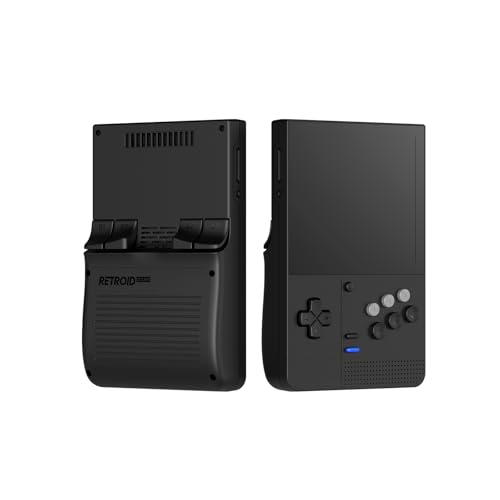
Retroid Pocket Classic Retro Handheld (Classic 6 GS, 3.92″ OLED)

GENKI x 8BitDo PocketPro Wireless Controller

Retroid Pocket 5 Retro Handheld (5.5″ 1080p, Snapdragon 865)

Retroid Pocket 4 Pro (D1100, Black)

Anbernic RG 476H (4.7″ IPS, Unisoc T820)
RG40XX V (4.0″ IPS, 64G TF, 5000+ games)

RG35XXSP Flip (3.5″ IPS, Clamshell)

Retroid Pocket Flip 2 (5.5″ AMOLED, Clamshell)

RG477M (4.7″ Touch, Dimensity 8300, CNC)
Meet The Standout Selections
Retroid’s smallest current handheld squeezes a vivid 3.92-inch OLED touchscreen into a body that disappears into a jacket pocket. Android 14 sits underneath, so the Google Play Store, sideloaded emulators, and modern cloud gaming apps all behave the way you expect on a phone. The 5000mAh battery (a measure of stored charge) keeps a long-haul flight or back-to-back meetings covered without a midday top-up.
Compared to the larger Retroid Pocket 5 reviewed later, this one trades raw horsepower for portability. For most players who mostly stream, emulate up to 16-bit and some 32-bit systems, and want a daily-carry device, that trade is a fair one.
Positive Takeaways
- 3.92-inch OLED touchscreen at 1240×1080, 60Hz (frames per second) for punchy colors and deep blacks
- 6GB RAM plus 128GB storage handles Android apps, emulators, and cloud gaming
- Android 14 with full Google Play Store support out of the box
- 5000mAh battery rated for extended play sessions between charges
- WiFi 5 (wireless networking standard) for stable downloads and streaming
Things To Consider
- No preloaded games, so setup requires sourcing your own library or installing apps
- The compact screen can feel tight for long sessions of text-heavy RPGs
Right Fit For
Commuters and travelers who want a small, bright OLED screen for short play bursts and emulator tinkering.
Look Elsewhere When
You mostly play demanding Android titles or modern 3D emulators, where the Retroid Pocket 5 delivers a more comfortable experience.
Functionally the Classic 6 GS variant shares most of its internals with the Retro edition covered above, swapping the color trim and a small set of cosmetic details. The same 3.92-inch OLED screen, Android 14 environment, 6GB of RAM, 128GB of storage, and 5000mAh battery carry over. It is a thoughtful alternative for shoppers who care about how the device looks in hand.
For most everyday owners, the practical behavior matches its sibling. Where it differs is the finish and the audience it courts: collectors, gift-givers, and anyone who treats a handheld as a personal item rather than a generic tool.
The Helpful Details
- Identical 1240×1080 OLED panel as the Retro version, with no visible downgrade
- Android 14 access to Google Play and sideloaded emulators
- 6GB RAM plus 128GB of internal storage
- 5000mAh battery sized for multi-hour trips
- Distinct color variant for shoppers who want something different from the default
Honest Caveats
- Price and feature parity mean most of the same limits apply as the Retro edition
- Stock can vary, and color choice may not be available at all times
Made For
Style-focused shoppers who want the same pocketable OLED experience with a fresh coat of color.
Skip It When
You only care about raw power, in which case the Retroid Pocket 5 is the more meaningful upgrade.
The PocketPro from the GENKI and 8BitDo collaboration takes the comfortable SNES-meets-DualShock layout and pushes it into 2026 with Hall-effect joysticks. Hall-effect sticks use magnetic sensors rather than physical contact, so they do not develop the gradual drift that plagues older analog controllers. The result is a pad that pairs quickly with the Switch, Steam Deck, ROG Ally, PC, Mac, iOS, Android, and even Tesla infotainment systems.
Where the previous picks in this list are full handhelds with their own screens, the PocketPro is a controller. For phone-based Android gaming, cloud streaming through Xbox Game Pass or Steam Link, or tight controls on a docked Steam Deck, that distinction matters.
The Practical Payoff
- Hall-effect joysticks designed to eliminate stick drift over time
- 19-button layout covering turbo, gyro, and a clicky D-pad (the four-direction cross pad)
- Bluetooth pairing with Switch, PC, Mac, iOS, Android, Steam Deck, ROG Ally, and Tesla
- USB-C cable included for wired play and charging
- Switch 2 support arrives via a manufacturer firmware update
Points To Note
- Firmware updates are required for some new platforms, which adds a small setup step
- Battery life varies significantly with rumble and gyro use, so heavy haptic users will charge more often
Key Product Details
Who It Suits Best
Phone-first Android gamers and Steam Deck or ROG Ally owners who want drift-proof sticks and a familiar shape.
A Better Fit Elsewhere
You want a self-contained screen for couch play, in which case the Retroid Pocket 5 makes more sense.
Where the Retroid Pocket Classic keeps things modest, the Retroid Pocket 5 pushes into flagship territory. The Snapdragon 865 is a high-end mobile processor from a few years back that still handles modern 3D Android games and high-demand emulators comfortably, paired with the Adreno 650 GPU (graphics chip) for smooth frame rates. A 5.5-inch 1080p touchscreen gives games the kind of room that 4-inch panels cannot match, and WiFi 6 plus Bluetooth 5.1 keep the wireless side current.
Android 13 powers the software, with full Google Play support. Owners stepping up from a smaller handheld will feel the difference immediately in game loading times and how far the emulator envelope stretches.
Strengths Worth Knowing
- Snapdragon 865 plus Adreno 650 handles demanding 3D emulators and modern Android games
- 8GB of LPDDR4X RAM (fast low-power memory) and 128GB of internal storage
- 5.5-inch 1080p touchscreen for sharper text and more visible detail
- WiFi 6 plus Bluetooth 5.1 for fast downloads and stable controller pairing
- Android 13 with the full Google Play Store available
Trade Offs
- Heavier and larger than the Retroid Pocket Classic covered earlier
- No preloaded games, so library setup is on you
- First-time owners may need to charge the device for around eight hours after long idle periods to wake the battery
Perfect Match For
Players who want real headroom for PSP, Dreamcast, GameCube, and many Android 3D titles in a pocketable form.
Reach For A Different Pick When
You want a clamshell design for screen protection, in which case the Retroid Pocket Flip 2 is a stronger fit.
The Retroid Pocket 4 Pro sits comfortably between the entry-level Classic and the flagship RP5. A MediaTek Dimensity 1100 octa-core processor (a chip with eight processing cores split between high-speed and efficiency tasks) clocks up to 2.6GHz on its four high-performance A78 cores, with a Mali-G77 MC9 GPU (graphics processor) running near 836MHz. The 4.7-inch display and 5000mAh battery combine for a sweet spot in size and endurance.
Players looking at this tier typically want a single device that handles everything from 8-bit retro up through PSP, Dreamcast, and lighter Android 3D titles. The 4 Pro is well matched to that brief, and its mature accessory ecosystem makes cases, grips, and screen protectors easy to source.
The Good Stuff
- Dimensity 1100 chip with strong single-core performance for emulators
- 8GB LPDDR4X RAM keeps multitasking and game loading responsive
- 4.7-inch screen hits a comfortable middle ground between pocket and full-size
- 5000mAh battery for multi-hour sessions away from a charger
Less-Strong Areas
- Struggles with the most demanding 3D systems compared to the Snapdragon 865-based RP5
- The 4.7-inch panel is smaller than the RP5, so text-heavy games feel tighter
Feature Snapshot
Best Suited To
All-around retro and indie gamers who want strong performance without paying for the flagship tier.
Where Another Pick Suits Better
You push 3DS, PS2, or modern Android games hard, where the Retroid Pocket 5 is the safer bet.
Anbernic’s RG 476H leans into a feature that many players overlook: a 120Hz IPS panel at 1280×960. IPS (in-plane switching) panels keep colors accurate from wide angles, and the 120Hz refresh (how many times per second the screen redraws) makes scrolling menus and 2D games feel unusually smooth. The Unisoc T820 processor is a mid-range 5G chip that handles Android 13 and a wide range of emulators without drama.
The 5000mAh battery delivers long sessions, and 5V/2A charging refills it in roughly 3.5 hours. 1080p DisplayPort output is the real surprise, turning the handheld into a living-room source when you want a big screen.
Notable Upsides
- 4.7-inch IPS at 120Hz with 1280×960 resolution for crisp, smooth visuals
- Unisoc T820 chip that handles modern Android and most popular emulators
- 5000mAh battery rated for over 8 hours of play per charge
- 1080p DisplayPort output for TV or monitor use
Small Caveats
- Anbernic software updates can lag behind the more developer-friendly Retroid lineup
- Higher refresh can drain the battery faster when 120Hz is locked on
Who Should Grab It
Owners who value a high-refresh screen and the option to dock to a TV through DisplayPort.
Consider Something Else When
You want a more mature accessory ecosystem, where the Retroid Pocket 4 Pro has a slight edge.
The RG40XX V arrives with a 64GB TF card pre-installed and a curated library of more than 5000 classic titles covering over 10 system formats. The 4.0-inch IPS screen lands in the sweet spot for 8-bit and 16-bit games, where the pixel grids match the original art. 5G WiFi and Bluetooth 4.2 handle wireless controllers and streaming, while an HDMI output opens the door to big-screen play.
Unlike the Retroid entries in this list, this handheld runs a Linux-style system rather than a full Android 13 environment. The trade is a tighter focus on emulation over app flexibility, and dual TF card slots support expansion up to 512GB.
A Few Strong Suits
- Preloaded 64GB TF card with 5000-plus classic games ready to play
- 4.0-inch IPS screen renders retro titles at their native pixel ratio
- 5G WiFi plus Bluetooth 4.2 for wireless controllers and streaming
- HDMI output to a TV for shared play sessions
- Dual TF slots support up to 512GB of additional storage
Practical Considerations
- Linux-style system does not run Google Play apps natively
- 4.0-inch screen can feel small for long sessions with text-heavy menus
Who It Suits Best
Anyone who wants a generous game library pre-installed and an easy path to a TV through HDMI.
Not Your Match When
You need Google Play apps and modern Android titles, where the Retroid Pocket Classic is the cleaner fit.
Clamshell handhelds have a way of disappearing into pockets and bags in a way that traditional slabs cannot. The RG35XXSP Flip uses a 3.5-inch IPS panel and a strong magnetic hinge that holds at preset angles around 190 and 155 degrees. A built-in Hall switch detects when the lid is closed, so screens and buttons stay protected during a commute.
Like the RG40XX V, this handheld ships with a 64GB TF card preloaded with more than 5000 classic games, plus 5G WiFi, Bluetooth, and HDMI output for TV play. It is a thoughtful gift and a great travel companion for retro-only sessions.
Useful Strengths
- Clamshell design protects the screen during pocket carry
- Hall-effect lid switch wakes and sleeps the device on open and close
- 64GB TF card with 5000-plus preloaded games
- 3.5-inch IPS panel is a great fit for Game Boy, NES, and SNES-era art
- 5G WiFi plus Bluetooth and HDMI output for flexibility
Points To Keep In Mind
- Linux-based system does not support Google Play apps
- 3.5-inch screen is small for 32-bit and 64-bit titles with detailed HUDs
Perfect Match For
Commuters and travelers who want a pocketable clamshell for short retro sessions between meetings.
Another Choice May Suit
You want a clamshell with full Android and a larger display, in which case the Retroid Pocket Flip 2 is a clear step up.
Retroid’s clamshell flagship combines a 5.5-inch AMOLED display at 1080p with the Snapdragon 865 and Adreno 650 GPU. AMOLED (active-matrix organic LED) panels offer perfect blacks and bright colors, and the clamshell form factor means that 5.5-inch screen folds shut for travel. Hall-effect sticks eliminate drift, and the reinforced hinge addresses the one clamshell weak point most competitors struggle with.
Android 13 with full Google Play support, an active-cooling system, and WiFi 6 plus Bluetooth 5.1 round out a thoughtful travel-ready device. The trade is weight: this is not the lightest handheld in the list.
Why It Works Well
- 5.5-inch 1080p AMOLED display at 500 nits (a brightness measure) and 60Hz
- Snapdragon 865 with Adreno 650 GPU for demanding emulators
- Hall-effect analog sticks designed to resist drift over time
- Active cooling system prevents thermal throttling (slowdown from heat) during long sessions
- WiFi 6, Bluetooth 5.1, USB-C DisplayPort, and a 3.5mm audio jack
Less Ideal Details
- Heavier than non-clamshell alternatives because of the hinge assembly
- No preloaded games, so first-day setup requires sourcing or installing titles
Quick Facts
Built With In Mind
Travelers and commuters who want a flagship screen, active cooling, and a clamshell body in one package.
Where A Sibling Pick Shines
You prefer a lighter, non-folding slab, in which case the Retroid Pocket 5 is the closer match.
The RG477M closes the list on a high note. A MediaTek Dimensity 8300 chip built on a 4nm process (a very small manufacturing size that improves efficiency) delivers current-generation performance, paired with 8GB of LPDDR5X RAM and 128GB of UFS 4.0 storage. UFS 4.0 is the latest high-speed storage standard for phones, which translates to fast app loading and snappy file transfers. The 4.7-inch touchscreen, Hall-effect joysticks, and 5300mAh battery round out a serious device.
Where the RG477M separates itself is the body: an aluminum CNC-machined shell (cut from a solid block of metal by a computer-controlled mill) with RGB lighting. Android 14, WiFi 6E, and Bluetooth 5.3 keep the wireless side modern. This is a premium-tier handheld aimed at players who want longevity and a refined feel.
Useful Highlights
- Dimensity 8300 on a 4nm process for current-generation efficiency
- 8GB LPDDR5X RAM plus 128GB UFS 4.0 storage for fast load times
- Aluminum CNC shell with RGB lighting accents
- Hall-effect joysticks, 5300mAh battery, and Android 14
- WiFi 6E plus Bluetooth 5.3 for fast, stable wireless
Trade-Offs To Consider
- Aluminum body adds weight compared to plastic-shelled handhelds
- Premium positioning commands a higher cost than mid-tier options
Whose Shelf It Belongs On
Power users who want a current-generation SoC (system-on-chip, the combined processor package), refined build, and modern connectivity in a single device.
Swap It Out When
You want a clamshell design with similar power, in which case the Retroid Pocket Flip 2 is the natural alternative.
What Matters Most Before Choosing Android Consoles
The Android console category looks crowded at a glance, but a few attributes quickly separate the easy wins from the regret purchases. Use the notes below as a checklist while comparing the picks above.
Processor And RAM Headroom
The chipset (the main processor package) and RAM determine how far your library can stretch. Older chips handle 8-bit and 16-bit emulation comfortably but choke on PSP, Dreamcast, and modern Android 3D titles. A Snapdragon 865 or Dimensity 8300 extends the ceiling considerably. At least 8GB of RAM is the practical floor in 2026, since modern Android is hungry even before you load an emulator.
Screen Size And Panel Type
OLED and AMOLED panels offer perfect blacks and vivid colors, which is a real edge for retro art. IPS panels deliver accurate colors at wide angles and, in some cases, higher refresh rates. Size is a personal call: 3.5 to 4.0 inches is wonderfully portable, 4.7 inches is the comfort zone for long sessions, and 5.5 inches is the closest you get to a living-room feel in handheld form.
Battery And Charging
5000mAh has quietly become the baseline for serious Android handhelds, and 5300mAh shows up in premium builds. Charging speed matters more than raw capacity for daily drivers, since fast top-ups between meetings and flights make the device feel less tethered to a cable.
Controls, Hinges, And Build
Hall-effect sticks are worth prioritizing in 2026 because they sidestep the drift problem that ruins older analog pads. Clamshell designs add a hinge as a wear point, so a reinforced hinge design and a magnetic lock are worth checking before purchase. For daily pocket carry, lighter plastic shells often beat heavier aluminum ones.
Things To Weigh Before You Buy
Pitfalls Shoppers Hit
The most common mistake is assuming all Android consoles run the Google Play Store. Several entries in this list run Linux-style systems tuned for emulation, which is great for retro fans but limits modern Android apps. Double-check the operating system before assuming any specific app will install.
A second trap is ignoring stick type. Older analog joysticks drift over time, and replacement or repair adds friction. Hall-effect sticks, where present, are a meaningful upgrade for the long haul.
When Paying More Pays Off
Premium handhelds like the RG477M and the Retroid Pocket Flip 2 cost more for a reason. The build quality, current-generation SoC, and refined cooling translate to longer useful life, fewer slowdowns during demanding games, and a device that still feels fast three or four years from now. For daily-use shoppers, that longevity is often a stronger value than saving on a cheaper mid-tier option.
Frequently Asked Questions
Do Android consoles run the Google Play Store?
Most modern Android-based handhelds do, though a few specialized emulators run Linux-style systems instead. Always check the listed operating system before purchase if Play Store access matters.
How long does the battery last on a typical Android handheld?
Most 5000mAh units deliver roughly 6 to 10 hours of mixed play, depending on screen brightness, WiFi use, and the demands of the running game or emulator. Demanding 3D titles and high-refresh displays will land closer to the lower end of that range.
What is a Hall-effect joystick?
A Hall-effect joystick uses magnetic sensors rather than physical contact points. That design avoids the gradual stick drift that traditional analog sticks develop over time, which is a meaningful durability upgrade for daily drivers.
Can I sideload emulators and ROMs on these devices?
On full Android handhelds, yes. The Google Play Store offers several legitimate frontend apps, and emulators can be sideloaded (manually installed from outside the official store) once the appropriate settings are enabled. Storage expansion through TF cards is common in this category.
Are clamshell handhelds more fragile than slab designs?
Clamshells add a hinge as a wear point, so look for reinforced designs and magnetic locks. With those features, modern clamshell handhelds hold up well in daily pocket carry, but the hinge remains the part most likely to need attention over years of use.
The Takeaway
Android consoles in 2026 cover a wide range of players, from quick-commute retro sessions to flagship emulation on a 5.5-inch AMOLED. Match the chipset, screen, and form factor to the way you actually play, and the right pick usually reveals itself quickly. Pick the one that fits your library, your bag, and your patience for tinkering, and you will enjoy it for a long time.



