


Stepping into VR used to feel like committing to a thousand-dollar rig and a wall of cables. In 2026, the entry point is far friendlier, and you can get a genuinely usable headset for the cost of a mid-tier phone. The challenge is sorting the standalones from the smartphone shells, the comfort-first designs from the ones that pinch after twenty minutes, and the bargain finds that quietly overdeliver. The seven picks below cover every flavor of budget VR worth your attention this year, from a full standalone headset to add-ons that stretch your existing gear further.
A Side-By-Side Look

Meta Quest 3S 128GB VR Headset

MagiMask VR Headset for Phone

Rebuff Reality VR Power Battery Pack
Oculus Quest 2 256GB VR Headset

3D VR Headset with Controller
TECKNET VR Headset for Phone
VIVE Ultimate Tracker
What Each Pick Brings To The Table
The Meta Quest 3S stands out as the most complete budget package on this list, blending standalone hardware with a generous 128GB of onboard storage. Unlike the phone-based shells that follow it, this headset runs entirely on its own, so you are not tethering it to a handset or a gaming PC. It blends digital objects into your actual room through mixed reality, letting you layer apps and games on top of your living space rather than blocking it out entirely.
A Batman: Arkham Shadow bundle sweetens the entry price, and the included Meta Horizon+ trial gives you a window into a sizable content library from day one. For first-timers, the appeal is real: you unbox it, charge it, and start playing without juggling accessories.
Where It Delivers
- Standalone operation means no external console, phone, or PC tethering required
- Mixed reality support blurs digital content into your real surroundings for spatial gaming
- 128GB storage holds a sizable library of titles without constant management
- Multi-window multitasking lets you browse, watch, and chat without leaving VR
- USB-C headphone support with optional 3.5mm adapter for private listening
Points To Keep In Mind
- Battery life is internal and finite, so marathon players may need to recharge mid-session
- The face cushion can collect sweat over time and benefits from regular wipe-downs
Made For
First-time VR owners and curious gamers who want a full standalone headset without the flagship price tag, especially anyone who values mixed-reality games and big-screen streaming.
Look Elsewhere When
If you already own a Quest 2 and need longer play sessions rather than a fresh headset, the Rebuff Reality VR Power battery pack is the smarter add-on for your existing rig.
The DroneMask MagiMask takes a different angle than the standalone Meta unit: it turns whatever phone you already own into an FPV monitor (first-person view, the live feed streamed from a drone or camera) or a private theater. The unibody lens design is the headline feature, with a single-piece optic that aims to deliver sharper visuals than the cheap two-lens shells crowding the budget category.
For drone pilots, the appeal is obvious. You slot in your phone, mount the headset, and watch the live feed hands-free, which removes the glare-and-squint problem of flying on a sunny day. It also pulls double duty as a movie viewer for long flights or train rides, a small but appreciated versatility.
Useful Strengths
- Unibody lens construction aims for crisper output than multi-piece budget optics
- Universal smartphone compatibility avoids the buy-for-your-phone headache
- Doubles as a portable theater for travel days and downtime
Honest Caveats
- Image quality depends heavily on the phone inside, so an older display will hold it back
- No head-tracking motors; experience is more viewer than immersive room-scale
- Foam padding can absorb sweat on warm days, so a wipe-down between sessions keeps it sanitary
Who It Suits Best
Drone hobbyists who want a hands-free FPV viewer, plus travelers and casual viewers who want a private big-screen experience without buying a dedicated headset.
Consider Something Else When
If you want room-scale gaming and six degrees of freedom rather than a stationary phone viewer, the Meta Quest 3S is the better fit, even at a higher entry cost.
The Rebuff Reality VR Power is not a headset, it is the accessory you strap to one. Designed for the Meta Quest 3S, Quest 3, and Quest 2, it houses a 10,000 mAh battery (a unit measuring how much charge the pack can hold, larger numbers mean longer runtimes) that extends playtime by roughly eight hours, which is the difference between a single evening session and a full day of demos.
The counter-balance design is the quietly clever part. By placing weight at the back of the head strap rather than only at the front, it offsets the front-heavy feel that makes long Quest sessions uncomfortable. For Quest owners who already love their headset but hate the cable-tethered feeling of a wall charger, this is the upgrade that completes the experience.
What Makes Sense
- 10,000 mAh capacity pushes typical Quest sessions past the eight-hour mark
- Rear counter-weight improves comfort during extended play
- Compatibility across Quest 3S, Quest 3, and Quest 2 covers the current Meta lineup
Trade Offs
- Adds noticeable bulk to the headstrap, which may bother users with smaller heads
- Not a standalone product; you still need a compatible Meta headset to use it
Best Suited To
Existing Quest 2, Quest 3, or Quest 3S owners who regularly hit low-battery warnings mid-game and want to extend sessions without sitting near an outlet.
Skip It When
You do not yet own a Quest headset, in which case the MagiMask VR Headset is a far cheaper entry point into the category, even with its more limited feature set.
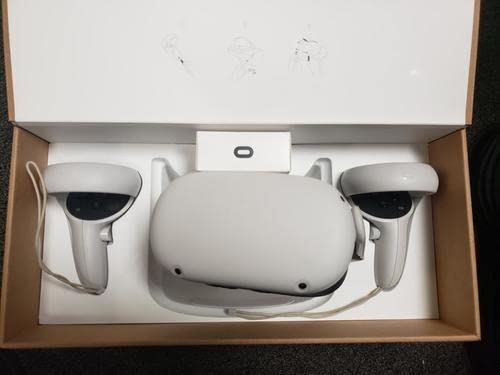
The Oculus Quest 2 256GB is the older sibling the budget category grew up around. While the Quest 3S now leads the lineup, the 256GB Quest 2 remains attractive for shoppers who want generous storage, a proven app ecosystem, and a price that has settled into serious bargain territory. The white colorway keeps the classic look that helped make the original Quest a household name.
For households already familiar with the Meta software environment, the experience translates smoothly. You get a full standalone headset with hand-tracking, a substantial game library, and the same account system that syncs purchases across the Meta ecosystem.
The Upside
- 256GB storage capacity handles a deep game library with room to spare
- Proven Meta software stack with a mature third-party accessory market
- Standalone operation means no PC, phone, or external sensors required
- Established comfort ecosystem with abundant third-party straps and covers
Possible Compromises
- Older chipset than the Quest 3S, so newer mixed-reality titles may feel limited
- Plastic build can scratch at the visor over time, making a protective case worth considering
Who Should Grab It
Cost-conscious VR enthusiasts who want a full standalone experience with ample storage and are happy to skip the very latest mixed-reality features.
Where Another Pick Suits Better
If you primarily watch content rather than game, the TECKNET VR Headset delivers a much lighter, lower-cost phone-based alternative that may fit your routine better.
The Mryzzsf 3D VR Headset focuses on the thing cheap VR shells usually get wrong: fit. It supports phones between 5.0 and 7.0 inches, and offers both FD (focal distance, how far the lens sits from your eye) and OD (object distance, the spacing between the two lenses) adjustments, plus unilateral myopic alignment (the ability to fine-tune each eye separately for users with different prescriptions in each eye). For glasses-free viewers with slightly different vision in each eye, that last feature alone can save a lot of squinting.
The included controller connects to your phone and handles play, pause, and volume without removing the headset. For casual movie nights and mobile VR apps, it is a tidy little package, though it does not pretend to compete with the standalone power of the Meta units above.
What Helps Most
- FD and OD adjustments plus per-eye alignment accommodate varied vision
- Wide field of view for an immersive feel at the price point
- Included controller simplifies media playback without headset removal
Where It May Fall Short
- No active cooling, so long sessions can leave the phone warm against your face
- Build is mostly plastic, which feels lighter but also less durable over years of use
Right Fit For
Casual viewers with phones between 5.0 and 7.0 inches who want a low-fuss headset for movies and simple mobile VR apps, especially users with different prescriptions in each eye.
A Better Fit Elsewhere
If you intend to use the headset for extended wear and comfort matters most, the TECKNET VR Headset is lighter and better ventilated for long sessions.
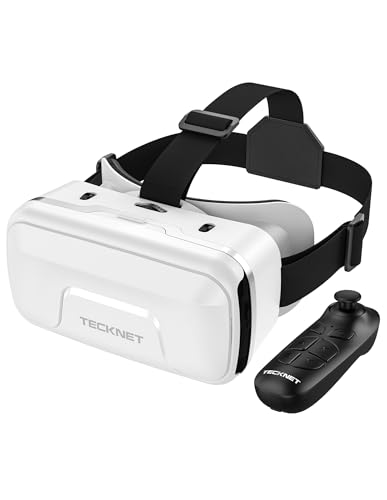
The TECKNET VR Headset is the comfort-first option in the phone-based category. At 268 grams, it is one of the lightest full-feature shells on the market, and the breathable soft foam mask is designed to reduce pressure and heat buildup, two issues that make most budget headsets hard to wear past the 30-minute mark.
The HD lenses offer a 110-degree field of view (how wide the visible image stretches from edge to edge, wider feels more immersive) with anti-blue light coating, which is a thoughtful touch for evening viewing sessions. The adjustable headband fits a wide range of head shapes, and the included controller handles media controls without headset removal.
Reasons It Performs
- 268g weight makes extended wear far more comfortable than heavier shells
- 110-degree FOV creates a wide, immersive viewing window
- Anti-blue light lenses reduce eye strain during long sessions
- Adjustable headband and soft nose rest adapt to varied face shapes
Less Ideal Details
- Phone compatibility tops out around 7.2 inches, so larger phablets may not fit
- Comes with a basic controller rather than motion-tracked gamepads
Who Will Love This
Movie watchers and casual VR users who want a phone-based headset light enough to wear for full films or gaming sessions without facial pressure.
Reach For A Different Pick When
You want to play room-scale standalone games rather than phone-based media, in which case the Meta Quest 3S earns the higher spend without question.
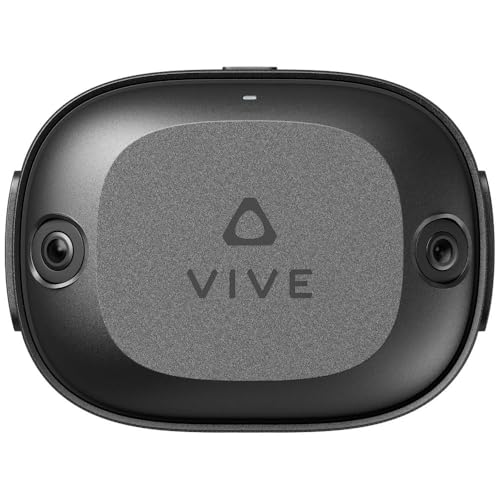
The VIVE Ultimate Tracker is a niche pick with a specific audience. It is not a headset at all, but a small, body-worn tracking puck that brings real-world movements into XR (extended reality, a category covering both VR and mixed-reality experiences) and PC VR (virtual reality powered by a desktop computer rather than running on the headset alone) experiences. For owners of compatible all-in-one XR headsets or PC-tethered VR rigs, it expands what the system can track, capturing feet, hips, or props rather than just hands.
With a compatible VIVE wireless dongle, you can connect up to five trackers simultaneously. For users building out a full-body tracking setup, the unit count matters, and the small puck form factor is far less intrusive than older belt-and-strap solutions.
A Favorable Mix
- Compact puck form factor is far less obtrusive than legacy body straps
- Supports up to five trackers per system for full-body coverage
- Compatible with both all-in-one XR and PC-tethered VR setups
Worth Bearing In Mind
- Requires a VIVE-compatible headset and wireless dongle to function
- Battery life per tracker is limited, and recharging mid-session is the norm for long workouts
Whose Shelf It Belongs On
Existing VIVE XR or PC VR owners who want to add full-body tracking for fitness apps, dance experiences, or mocap-style creative work.
Where A Sibling Pick Shines
For shoppers who do not yet own a compatible VIVE system, the Meta Quest 3S is a far more accessible standalone entry that does not require extra dongles or trackers.
Smart Shopper’s Guide To Budget Vr Headsets
Standalone Vs. Phone-Based
The first fork in the road is whether you want a headset that runs on its own or one that borrows your phone’s display and processing. Standalone units like the Meta Quest 3S and Oculus Quest 2 handle everything internally, with their own screens, batteries, and processors, which means you can play anywhere without tethering. Phone-based shells like the TECKNET or MagiMask rely on whatever handset you slot inside, making them lighter, cheaper, and more dependent on the device you already own. For shoppers who want hassle-free play, standalone wins. For travelers and casual viewers, phone-based shells can be the more practical pick.
Comfort And Fit Matter More Than Spec Sheets
A headset that pinches your face or fogs up after ten minutes will collect dust, no matter how good its display is. Weight, foam quality, head-strap adjustability, and ventilation are the attributes that decide whether you reach for the headset or leave it in a drawer. The TECKNET’s 268-gram build and breathable foam is the comfort benchmark in the budget range, and the Rebuff Reality battery pack addresses comfort from a different angle by rebalancing the headset’s weight.
Storage And Battery Decide Session Length
Internal storage determines how many games and apps you can keep installed without juggling space. The Quest 3S at 128GB and Quest 2 at 256GB give you meaningful library room, while phone-based headsets sidestep the issue entirely by using your phone’s existing storage. Battery life matters most for standalone units, and the Rebuff Reality pack is the workaround for anyone who finds the internal battery too short for movie marathons or demo sessions.
Key Considerations Across These Picks
Where Shoppers Go Wrong
The most common slip is buying a phone-based headset assuming it will feel like a Quest. Phone shells are media viewers and FPV tools, not room-scale gaming systems, and expecting them to deliver the same immersion sets you up for disappointment. The other trap is ignoring phone size compatibility: a 7.2-inch phone will not fit in a headset capped at 6.5 inches, and forcing it can crack the lens cradle. Measure your phone before you buy, and check the headset’s compatibility window.
When Paying More Pays Off
Stepping up from a $30 phone shell to a $300 standalone buys you three things that genuinely change the experience: positional tracking (the headset’s ability to follow your movement through 3D space, not just head turns), room-scale play, and an app ecosystem built specifically for the hardware. The Quest 3S is the tipping point where price and capability meet, and for anyone planning to play games rather than just watch content, that upgrade is hard to argue with. Accessories like the Rebuff Reality battery or the VIVE Ultimate Tracker also illustrate how the right add-on can matter more than buying a higher-tier base model.
Frequently Asked Questions
Are budget VR headsets worth it in 2026?
Yes, especially the standalone Meta models, which now offer mixed reality and full game libraries at price points that would have seemed unrealistic a few years ago. Phone-based shells are worth it for media and casual use, though they cannot match the immersion of a standalone system.
Do I need a powerful phone for a phone-based VR headset?
You need a phone that physically fits the headset’s size range, ideally one with a sharp display. Performance matters less than screen quality, since the phone is mostly displaying content rather than rendering complex 3D scenes.
Can kids use these VR headsets safely?
Phone-based models like the TECKNET are often marketed for family use, but you should follow age guidance on the headset itself and limit session length. For younger children, parental supervision and short viewing windows are the safest approach.
What is mixed reality, and do I need it?
Mixed reality blends digital objects into your real surroundings through cameras on the headset, so you can see your room with virtual items layered on top. It is a fun feature, but full VR (where the headset completely replaces your view) is still where most of the best content lives.
How long do budget VR headsets typically last?
With reasonable care, the headsets themselves tend to last several years, while the foam padding and head straps are the parts that wear out first. Replacement straps and covers are widely available, especially for the Meta lineup, which extends the practical lifespan well beyond the warranty window.
The Takeaway
The right budget VR headset depends on what you want to do with it. Standalone Meta models are the strongest all-around picks for gaming and mixed reality, phone-based shells like the TECKNET and MagiMask shine for media and travel, and accessories like the Rebuff Reality battery or VIVE Ultimate Tracker extend the value of gear you may already own. Start with your use case, not the price tag, and the right pick tends to fall into place.



