


A gaming DAC amp is one of those quiet upgrades that tends to outshine the headset it sits behind. Swap one in and crowded firefights start to feel layered, dialogue stops muddying into explosions, and footstep cues that used to vanish in the noise become genuinely useful intel. The ten options below cover the spread most gamers actually need: USB desktop hubs, portable dongles for laptops and handhelds, a few balanced-output picks for higher-end cans, and one home-speaker amplifier for anyone running a desktop setup with bookshelf monitors. Compare the use cases and you’ll land on the right fit.
A Quick View Of The Lineup

Fosi Audio C3 Gaming DAC Amp for PC

FOLA Wired Gaming Earbuds IEM
TANCHJIM Space PRO Gaming AMP

Fosi Audio K7 DAC Headphone Amp
FiiO K5 Pro Headphone Amps DAC

Fosi Audio V1.0G Class D Amplifier

MECHEN AP10 USB DAC Dongle
EYTSE HA05 Portable USB C DAC
Fosi Audio K5 Pro Gaming DAC

TANCHJIM Bunny Wired Gaming Earphones
Meet The Standout Selections
The Fosi Audio C3 is built around one specific job: helping competitive FPS players hear what’s coming before it arrives. StepSense processing (a footstep-focused audio mode that lifts midrange movement cues) sits next to native 7.1 surround (multi-channel positional audio that places sounds around the listener), and the desktop volume knob keeps adjustments tactile mid-match.
Compatibility stretches across PC, PS5, and Switch, so multi-platform players don’t need a second device. Owners commonly note that the on-board controls stay out of the way during long sessions. For most ranked-grind evenings, the C3 earns its place on a crowded desk.
Practical Pluses
- StepSense mode surfaces enemy movement without drowning gunfire
- Native 7.1 surround gives directional cues a real lift
- Plug-and-play across PC, PS5, and Switch
- Dedicated desktop volume knob for quick mid-match tweaks
- Compact footprint suits tighter desk layouts
Things To Consider
- Surround processing is most useful for shooters; RPG players may prefer a flat signal
- A single USB connection means the unit is tethered, not portable
Key Specs
Who It Suits Best
Competitive FPS players on PC who want cleaner footstep cues and tactile control without juggling software menus.
Look Elsewhere When
The Fosi Audio K7 makes more sense for anyone running balanced headphones and wanting a higher-power desktop hub.
Where most gaming headsets go big, the FOLA IEM (in-ear monitor) goes small, and that portability is its real pitch. Dual-cavity dynamic drivers (two chambered speaker elements per side that separate bass from mid/treble) handle the imaging work, and the virtual 7.1/5.1 modes give Switch and handheld players a sense of space on the road.
Without a mic built in, this is a listen-only option, which is fine for late-night play where a headset microphone would just pick up background noise. The brass waveguide face and composite diaphragm construction add some real heft to the sound for the size. Compared to the C3 above, this pick is for anyone whose gaming happens in shorter bursts and on smaller screens.
Real-World Strengths
- Dual-cavity drivers handle imaging better than typical earbuds
- Virtual 7.1/5.1 modes give handheld players a real sense of space
- Compact form slips into a pocket or controller pouch
- Brass waveguide construction adds sonic weight at low volume
Worth Noting
- No built-in mic rules out chat-heavy multiplayer
- In-ear fit varies, and a poor seal kills the bass response
Right Fit For
Switch and handheld players who game in shorter sessions and want a portable in-ear option over a full headset.
Consider Something Else When
The Bunny Wired Gaming Earphones make more sense for anyone who needs a mic and a single 3.5mm jack.
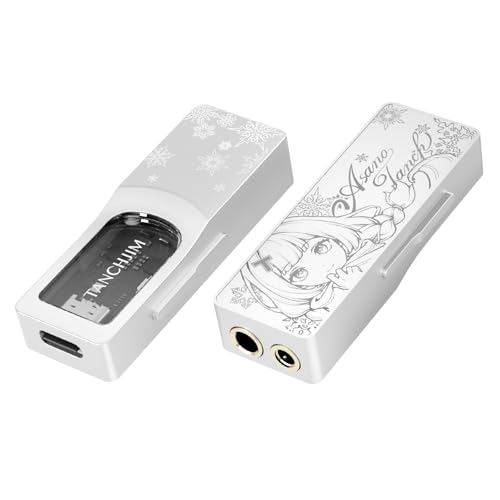
The Space PRO pushes portable gaming audio into hi-fi territory. Two CS43198 DAC chips (digital-to-analog converters that turn your computer’s digital audio signal into the analog sound your ears can hear) feed independent left and right amplifiers, and the fully balanced four-channel decoding layout keeps the two channels cleanly separated. In plain terms, the soundstage (the perceived width and depth of audio around your head) opens up and instrument placement becomes more precise.
Virtual 5.1 and 7.1 modes bring the gaming flavor when you want it, and mic support covers the chat side. Owners report that the unit gets warm during long sessions, so plan airflow around it. Compared to the FOLA IEM above, this is the pick when balanced output and dedicated amplification matter more than pocket size.
Good Reasons To Consider
- Dual DAC architecture gives genuine channel separation
- Balanced output drives demanding headphones cleanly
- Virtual 5.1 and 7.1 modes cover multiplayer and single-player
- Mic support keeps chat in the mix
Trade Offs
- Runs warmer than smaller dongles, so airflow matters
- Higher power draw can tax phone batteries on long sessions
Best Suited To
Hi-fi-minded gamers who already own balanced headphones and want portable amplification with surround on demand.
Not Your Match When
The MECHEN AP10 is a better fit for anyone after a lighter pocket dongle with balanced output at a more modest feature set.
The K7 is the desktop hub most setups end up wanting after a year of swapping dongles. The AK4493S DAC handles PCM decoding up to 384kHz/32bit (a high-resolution digital audio format), and the rated 2100mW output handles power-hungry planars (flat-diaphragm headphones that need strong current) without breaking a sweat. Connectivity is the quiet star here: USB-C, USB-B, optical, coaxial, Bluetooth with aptX HD LL (a low-latency Bluetooth codec that keeps audio in sync with video), and a mic input cover almost every source on a modern desk.
Output options include 4.4mm balanced (a four-pole headphone jack that keeps the left and right channels fully separated), 3.5mm single-ended, and RCA line-out, so pairing with active speakers or a second amp is simple. For most players running a permanent gaming-and-music desk, the K7 earns the Editor’s Choice slot.
Positive Points
- 2100mW output drives demanding planar headphones cleanly
- Bluetooth with low-latency codec suits wireless gaming
- 4.4mm balanced plus 3.5mm and RCA outputs cover most setups
- Optical and coaxial inputs support legacy consoles and CD players
Points To Note
- Full feature count makes initial setup take longer than a basic dongle
- Desktop footprint is larger than compact portable options
Feature Snapshot
Made For
Multi-platform desktop gamers running high-impedance or planar headphones who want a single hub for PC, PS5, Switch, and music sources.
Skip It When
The FiiO K5 Pro suits anyone who values reference-tier ESS Sabre conversion and doesn’t need Bluetooth wireless input.
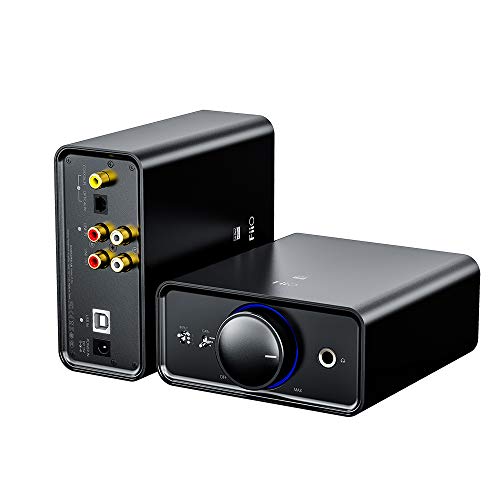
The K5 Pro is a desktop workhorse with the kind of pedigree that survived its first product cycle. The ES9038PRO DAC chip with 32-bit processing pairs with the XUF208 USB decoder (a USB interface chip that handles high-resolution digital audio streams from your computer), and DSD512 native playback (a high-density audiophile file format) puts it in reference territory. Headphone output reaches 1.5W into 32 ohms and 20Vpp (volts peak-to-peak, a measure of output swing) at 300 ohms, which covers anything from sensitive IEMs to full-size planars.
Inputs include coaxial, optical, and RCA line-in, with optical and coaxial accepting up to 192kHz. Outputs cover 6.35mm headphone and RCA line-out for active speakers. The honest read is that this is the pick when music matters as much as gaming.
The Case For It
- Reference-grade ES9038PRO DAC delivers clean, detailed sound
- Native DSD512 playback appeals to serious music listeners
- Output swing handles both sensitive IEMs and high-impedance cans
- Optical and coaxial inputs support legacy sources
Honest Caveats
- Single-ended 6.35mm only; no balanced output
- Lacks Bluetooth, so wireless pairing needs an extra adapter
- No gaming-specific surround processing
Perfect Match For
Listeners who split time between hi-fi music sessions and single-player gaming on a desktop setup with quality headphones or active speakers.
Reach For A Different Pick When
The Fosi Audio K7 suits anyone who wants Bluetooth input, a balanced 4.4mm headphone output, and gaming-friendly features in the same box.
The V1.0G is the odd one in this list, and that’s the point. A TPA3116D2 Class D chip (a high-efficiency switching amplifier design that runs cool and sips power) drives 50W per channel into a pair of passive bookshelf speakers, which means this isn’t a headphone DAC at all. For gamers running a desktop setup with small monitor speakers, it adds the kind of room-filling stage that headphones can’t match.
The solid aluminum chassis and built-in speaker protection circuit earn their keep during long sessions. The supply range of 12V to 24V makes it adaptable across home and lighter pro use. Owners commonly note clean, dead-silent output when nothing plays through it, which is rare at this size.
Bright Spots
- 50W per channel into passive bookshelf speakers
- Class D efficiency keeps heat and power draw modest
- Built-in speaker protection circuit for long sessions
- Dead-silent background when no audio is playing
Possible Compromises
- Not a headphone amp; needs passive speakers to do its job
- No surround processing for gaming
- Single analog input limits source flexibility
Who Will Love This
Gamers who prefer a desktop speaker setup for immersive single-player sessions and want a compact amp to drive their passive monitors.
A Better Fit Elsewhere
The Fosi Audio K5 Pro Gaming DAC is the smarter choice for anyone whose priority is headphone output with gaming-friendly connectivity.
The AP10 keeps things small without giving up balanced output. The ES9028Q2M DAC chip brings native hardware decoding for DSD256 and 32-bit/384kHz audio, and HyperStream II plus Time Domain Jitter Eliminator (technologies that reduce timing errors in the digital signal) keep the output clean. The result is a dongle that punches well above its weight class.
Both 3.5mm and 4.4mm balanced outputs sit on the chassis, so it adapts to single-ended and balanced headphones without an adapter. The all-black housing stays understated on a desk. For most laptops and phone-based gaming sessions, the AP10 is the kind of upgrade you forget is even there.
Why It Works Well
- Balanced 4.4mm and single-ended 3.5mm outputs in one unit
- Native DSD256 and 32-bit/384kHz decoding
- Compact dongle size suits travel and laptop bags
- Understated black housing fits a clean desk aesthetic
A Few Limitations
- No surround processing, so gaming relies on headphone virtualization
- Higher power draw at balanced output can drain phone batteries
Quick Facts
Built With In Mind
Travelers and laptop gamers who want balanced output and hi-fi decoding from a pocket-friendly dongle.
Where A Sibling Pick Shines
The TANCHJIM Space PRO is worth considering for anyone who wants virtual surround and a mic input on the same portable unit.
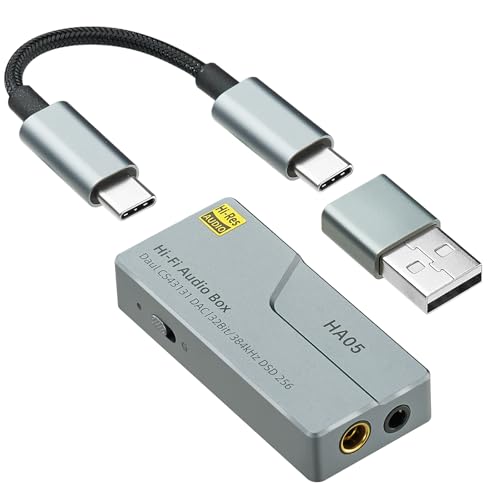
The HA05 skips the battery entirely, which is a quietly smart move. Dual CS43131 DAC chips (a Cirrus Logic chip known for low power draw and clean output) decode up to DSD256 and 32-bit/384kHz audio, and the aerospace aluminum housing keeps weight down while shielding the internals. Power comes straight from the USB-C port, so there’s nothing to charge before a session.
Both 3.5mm and 4.4mm balanced outputs are present, and the unit works with phones, tablets, laptops, and PCs. For commutes, handhelds, and hotel-room gaming nights, this is the dongle that just works. Compared to the MECHEN AP10 above, the choice comes down to which chip architecture you prefer.
Strong Points
- Battery-free design means zero charging hassle
- Dual CS43131 chips deliver clean, low-noise output
- Aerospace aluminum housing keeps weight minimal
- USB-C compatibility spans phones, tablets, and laptops
Where It May Fall Short
- No gaming-specific surround modes
- Higher output modes depend on host device power delivery
Who Should Grab It
Phone and tablet gamers who want hi-fi decoding and balanced output from a dongle that never needs charging.
Swap It Out When
The MECHEN AP10 makes more sense for anyone who prefers the ES9028Q2M chip family and wants similar balanced output in a comparable form factor.
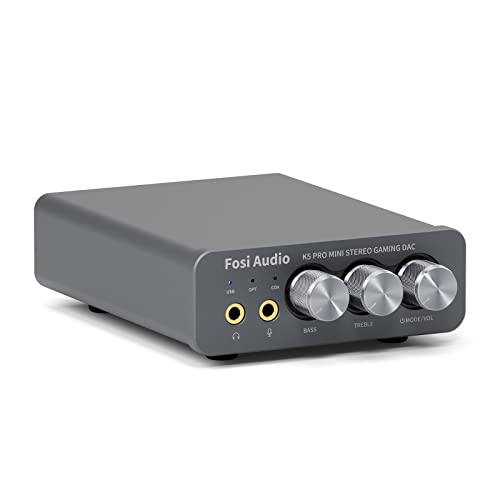
The K5 Pro is the gateway gaming DAC for anyone moving up from onboard audio. The NE5532 op-amp (a small analog chip that shapes the sound signature and adds gain) keeps the noise floor low, and the unit pulls double duty as an external sound card across PS5, PC, and Mac. A combined power-and-volume knob keeps the front panel simple, and bass and treble controls let you tune the signal without diving into software.
USB-C input supports up to 24-bit/96kHz, while optical and coaxial inputs reach 24-bit/192kHz. Output power ranges from 1000mW at 16 ohms down to 80mW at 300 ohms, so it handles a wide range of headphones. The honest read is that this is the unit to buy when a K7 feels like overkill.
What Earns Its Place
- Acts as a true external sound card for PS5, PC, and Mac
- Bass and treble controls on the front panel
- Wide impedance coverage for varied headphones
- USB-C, optical, and coaxial inputs cover most sources
Practical Considerations
- No surround processing, so positional cues rely on headphone virtualization
- Single-ended output only, no balanced option
Spec Overview
Whose Shelf It Belongs On
Entry-level PC and console gamers who want a real external DAC upgrade over motherboard audio without stretching to flagship pricing.
Where Another Pick Suits Better
The Fosi Audio C3 is a better fit for FPS-focused players who want surround processing and a footstep-tweaked signal out of the box.
The Bunny is a wired IEM with a built-in mic and a single 3.5mm jack, which makes it the most plug-and-play option in this lineup. The dual-chamber dynamic driver layout keeps harmonic distortion under 0.05% at 94dB (a loudness level that handles most game audio cleanly), and the low-distortion waveguide cover carries tech borrowed from the brand’s higher-end dynamic driver models.
For anyone running a single-jack setup on a controller, laptop, or older phone, this is the path of least resistance. Midrange and bass tuning leans toward clarity over slam, which is a good fit for dialogue-heavy RPGs. Compared to the FOLA above, the Bunny trades the surround virtual modes for a mic.
Positive Takeaways
- Single 3.5mm jack works with controllers and laptops
- Built-in mic covers casual chat without extra gear
- Low-distortion dual-chamber driver keeps detail intact
- Clear midrange tuning suits dialogue-heavy games
Some Limits To Know
- No balanced or USB-C connection, so no external DAC chain
- In-ear fit requires tip swapping for best seal and bass
Whose Shelf It Belongs On
Wired single-jack gamers on consoles, controllers, or older phones who want a listen-and-chat IEM without adapters or external DACs.
Where A Sibling Pick Shines
The FOLA Wired Gaming Earbuds IEM is the better fit for anyone who skips the mic and wants virtual surround modes instead.
What To Weigh Before Choosing A Gaming DAC Amp
Output Type Matches Your Headphones
The biggest decision is whether the amp drives single-ended 3.5mm/6.35mm cans or balanced 4.4mm headphones. Planar magnetic and high-impedance models need more current than mobile dongles can deliver, so a desktop hub like the Fosi Audio K7 or FiiO K5 Pro is the safer pick. For sensitive IEMs and casual headsets, a portable dongle like the MECHEN AP10 or EYTSE HA05 does the job.
Source Compatibility And Inputs
Match the input list to your actual setup. PC-only gamers can live with USB-C, while multi-platform players benefit from optical or coaxial inputs that handle PS5 and older consoles. Bluetooth with a low-latency codec adds wireless flexibility for casual sessions without an extra adapter.
Surround Processing Versus Pure Stereo
Surround modes on the C3 and Space PRO are tailored for FPS positional audio, while pure stereo paths on the FiiO K5 Pro and MECHEN AP10 keep music and single-player games cleaner. Competitive players lean toward processed surround; RPG and adventure fans usually prefer flat stereo.
Power, Portability, And Footprint
Output power (measured in milliwatts) determines which headphones a unit can drive, but a higher-wattage desktop amp costs desk space. Travelers and laptop gamers usually want a dongle that disappears into a bag, even at the cost of some power.
Key Considerations Across These Picks
Common Shopping Slip Ups
Buying a DAC amp before checking your headphone impedance (the electrical resistance of your headphones, measured in ohms) is the classic mistake. A 300-ohm planar needs a desktop-class amp, not a phone-bound dongle. Skipping input compatibility is a close second, since optical and coaxial support opens up older consoles and CD players that USB alone can’t reach.
What The Higher Tier Buys
The jump from budget to mid-tier brings more output power, balanced output, and a quieter noise floor. That means harder-to-drive headphones get clean volume, and sensitive IEMs don’t pick up hiss. For anyone running demanding cans, that upgrade is the one that changes daily listening most.


