


A solid gaming keyboard doesn’t have to drain your savings. The current crop of mechanical and optical boards delivers responsive switches, durable keycaps, and full RGB customization at prices that make sense for casual players, esports hopefuls, and anyone building a starter battlestation. Whether you want a wired workhorse for tournament play, a wireless setup to clear desk clutter, or a compact 60% board for travel, this lineup covers the formats and switch types worth your attention. Every pick below is judged on what the specs actually deliver in daily use, not on marketing fluff.
The Lineup, Simplified

Logitech G713 Wired Gaming Keyboard (White Mist)

YUNZII C75 Cute 75% Wireless Mechanical Keyboard (Beige)

Razer Huntsman V3 Pro TKL 8KHz Esports Gaming Keyboard

Razer Huntsman V3 Pro TKL Esports Gaming Keyboard
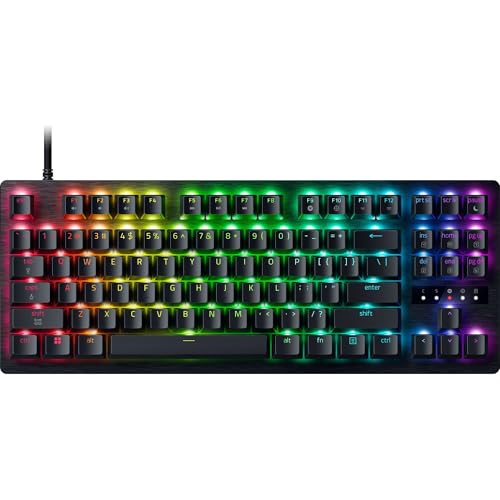
Razer Huntsman V3 TKL 8KHz Analog Optical Esports Gaming Keyboard

Razer Huntsman V3 Pro 8KHz Esports Gaming Keyboard (Analog Optical)

Razer Huntsman V3 Pro Mini 60% Esports Gaming Keyboard

Razer BlackWidow V4 Pro 75% Wireless Gaming Keyboard

Razer BlackWidow V4 TKL Wireless Gaming Keyboard
Razer Pro Type Ergo Wireless Split Ergonomic RGB Keyboard
A Deeper Look At The Lineup
The Logitech G713 lands in that rare middle ground where style and substance meet. Its White Mist finish and cloud-shaped palm rest make it look more like a piece of minimalist furniture than a gaming peripheral, which matters if your desk lives on camera for streams or video calls. The tenkeyless layout (meaning the dedicated number pad is removed) frees up mouse space without sacrificing the function row or arrow cluster, and the adjustable height lets you dial in wrist angle for long sessions.
GX Brown tactile switches give you a gentle bump on each press without the loud click of blue-style switches, so late-night gaming won’t wake a roommate. LIGHTSYNC RGB (Logitech’s per-key lighting system) ties into the broader Logitech ecosystem, syncing effects across compatible mice and headsets. PC and Mac compatibility means you can swap workstations without re-mapping muscle memory.
Real Benefits
- Cloud-shaped palm rest genuinely reduces wrist fatigue during multi-hour play sessions.
- GX Brown switches offer a balanced typing feel for both gaming and daily productivity.
- LIGHTSYNC RGB integrates cleanly with other Logitech peripherals for unified ambient lighting.
- Tenkeyless footprint gives competitive shooters more room for wide mouse sweeps.
Small Caveats
- Wired-only design means cable management still matters on a clean desk.
- The bright white finish shows dust and fingerprints more readily than darker boards.
- No dedicated media keys; you rely on function-layer shortcuts for playback control.
Who It Suits Best
Style-conscious casual gamers and content creators who want a tactile mechanical feel without the gamer aesthetic overload.
Where Another Pick Suits Better
Competitive Valorant or CS2 players chasing the lowest latency will get more from the Razer Huntsman V3 Pro TKL 8KHz Esports Gaming Keyboard, which leans harder into analog speed.
The YUNZII C75 is a keyboard that knows exactly what it is: a personality piece. The beige chassis and pastel keycap set signal “cute desk” from across the room, and the 75% layout (which trims the numpad but keeps the function row and arrow keys) keeps things compact without forcing you into a 60% learning curve. Candy switches lean toward a smooth linear feel, which suits both casual gaming and extended typing sessions without the finger fatigue of stiffer clicky options.
Multi-mode connectivity covers 2.4 GHz wireless (a dedicated dongle for low-latency play), Bluetooth for tablets and phones, and a wired USB-C fallback for charging or zero-latency use. The creamy typing sound is a real selling point in shared spaces or open-plan offices. Compared to the G713’s understated white aesthetic, the YUNZII is a louder design statement.
The Case For It
- Triple connectivity (2.4 GHz, Bluetooth, wired) handles laptop, desktop, and mobile setups from one board.
- Linear Candy switches produce a satisfying, muted thock that won’t annoy people nearby.
- 75% form factor keeps arrow keys and a function row without eating desk space.
- The aesthetic stands out on stream overlays and desk-flatlay photos.
Points To Note
- The novelty colorway won’t appeal to anyone preferring a stealth or all-black setup.
- Wireless battery life depends heavily on RGB brightness; heavy lighting trims runtime noticeably.
Made For
Creators, students, and casual players who want a wireless board that doubles as desk decor without the industrial gamer look.
Skip It When
Hardcore competitive players should look at the Razer Huntsman V3 TKL 8KHz Analog Optical Esports Gaming Keyboard, which prioritizes tournament-grade switches over personality.
The Razer Huntsman V3 Pro TKL 8KHz sits at the top of the analog optical tree. Analog optical switches (which use light to detect keypress depth, not just contact) measure how far you press, not just whether you pressed, so you can set ultra-shallow actuation points (the depth at which a key registers) for hair-trigger movement in Valorant or CS2. The 8KHz polling rate (meaning the keyboard reports its state to your PC 8,000 times per second) cuts input delay to a level that serious ranked players genuinely notice, and the tenkeyless frame keeps your mouse hand unrestricted.
Rapid Trigger is the headline feature for anyone who strafe-jumps or counter-strafes: it resets a key the instant it travels back up, so you can re-fire directional inputs faster than a standard mechanical switch allows. Razer Snap Tap prioritizes the last pressed of two conflicting movement keys, smoothing out 180-degree flicks. For casual players, the value of analog optical switches is mostly invisible. For ranked grinders, it’s a legitimate edge.
Strong Points
- Adjustable actuation from 0.1 to 4.0 mm lets you tune each key’s trigger depth in software.
- 8KHz polling rate slashes input lag compared to standard 1KHz boards.
- Rapid Trigger mode shines in fast-paced FPS movement mechanics.
- TKL layout delivers pro-tournament form factor without the desk sprawl of a full board.
Worth Noting
- Price-per-feature ratio only pays off for players who actually use adjustable actuation.
- Wired-only design keeps you tethered; no wireless flexibility here.
Key Specs
Best Suited To
Esports competitors and ranked FPS players who want every legal advantage in input speed and customization.
Consider Something Else When
Casual gamers who mostly play single-player titles will get more everyday value from the Logitech G713’s tactile comfort and broader ecosystem integration.
Think of the Huntsman V3 Pro TKL as the V3 Pro 8KHz’s slightly trimmed sibling. It carries the same analog optical switch platform and the same Rapid Trigger + Snap Tap combo, but pairs them with a standard 1KHz polling rate rather than 8KHz. For most players the difference is imperceptible. The keyboard still feels lightning fast, and the wired TKL build is identical in footprint.
Adjustable actuation between 0.1 and 4.0 mm gives you the same per-key tuning via Razer Synapse, so you can have hair-trigger WASD (the standard movement keys: W, A, S, D) for movement and a deeper press for utility keys to avoid misfires. It’s a smart middle ground if analog optical performance matters more than the absolute peak polling rate.
What Makes Sense
- Same analog optical switch tech as the 8KHz model at a friendlier entry point.
- Rapid Trigger and Snap Tap handle the movement mechanics that define modern FPS play.
- TKL form factor suits competitive setups where mouse space is premium.
- Software-driven actuation tuning means you can experiment without buying new switches.
Things To Consider
- 1KHz polling rate lags behind the 8KHz model, however slightly, in raw input reporting.
- Wired-only design limits desk flexibility.
Who Will Love This
FPS players who want analog optical customization without stretching to flagship pricing.
A Better Fit Elsewhere
Travelers and minimalists should consider the Razer Huntsman V3 Pro Mini 60% Esports Gaming Keyboard, which packs the same switch platform into a much smaller frame.
The Huntsman V3 TKL 8KHz slots into Razer’s lineup as the step-up option for gamers who want 8KHz polling without the full Pro price tag. It runs on second-generation analog optical switches with the same 0.1 to 4.0 mm adjustable actuation range, so the precision and Rapid Trigger behavior match the flagship experience. Razer Snap Tap handles simultaneous key conflicts for clean counter-strafing.
What you give up versus the Pro variants is mostly branding and accessory bits, not core performance. For an FPS main climbing through ranked tiers, this board delivers the input speed that actually matters without paying for features you may never touch.
Standout Benefits
- 8KHz polling delivers tournament-grade input reporting without the flagship premium.
- Analog optical switches enable per-key actuation depth customization.
- Rapid Trigger optimizes movement-heavy gameplay in CS2, Valorant, and similar titles.
- TKL frame leaves ample mousepad real estate for low-DPI aimers.
Trade Offs
- No wireless option, so cable routing still matters on your battle station.
- Synapse software is required for full actuation tuning, which adds a setup step.
Feature Snapshot
Perfect Match For
Competitive FPS players ready to invest in 8KHz input speed without paying flagship-tier prices.
Look Elsewhere When
Anyone who wants wireless freedom for a clutter-free setup should consider the Razer BlackWidow V4 TKL Wireless Gaming Keyboard instead.
The full-size Huntsman V3 Pro 8KHz is what you buy when you want flagship switch tech without sacrificing the numpad. It’s the same analog optical Gen-2 platform found in the TKL siblings, including the 0.1 to 4.0 mm adjustable actuation, Rapid Trigger, and Snap Tap. What you add is a complete key layout for spreadsheet work, macro-heavy MMO play, or anyone who genuinely uses the number pad for in-game commands or creative software.
8KHz polling applies to all 104+ keys, so there’s no compromise on input speed just because you went full-size. The wired connection keeps latency floor at the absolute minimum, and the broader key layout gives you more programmable real estate through Razer Synapse.
A Strong Showing
- Full-size layout covers numpad users who don’t want to relearn muscle memory.
- 8KHz polling and analog optical switches deliver flagship-grade responsiveness.
- 100-million keystroke lifespan rating suggests long-term durability for daily use.
- Programmable keys via Synapse support complex macros for MMO or productivity workflows.
Honest Caveats
- Larger footprint demands more desk space than a TKL or 60% board.
- Wired-only setup, no wireless convenience.
Who Should Grab It
MMO players, sim racers, and productivity-focused gamers who want every key type without giving up competitive switch performance.
Reach For A Different Pick When
Low-sensitivity FPS players will get more mouse room from the Razer Huntsman V3 Pro Mini 60% Esports Gaming Keyboard’s ultra-compact frame.
The Huntsman V3 Pro Mini is the smallest entry in the V3 Pro family and arguably the most niche. A 60% layout removes the function row, arrow keys, and numpad, leaving just the core alphanumeric cluster. For most people that’s a dealbreaker. For low-sensitivity FPS players using a wide mousepad, it’s a revelation: you can park your mouse further left, swing your arm freely, and never reach for a key that isn’t in the main cluster.
The analog optical switch platform stays intact, so Rapid Trigger and adjustable actuation work the same as on the full-size and TKL siblings. Razer Snap Tap smooths out movement inputs. Dual-purpose keys (which trigger alternate commands when held rather than tapped) layer functionality back in through a function modifier, but expect a learning curve if you’ve never used 60% before.
What Stands Out
- Tiny footprint maximizes mouse movement range on wide pads.
- Same analog optical performance as larger V3 Pro boards.
- Travel-friendly size for LAN parties and tournaments.
Factors To Consider
- 60% layout has a steep adjustment period if you’re coming from a TKL or full-size board.
- No dedicated arrow keys complicates spreadsheet and document work.
At A Glance
Built With In Mind
Low-sensitivity FPS players who want every millimeter of mousepad space and don’t mind a compact layout.
Swap It Out When
MMO players, writers, and anyone using productivity software daily should grab the full-size Razer Huntsman V3 Pro 8KHz Esports Gaming Keyboard for proper arrow and numpad keys.
The BlackWidow V4 Pro 75% takes a different angle than the Huntsman line. Instead of analog optical switches, it ships with Razer Orange tactile mechanical switches, which give you a quiet bump on each press without the click of a blue-style switch. Where it stands out is the OLED display and Command Dial built into the top-right corner. You can monitor system metrics at a glance, scrub through video timelines, or trigger custom commands without alt-tabbing out of your game.
Wireless connectivity (2.4 GHz and Bluetooth) cuts the cable clutter, and the hot-swappable socketed PCB (printed circuit board) accepts 3-pin or 5-pin switches, so swapping to aftermarket switches doesn’t require a soldering iron. It’s the enthusiast’s pick: feature-dense, customizable, and built for people who like to tinker with their setup.
The Upside
- OLED screen with Command Dial adds genuine workflow value for creators and multitaskers.
- Hot-swappable PCB supports custom switch experimentation without soldering.
- Wireless connectivity keeps the desk clean for non-gaming work.
- 75% layout balances compactness with arrow and function key access.
Some Limits To Know
- Lacks analog optical features, so Rapid Trigger fans should look at the Huntsman line.
- Premium feature set comes at a higher cost than basic mechanical boards.
Feature Rundown
The Right Fit
Enthusiast gamers, streamers, and creative professionals who want a feature-rich wireless board with room to customize.
Where A Sibling Pick Shines
Pure competitive FPS players chasing every millisecond should choose the Razer Huntsman V3 Pro TKL 8KHz Esports Gaming Keyboard for its analog optical switch platform.
The BlackWidow V4 TKL Wireless is the no-nonsense wireless workhorse in this lineup. You get Razer’s HyperSpeed 2.4 GHz wireless for low-latency gaming, plus Bluetooth for pairing laptops, tablets, or phones. The TKL layout keeps the function row and arrows, so you don’t sacrifice productivity for the smaller footprint. Razer Orange tactile switches provide that same quiet bump that suits late-night sessions or shared offices.
Multi-device support through the same dongle is a small touch that pays off if you already use a Razer mouse. Hot-swappable switch sockets accept both 3-pin and 5-pin switches, so customization is there if you want it. It lacks the analog optical tech of the Huntsman line, but for most players, mechanical Orange switches deliver more than enough speed for everything outside elite competitive play.
Useful Strengths
- Wireless freedom without the latency tax of standard Bluetooth.
- Hot-swappable design future-proofs the board for switch upgrades.
- TKL layout suits both gaming and everyday productivity use.
- Multi-device pairing through a single dongle reduces USB port clutter.
Potential Drawbacks
- Battery life varies with RGB usage; max brightness drains the cell faster.
- No analog optical features, so Rapid Trigger users should look at the Huntsman line.
Whose Shelf It Belongs On
Hybrid gamers who split time between competitive titles and general productivity and want one wireless board for both.
Not Your Match When
Hardcore esports players pushing the absolute limits of input speed should grab the Razer Huntsman V3 Pro TKL 8KHz Esports Gaming Keyboard instead.
The Pro Type Ergo is the odd one out in this roundup, and deliberately so. It’s not built for esports. It’s built for the people who game, type, code, or write for hours and finish every session with sore wrists. The split layout angles the two halves of the keyboard outward, with a 10° slope and adjustable 4° or 7° tilt to keep your forearms in a more neutral position.
Ultra-low-profile keycaps with spherical indents (small concave dips that cradle your fingertip) reduce the distance your fingers travel on each press, which cuts fatigue over long sessions. Dual “B” keys give you a choice of thumb position to match your natural grip. Wireless connectivity keeps the desk clean. It’s a niche pick, but for the right person, it’s the difference between ending the day comfortable and ending it stiff.
Where It Delivers
- Split layout with adjustable tilt genuinely reduces wrist strain for extended typing.
- Low-profile keycaps with spherical indents shorten finger travel and improve accuracy.
- Wireless design complements a clutter-free productivity setup.
- Dual “B” keys accommodate different thumb placements for natural hand positioning.
Where It Is Less Suited
- Ergonomic split layout has a meaningful adjustment period.
- Not designed for competitive gaming; lacks analog optical features and Rapid Trigger.
Right Fit For
Remote workers, writers, and anyone with wrist discomfort who games casually and types heavily.
Where Another Pick Suits Better
Competitive gamers who prioritize FPS performance over ergonomics will find more value in the Razer Huntsman V3 TKL 8KHz Analog Optical Esports Gaming Keyboard.
What Matters Most Before Choosing Affordable Gaming Keyboards
Switch Type Changes The Feel
Mechanical switches fall into three broad families: linear (smooth, no bump, common for gaming), tactile (gentle bump on press, good for typing and gaming), and clicky (tactile plus audible click, best for typists who don’t share a room). Optical switches add a fourth option: light-triggered actuation, which lets you set per-key trigger depths. If you mostly play FPS games where fast repeated inputs matter, analog optical or rapid-trigger-ready mechanical switches are worth the investment. For mixed gaming and typing, tactile switches like Razer Orange or Logitech GX Brown hit a versatile sweet spot.
Wired Versus Wireless Tradeoffs
Wireless boards have closed the latency gap almost entirely, with 2.4 GHz dongles delivering near-wired response times. The real tradeoffs are battery life, RGB brightness, and dongle management. If your desk is already a cable jungle, wireless simplifies things. If you play in long sessions at max polling rates with full RGB, plan on more frequent charging or keeping the USB-C cable handy as a fallback.
Layout Defines Your Desk Real Estate
A full-size board covers every key type but eats desk space. TKL trims the numpad and is the standard for competitive play. 75% keeps arrow keys and a function column in a tighter frame. 60% goes minimal, freeing up massive mouse space but requiring function-layer habits. Pick the smallest layout that still covers how you actually use your keyboard. Downsizing is satisfying; upsizing after a compact habit is painful.
Form Factor And Build Considerations
Wired-only boards tend to be lighter and more portable for LAN trips. Wireless boards add weight from the battery but declutter your daily setup. Hot-swappable PCBs future-proof your investment if you enjoy trying different switch types. A metal top plate versus plastic construction changes the typing acoustics and weight significantly, so if possible, check hands-on impressions before committing.
Key Considerations Across These Picks
Pitfalls Shoppers Hit
First-time buyers often reach for the loudest, most RGB-loaded board and regret the noise within a week. Consider your household: shared rooms and open offices favor tactile or silent switches over clicky. Another common slip is overpriorizing polling rate: the jump from 1KHz to 8KHz matters for elite competitive play but is imperceptible for casual or single-player gaming. Finally, don’t ignore switch feel in the spec sheet. A “fast” switch with too little resistance will tire your fingers during long sessions.
Where The Extra Money Goes
Stepping up to flagship analog optical boards buys you adjustable actuation, Rapid Trigger, and the lowest possible input latency. These features matter in ranked FPS titles at higher skill tiers, where every millisecond of input delay can shift a duel. For casual or single-player gaming, mid-tier mechanical boards with quality switches deliver 90% of the experience at a fraction of the cost. Spend up only when you can name a specific feature you’ll use daily.
Frequently Asked Questions
What Switch Type Suits Gaming Best
Linear and analog optical switches are popular for gaming because they offer smooth, uninterrupted key travel with low actuation force, letting you tap keys quickly without fighting resistance. Tactile switches work fine too, but the small bump can feel like drag during rapid repeated inputs.
Is Wireless Latency Noticeable For Gaming
Modern 2.4 GHz wireless keyboards report latency figures close enough to wired that most players can’t tell the difference outside controlled lab tests. Standard Bluetooth introduces more delay and is best reserved for productivity, not competitive play.
Do I Need 8KHz Polling Rate
For ranked competitive FPS play, 8KHz provides a slight edge in input freshness. For single-player, MMO, MOBAs, or general use, the difference between 8KHz and 1KHz is essentially imperceptible. Match the polling rate to your skill tier and game genre.
What Is A Tenkeyless Keyboard
Tenkeyless (TKL) keyboards remove the dedicated number pad on the right side, keeping the main alphanumeric cluster, function row, and arrow keys. TKL is a popular layout for gaming because the smaller footprint gives your mouse more room to move.
How Long Do Mechanical Switches Last
Most quality mechanical switches are rated for 50 to 100 million keystroke presses, which translates to many years of typical use. Optical switches can offer similar or longer rated lifespans. Actual longevity depends on usage patterns, dust exposure, and how aggressively you press keys.
Final Verdict
The right gaming keyboard depends on what you actually do at your desk. Esports players chasing every input edge should land on a Huntsman V3 Pro TKL with 8KHz polling and analog optical switches. Style-first setups pair nicely with the Logitech G713 or the YUNZII C75’s playful aesthetic. Wireless lovers get the cleanest experience from the BlackWidow V4 TKL Wireless. And anyone whose wrists ache after long sessions will find the Pro Type Ergo’s split layout genuinely useful. Start with the match between your games and the board’s strengths, and the rest of the decision follows naturally.


