


A prebuilt gaming desktop saves you the headaches of part compatibility and the long weekend of assembly. For most people, that tradeoff is worth it: a working machine arrives, you plug in your monitor, and you’re loading into a match the same night. The seven machines below span small-form mini PCs, mainstream towers, and high-end builds with serious graphics muscle, so there’s a sensible match whether you mostly play indie games or push frame rates in competitive shooters.
A Side-By-Side Look
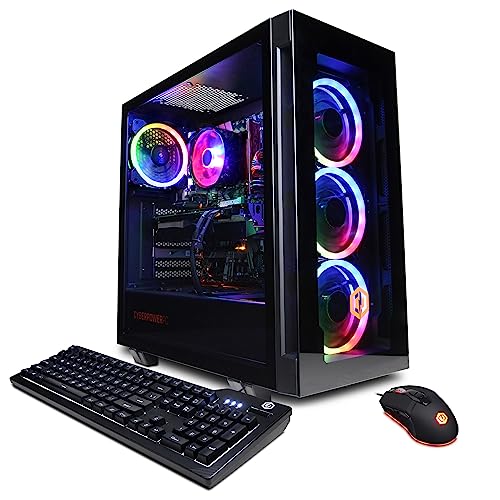
CYBERPOWERPC Gamer Master Gaming PC (GMA2700A)

MINISFORUM AI X1 Pro-370 Mini PC

MINISFORUM M1 Pro Mini PC
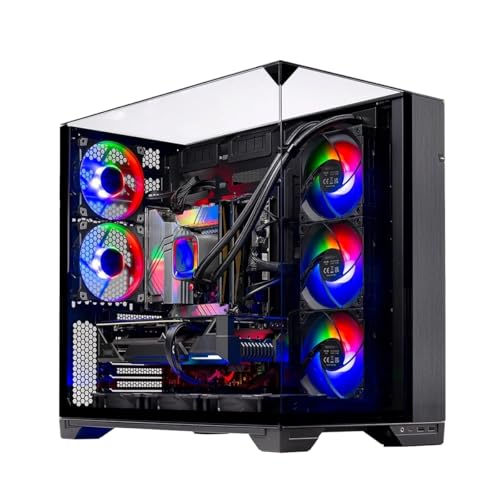
Skytech Gaming O11 Vision Gaming PC

ASUS ROG G700 (2025) Gaming Desktop
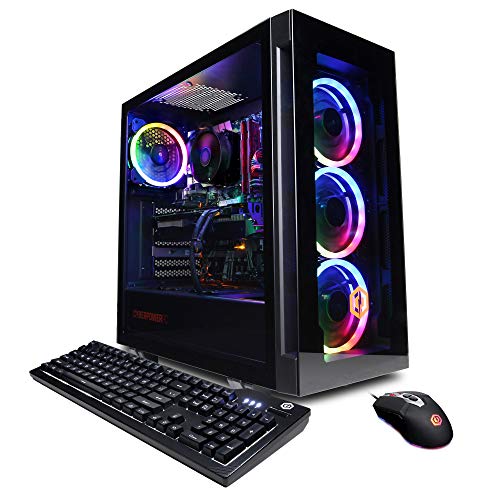
CyberpowerPC Gamer Xtreme VR Gaming PC

MINISFORUM X1-255 Mini PC (Barebone)
Meet The Standout Selections
The Gamer Master lands in a comfortable middle ground that suits the majority of PC gamers running 1080p monitors. Inside, a Ryzen 5 7600 handles six cores (the small processing units a CPU splits work across) and twelve threads (parallel processing lanes inside those cores) at a 3.8GHz base, paired with NVIDIA’s RTX 4060, an entry-level ray-tracing card in the current GeForce lineup. Ray tracing is a rendering technique that simulates realistic light and shadow behavior, and the 4060 handles it at modest settings while pushing high frame rates in most modern titles.
16GB of DDR5 RAM (a faster, more power-efficient memory standard than DDR4) and a 500GB PCIe Gen4 NVMe SSD round out a build that boots Windows 11 Home in seconds. PCIe Gen4 is the current generation of the motherboard slot standard, doubling bandwidth over Gen3 and shortening game load times noticeably. A tempered-glass side panel, RGB case lighting, and a seven-color gaming mouse ship in the box, so you can hand it to someone on day one and they’re ready to play.
Notable Gains
- Ryzen 5 7600 with six cores handles modern gaming and daily multitasking without breaking a sweat.
- RTX 4060 brings DLSS support, an NVIDIA feature that uses AI to upscale lower-resolution frames into sharp high-resolution images and lift frame rates.
- DDR5 memory and PCIe Gen4 storage keep the platform feeling current for years.
- Six USB 3.1 ports plus two USB 2.0 let you plug in controllers, headsets, and external drives without a hub.
- Wi-Fi included, so a cable run to the router isn’t required in a dorm or bedroom setup.
- Keyboard and mouse in the box lower the cost of entry for a first gaming PC.
Honest Caveats
- 500GB of storage fills up quickly once a handful of large modern games are installed.
- The included peripherals are functional, but most people replace them within a year.
Key Product Details
Who It Suits Best
Mainstream 1080p gamers who want a balanced Ryzen and GeForce pairing without overspending on a flagship card.
A Better Fit Elsewhere
Competitive players chasing 240Hz frame rates will find the Skytech Gaming O11 Vision Gaming PC a stronger match with its RTX 5070.
This is the smallest machine on the list, but the spec sheet is anything but modest. The Ryzen AI 9 HX 370 delivers twelve cores and twenty-four threads, with a 5.1GHz boost clock, while the integrated Radeon 890M graphics handle casual and esports gaming without a discrete GPU. The NPU, a Neural Processing Unit, is a dedicated chip for AI workloads that handles up to 50 TOPS (trillion operations per second, a standard measure of AI compute power), and the total platform reaches roughly 80 TOPS for on-device AI tasks like Windows Copilot features.
Compared to the tower PCs above, you trade raw GPU muscle for a footprint that disappears behind a monitor. Dual 2.5GbE ports, two USB4 connections, HDMI, DisplayPort, Wi-Fi 7, and Bluetooth 5.4 cover virtually any desk setup, and the 1TB SSD gives a healthy starting point for software and a modest game library.
Advantages To Know
- Radeon 890M integrated graphics run esports titles and lighter games at smooth frame rates.
- Wi-Fi 7 and dual 2.5GbE Ethernet provide future-proof networking.
- Four video outputs support a multi-monitor workstation for productivity.
- 32GB of DDR5 RAM handles heavy browser tabs and content workflows comfortably.
Things To Consider
- Integrated graphics will struggle with demanding AAA games at high settings.
- Compact cases run warmer; owners commonly report that sustained loads need the fan curve tuned.
Who Will Love This
Productivity-focused users with limited desk space who want light gaming and serious AI performance in one box.
Consider Something Else When
Gamers wanting dedicated GPU power should look at the CYBERPOWERPC Gamer Master Gaming PC, which pairs a discrete RTX card with a similar price class.
The M1 Pro takes a different angle than the AI X1 above, swapping AMD silicon for Intel’s Core Ultra 5 125H with fourteen cores and eighteen threads. The integrated Arc GPU, Intel’s modern integrated graphics, is the main story here: it nearly doubles the iGPU performance of the prior generation, which matters for anyone hoping to play real games without a desktop graphics card.
The standout addition is the Oculink port, a high-bandwidth external connector that lets you attach a separate GPU enclosure later. That’s an unusual feature at this size class and makes the M1 Pro a flexible long-term buy. Two USB4 outputs, HDMI, DisplayPort, 2.5GbE, Wi-Fi 7, and Bluetooth 5.4 round out the connectivity, and 32GB of DDR5 at 5600MHz (overclockable to 6400MHz) gives the CPU plenty of memory bandwidth.
What Makes Sense
- Oculink port enables an external GPU upgrade path without replacing the whole PC.
- Intel Arc integrated graphics handle light and modern indie games smoothly.
- 32GB DDR5 at 5600MHz keeps multitasking responsive.
- Wi-Fi 7 and dual Ethernet cover stable, high-speed network needs.
Trade Offs
- An external GPU enclosure adds cost and desk clutter, partially negating the small form factor.
- Intel Arc drivers, while much improved, still trail NVIDIA in some game compatibility scenarios.
Right Fit For
Hybrid users who split time between productivity work and casual gaming, and who want the option to bolt on a real GPU later.
Skip It When
Pure gamers who already know they want a discrete GPU today should consider the CYBERPOWERPC Gamer Xtreme VR Gaming PC for a budget tower with a real graphics card out of the box.
The O11 Vision steps things up significantly. The Ryzen 7 7700X hits 4.5GHz base and 5.4GHz boost across eight cores, and the RTX 5070 with 12GB of GDDR7, the newest generation of VRAM, runs cool and quiet under load. The X670 motherboard, AMD’s high-end AM5 platform chipset, opens the door to future CPU upgrades without replacing the whole system, an important detail for a build at this level.
Skytech pairs that silicon with a 360mm AIO liquid cooler, three ARGB fans, and an 850W Gold ATX 3.0 power supply. ATX 3.0 is the latest PSU standard, designed to handle transient power spikes from modern graphics cards. The case itself borrows the iconic O11 dual-chamber design that PC builders have favored for years, so cable management and thermals stay clean even with the higher-end parts inside.
Good Reasons To Consider
- RTX 5070 delivers strong 1440p and entry 4K gaming with full ray tracing.
- 32GB of DDR5 at 5600MT/s gives the CPU room to breathe in heavy multitasking.
- 360mm AIO keeps the 7700X cool under sustained gaming and productivity loads.
- 850W Gold ATX 3.0 PSU provides headroom for future GPU upgrades.
Points To Keep In Mind
- 1TB SSD fills quickly with modern game installs.
- The full tower takes up considerably more space than the mini PCs above.
Feature Snapshot
Made For
Gamers who want high-refresh 1440p performance today with room to upgrade the CPU on the same AM5 motherboard tomorrow.
Look Elsewhere When
Shoppers who prefer Intel’s platform and a more refined chassis experience should look at the ASUS ROG G700 (2025) Gaming Desktop instead.
ASUS positions the ROG G700 as a flagship showpiece, and the design language backs that up. A dual-glass panel chassis, a stylized ROG Slash, and Aura Sync RGB lighting create a centerpiece look, while the Core Ultra 7 265F and RTX 5070 handle the actual work. The 265F is part of Intel’s Arrow Lake generation, a desktop CPU line that pairs high-efficiency cores with performance cores to balance multi-threaded throughput and gaming responsiveness.
Beyond the aesthetic, the G700 ships with 32GB of DDR5 and a 1TB PCIe 4.0 NVMe SSD, which keeps boot and load times brisk. The trade-off versus the Skytech build above is largely a stylistic and platform preference: ASUS leans on its brand polish and Intel silicon, while Skytech pairs AMD’s mature AM5 platform with a third-party O11 case. Both deliver the same RTX 5070 gaming experience.
A Strong Showing
- Core Ultra 7 265F delivers strong multi-threaded performance for streaming and content work.
- Dual-glass chassis showcases the components with a premium finish.
- Aura Sync RGB integrates with other ROG peripherals for a matched setup.
- RTX 5070 ensures modern features like DLSS 4 and frame generation are available.
Potential Drawbacks
- ROG branding and the showcase chassis typically carry a higher cost than equivalent-spec competitors.
- Dual-glass cases need regular dusting to keep the interior looking clean.
Best Suited To
Shoppers who care as much about the visual presentation of their desktop as the frame rates it produces, and who prefer Intel’s platform.
Another Choice May Suit
Buyers who prioritize CPU upgrade paths on AMD’s AM5 platform should pivot to the Skytech Gaming O11 Vision Gaming PC.
The Gamer Xtreme is the older sibling to the Gamer Master reviewed first, and the differences matter. It runs an Intel Core i7-12700F with twelve cores (eight performance plus four efficiency) and pairs that with the RTX 3060 12GB. The 12GB frame buffer is unusually generous for this card class, which helps in heavily modded games and certain creative apps. DDR4 memory and a 1TB NVMe SSD round out a build that targets 1080p gaming at high settings.
Compared to the GMA2700A, this is a previous-generation platform, and that translates to lower upgrade headroom on the motherboard. Still, for someone stepping into PC gaming for the first time, the lower cost and 1TB of storage make it a friendly entry point. The tempered glass side panel and RGB lighting keep the visual experience in line with newer CyberpowerPC models.
Noteworthy Benefits
- 12GB RTX 3060 offers more VRAM than most cards at the entry tier, helping in modded games.
- 1TB SSD provides room for a healthy launch game library.
- Intel i7-12700F handles twelve-core workloads well for streaming on a budget.
- Keyboard and mouse included for a true out-of-box experience.
Points To Note
- DDR4 and an older Intel platform limit long-term CPU upgrade options.
- The 12th-gen chip draws more power than newer equivalents at similar performance levels.
Whose Shelf It Belongs On
First-time PC shoppers who want a working tower, a real graphics card, and the lowest possible entry cost.
Reach For A Different Pick When
Anyone planning to keep a PC for five-plus years will get more longevity from the CYBERPOWERPC Gamer Master Gaming PC and its newer AM5 platform.
The X1-255 is the only barebone unit in this roundup, meaning the case, motherboard, CPU, and cooler arrive ready, but you supply your own RAM and storage. That makes it a better fit for hobbyists comfortable opening a small PC and installing SO-DIMM laptop-style memory and an M.2 SSD. The Ryzen 7 255 is an eight-core, sixteen-thread processor that handles productivity tasks with room to spare.
The connectivity matches the other MINISFORUM entries: HDMI 2.1, DisplayPort 2.0, two USB4 ports, an Oculink connector for an external GPU, 2.5GbE Ethernet, Wi-Fi 7, and Bluetooth 5.4. The integrated Radeon graphics handle light and esports gaming out of the box, and the Oculink port gives you a real upgrade path to a discrete GPU later without replacing the entire PC.
What Earns Its Place
- Barebone format lets you choose the exact RAM capacity and SSD size for your workload.
- Oculink support enables a real external GPU down the line.
- Ryzen 7 255 handles image editing, programming, and light gaming with ease.
- Tiny chassis fits behind a monitor or on a small shelf.
Worth Bearing In Mind
- RAM and storage are not included, so the total cost climbs once those parts are added.
- Not ideal for plug-and-play shoppers who want a fully assembled system on arrival.
Feature Facts
Who Should Grab It
Tinkerers and small-form-factor enthusiasts who want a compact PC to build out and customize over time.
Swap It Out When
Anyone who wants a fully built, ready-to-game tower from day one should pick the CYBERPOWERPC Gamer Master Gaming PC instead.
What To Weigh Before Picking A Gaming Desktop
The most important spec on any prebuilt is the GPU, since it has the largest effect on frame rates. Pair the graphics card with a CPU that won’t bottleneck it: a modern six-core chip like the Ryzen 5 7600 or Core Ultra 5 is enough for an RTX 4060, while an RTX 5070 deserves a Ryzen 7 or Core Ultra 7. RAM at 16GB is the current floor, and 32GB gives you headroom for browser tabs, voice chat, and streaming tools running in the background.
Storage matters more than people expect. Modern AAA games regularly exceed 100GB each, so a 500GB boot drive fills up fast. A 1TB SSD is friendlier, and a secondary HDD for media libraries keeps the main drive lean. PCIe Gen4 NVMe drives load games noticeably faster than older SATA SSDs, and the difference shows up in open-world titles with long texture streaming.
Connectivity is easy to overlook. Count the USB ports you’ll need for controllers, headsets, webcams, and external drives, then check whether the case supports Wi-Fi. Mini PCs and small-form-factor builds save desk space, but they also run warmer and limit future GPU upgrades, so a tower is the better long-term buy for serious gaming. Form factor is a real decision point: the Skytech and ASUS desktops above give you case room for cooling and storage, while the MINISFORUM models trade that flexibility for size.
Key Considerations Across These Picks
Pitfalls Shoppers Hit
A common mistake is picking a prebuilt based on CPU alone. The GPU drives gaming frame rates, so a system with a strong processor and a weak card will still feel sluggish in modern titles. Another trap is overlooking storage capacity: a 500GB SSD is the bare minimum today, and you’ll likely need to add a drive within a year. RGB lighting, tempered glass, and included peripherals look great on a product page, but they don’t improve performance, so it’s worth weighing them against raw specs.
Where The Extra Money Goes
Stepping up from an RTX 4060 to an RTX 5070 unlocks proper 1440p gaming and current-generation features like DLSS 4 multi-frame generation, which AI-generates additional frames between rendered ones to boost perceived smoothness. Higher-tier builds also pair better cooling solutions (like 360mm AIOs) with more efficient power supplies, which tend to run quieter and last longer. The case quality, motherboard tier, and PSU wattage are the silent upgrades that make a premium build feel premium years down the road, not just on day one.
Frequently Asked Questions
How much RAM do I actually need for gaming in 2026?
16GB handles most modern games today, but 32GB is the safer long-term pick if you keep browser tabs, Discord, and game launchers running alongside a match.
Is an RTX 4060 still enough for 1080p gaming?
Yes, the RTX 4060 comfortably runs most current titles at high or ultra settings at 1080p, and DLSS support extends its life as games demand more.
Do mini PCs like the MINISFORUM models really game well?
They handle esports, indie, and older AAA titles well through integrated graphics, but for demanding modern games, you’ll want a discrete GPU tower like the Skytech or ASUS options.
What is the difference between DDR4 and DDR5 in a prebuilt?
DDR5 is faster and more power-efficient, which helps in modern games and productivity, though DDR4 systems like the Gamer Xtreme still game well at 1080p.
Should I buy a prebuilt or build my own PC?
Prebuilts save time and ship with warranty and support, while custom builds offer more component control at a similar cost for those comfortable with assembly.
Wrap Up
A prebuilt desktop gets you into a game faster, and the seven machines above cover the realistic use cases most shoppers fall into. Match the GPU to your monitor’s resolution, give yourself at least 1TB of storage, and pick the form factor that fits your space. Whichever direction you go, the right PC is the one that matches the games you actually play and the desk you sit at every night.


