


If your mouse is begging for more desk real estate and you keep bonking the number pad mid-match, the move is obvious: shrink the board. The hunt for 60 percent keyboards for gaming has exploded because the format frees up roughly 40 percent of the surface a full-size board eats, which translates to wider mouse swipes and a cleaner battle station. The trade-off is real, though, as arrow keys and a function row usually vanish, so you’ll live in layers. This list sorts the best options for competitive players, everyday typists who dabble in ranked, and anyone chasing a tidy minimal setup.
An Overview Of The Picks

Razer Huntsman V3 Pro TKL 8KHz Esports Keyboard

Razer Huntsman V3 Pro TKL Esports Keyboard

KiiBoom Fantasy of Egypt PBT Keycaps

YUNZII AL65 Wireless Mechanical Keyboard
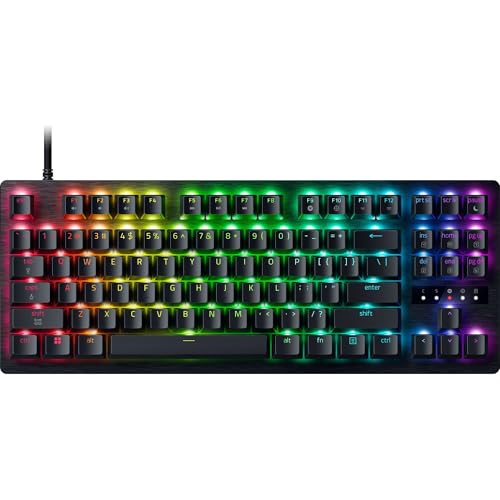
Razer Huntsman V3 TKL 8KHz Esports Keyboard

Razer Huntsman V3 Pro 8KHz Esports Keyboard

Razer Huntsman V3 Pro Mini 60% Keyboard

Razer BlackWidow V4 Pro 75% Wireless

Razer BlackWidow V4 TKL Wireless
Razer Pro Type Ergo Wireless Split Keyboard
The Strengths Of Each Pick
The TKL sibling of Razer’s flagship Pro line keeps everything that made the full-size board sing while shrinking the footprint, and on a wide mousepad that extra bench space becomes the difference between a clean flick and a wrist crash. Razer’s second-generation analog optical switches handle actuation anywhere between 0.1 and 4.0 mm, which is the kind of granular control competitive FPS players obsess over because you can fine-tune exactly how deep a key needs to travel before it fires. Compared to the original Huntsman V3 Pro TKL further down this list, the headline upgrade is the 8000 Hz polling rate, a polling speed being how often the keyboard reports your input to the PC, which smooths out the roughest micro-adjustments in fast strafing. You do pay a premium for that speed, but the build quality and switch feel are exactly what you’d expect at this level.
Notable Upsides
- 8KHz polling rate helps every tiny directional change register with minimal lag
- Adjustable actuation from 0.1 to 4.0 mm lets you tune sensitivity per key
- Rapid Trigger mode enables very fast repeated inputs for counter-strafing
- Switch lifespan rated for roughly 100 million keystrokes
- TKL layout frees a noticeable strip of desk compared to the full-size Pro
Worth Noting
- The full software learning curve is steep if you have never tweaked actuation before
- Wired only, so cable management matters on a clean setup
- You will likely remap a few arrows and function keys to layers to get the most out of the layout
Key Specs
Right Fit For
Hardcore FPS and esports players who want TKL desk space without giving up the polling rate and analog control of a flagship board.
Consider Something Else When
You need wireless freedom for a couch setup; the Razer BlackWidow V4 TKL Wireless suits cable-free living much better.
The original Huntsman V3 Pro TKL sits a tier below the 8KHz version above it, but for most people the polling rate difference is academic, and you still get the same analog optical switches with adjustable actuation and the always-handy Snap Tap feature, which prioritizes the last direction you pressed when two opposing keys get tapped near-simultaneously. In everyday ranked play, that trick alone cleans up a lot of awkward movement cancels. Compared to the bigger Huntsman V3 Pro full-size, the TKL cut means losing the number pad but gaining a cleaner desk, and for many setups that is a fair swap.
What Pays Off
- Snap Tap smooths out rapid counter-strafing and direction changes
- Analog optical switches let you set multiple actuation points per key
- Rapid Trigger helps with fast repeated inputs in shooters
- Lower cost than the 8KHz sibling while keeping the core feature set
Trade Offs
- No wireless option means a fixed cable run
- Still needs Razer’s Synapse software for the best tweaks
- Standard polling rate falls short of the 8KHz Pro variant above
Built With In Mind
Competitive FPS players who want analog switch control and Snap Tap at a more approachable price than the 8KHz version.
Skip It When
You crave the smallest possible mouse space; the Razer Huntsman V3 Pro Mini 60% gives up the function row for the tightest layout in the family.
Yes, this is a keycap set and not a full keyboard, but a 60 percent build is only as personal as the caps on top of it, and KiiBoom’s Civilization set delivers a deeply themed red-and-yellow Egyptian palette that immediately changes the look of any board it lands on. The 142-key count covers ANSI and ISO layouts across full-size, 80 percent, 75 percent, and 60 percent boards, so you will not run short of alternates for odd rows. The PBT plastic and dye-sublimated legends, which means the legend is dyed into the plastic rather than printed on top, tend to hold up well to greasy fingers over months of use.
Benefits That Matter
- PBT plastic resists the shine that ABS caps develop over time
- Dye-sub legends stay legible even after heavy daily typing
- 142 keys cover everything from 60% boards up to full-size builds
- MDA profile offers a taller, sculpted feel that many typists prefer
Points To Note
- MDA profile is not for everyone; it sits taller than Cherry or OEM
- Strong color theme may clash with other peripherals
The Right Fit
Themed-build enthusiasts who want a 60% board to actually look like something and don’t mind the taller MDA cap profile.
A Better Fit Elsewhere
You need a working keyboard out of the box; the YUNZII AL65 Wireless Mechanical Keyboard comes fully assembled and ready to remap.
The AL65 is the build-it-and-tweak-it pick on this list, and for people who love dialing in a board it hits the right notes: a CNC aluminum case, a gasket-mounted structure, a gasket mount being a soft, foam-padded sandwich that gives the typing feel a springy, less harsh bottom-out, and QMK/VIA support for full key remapping. That last bit is the real prize, because QMK and VIA are open-source firmware tools that let you reassign every key, build macros, and adjust RGB without proprietary software getting in the way. Hot-swap sockets let you pull and replace the Gateron switches without soldering, so the feel of the board can change over time as you try new switches.
Practical Advantages
- QMK/VIA firmware gives complete remapping and macro control
- Triple-mode connectivity covers Bluetooth, 2.4 GHz wireless, and USB-C
- Hot-swap PCB accepts 3-pin and 5-pin switches for easy modding
- Gasket-mount design softens the bottom-out for a cushier typing feel
Things To Consider
- Aluminum body is heavier than plastic alternatives, harder to travel with
- Default 16 RGB effects are solid but not as flashy as Razer’s Chroma suite
- Mac and Windows mode switching needs a key combo, easy to forget
Key Specs
Who It Suits Best
Keyboard hobbyists who want a wireless aluminum 60% with open-source firmware and don’t mind a bit of tinkering.
Look Elsewhere When
You’d rather plug in a flagship and play; the Razer Huntsman V3 Pro Mini 60% offers higher-end analog switches in a similar footprint with far less setup.
This is the V3 TKL without the “Pro” tag, and the main difference between it and the Pro TKL above is the price versus the depth of switch control. You still get the 8KHz polling rate and the second-generation analog optical switches, but the feature set trims back a touch in the software department. For most ranked players that is a non-issue, and you pocket real money by skipping the Pro badge. Compared to the YUNZII AL65, this is a much more out-of-the-box play experience: zero soldering, zero firmware flashing, just plug it in and the Synapse app does the heavy lifting.
Where It Delivers
- 8KHz polling is a rare feature at this price tier
- Analog optical switches support adjustable actuation
- TKL form factor suits both typing and gaming setups
- Razer build quality and key stabilizer tuning tend to be consistent
Honest Caveats
- Software control is locked behind Razer’s Synapse ecosystem
- Wired connection may bother clean-aesthetic fans
Best Suited To
Existing Razer fans moving from an older board who want the 8KHz polling without the full Pro tax.
Reach For A Different Pick When
You want a wireless setup; the Razer BlackWidow V4 TKL Wireless hits a similar TKL footprint without the cable.
The full-size Huntsman V3 Pro 8KHz is the big sibling of the TKL version earlier on this list, and the obvious trade-off is desk space versus features. You get the same Gen-2 analog optical switches, the same 0.1 to 4.0 mm actuation range, and the same 8KHz polling, but you also keep a full number pad, which is genuinely useful if you bounce between gaming and spreadsheet-heavy work. The 100-million-keystroke rated switch lifespan means this is a board that wants to live on your desk for years, not get rotated out after one tournament cycle. The honest read is that 60% hunters are not the target here, so if you’ve already decided on the smaller format, scroll back up to the Mini.
A Favorable Mix
- Full-size layout suits hybrid gaming and productivity setups
- 8KHz polling rate at the flagship level
- Analog optical switches with wide actuation adjustment
- Long switch lifespan for daily heavy use
Softer Spots
- Takes up more desk space than a 60% or TKL alternative
- Not the right choice for low-sensitivity mouse sweepers
Made For
Players who split time between competitive gaming and number-pad-heavy work like editing, finance sheets, or stream overlays.
Where A Sibling Pick Shines
You want the smallest possible board; the Razer Huntsman V3 Pro Mini 60% trims this exact formula down to its essentials.
The Mini is the 60% version of Razer’s flagship analog line, and it is the closest the brand comes to a true 60% form factor, meaning the arrow keys, function row, and numpad are all gone, so you live or die by the layer system. In return, your mouse gets almost all of the desk back, which low-sensitivity players tend to love. Analog optical switches with adjustable actuation, Snap Tap, and Rapid Trigger all carry over from the larger Pro boards, so you are not trading flagship features for size, only the convenience of dedicated keys. Compared to the TKL Pro earlier, the move to 60% is a real commitment, so it helps to already know you’ll remap arrows to IJKL or similar.
Well-Handled Touches
- Smallest flagship-class analog Razer board available
- Snap Tap and Rapid Trigger carry over from larger siblings
- Adjustable actuation per key through Synapse
- Dual-purpose secondary functions add value to the missing keys
Things To Weigh
- Layer-based arrows take a couple weeks to memorize
- Wired only, no wireless option in this form factor
Perfect Match For
Low-DPI FPS players and esports competitors who want maximum mouse space without giving up analog switch tech.
Swap It Out When
You want wireless and a slightly larger layout; the Razer BlackWidow V4 TKL Wireless is a step up in size but keeps the cable off the desk.
The BlackWidow V4 Pro 75% is a slightly bigger option, technically a 75% layout rather than a strict 60%, but it earns its spot because of the OLED display and command dial combo, which is genuinely useful for streaming, system monitoring, and quick setting tweaks without alt-tabbing out of a game. Wireless connectivity frees the desk of cable clutter, and the orange tactile switches are a classic Razer feel that you either love or you swap. Compared to the YUNZII AL65, this is a much more plug-and-play package, though it loses the open-source firmware flexibility.
Positive Takeaways
- OLED screen with command dial adds at-a-glance system info
- Wireless frees the desk of one more cable
- Hot-swappable design accepts 3 and 5-pin switches
- 75% layout keeps a function row, useful for productivity work
Small Caveats
- Heavier than a true 60% board, less travel-friendly
- OLED and command dial raise the price noticeably
Feature Snapshot
Who Should Grab It
Streamers and creators who want a wireless keyboard with on-board system readouts and a familiar 75% layout.
Not Your Match When
You want the smallest possible footprint; the Razer Huntsman V3 Pro Mini 60% trims size further at the cost of an OLED screen.
The TKL Wireless version of the BlackWidow V4 is the most balanced pick on this list for someone who wants Razer’s ecosystem without the flagship price. Razer HyperSpeed wireless keeps latency low in competitive play, and Bluetooth lets the same board pair with up to three devices for quick toggling between a desktop, laptop, and tablet. The hot-swappable socket design is a sleeper feature because it means you can swap in linear, tactile, or clicky switches to find a feel that matches your play style. Compared to the Huntsman V3 TKL above, you give up analog optical switches for traditional mechanicals, but gain wireless freedom.
Bright Spots
- Razer HyperSpeed wireless with multi-device Bluetooth support
- Hot-swap PCB works with 3-pin and 5-pin switch types
- Tenkeyless layout suits both gaming and typing setups
- Single dongle can pair with compatible Razer mice
A Few Limitations
- Standard polling rate falls below the 8KHz Huntsman boards
- Switch feel is a personal call; you may end up swapping the stock Oranges
Quick Facts
Whose Shelf It Belongs On
Multi-device users who bounce between a gaming desktop and a work laptop, and want one wireless board to do it all.
Another Choice May Suit
You need analog actuation; the Razer Huntsman V3 Pro TKL Esports Keyboard delivers that with a wired connection.
The Pro Type Ergo is the odd one out on a gaming list, but it earns its spot because the “60 percent keyboards for gaming” conversation often includes people who game on the same board they type on all day. A split layout with adjustable tilt reduces wrist strain over long sessions, and the low-profile fingertip-shaped keycaps, with spherical indents that match your fingertip, keep finger travel short. It’s a wireless board, and RGB is included for those who want a little desk flair. Compared to the Huntsman V3 Pro Mini above, the focus is squarely on ergonomics, not raw speed, so frame it that way when you shop.
Real-World Strengths
- Split layout with 10 degree slope and adjustable tilt reduces wrist strain
- Dual B keys accommodate both left and right hand reach
- Low-profile keycaps shorten finger travel for faster typing
- Wireless connectivity keeps the desk clean
Potential Compromises
- Not designed for tournament-grade analog actuation
- Split layout takes a week of practice to feel natural for some users
Feature Overview
Who Will Love This
People who game and work long hours on the same board and want wrist-friendly ergonomics above tournament speed.
Where Another Pick Suits Better
You want pure competitive speed; the Razer Huntsman V3 Pro Mini 60% sits in a much smaller footprint with analog switches designed for FPS play.
Picking The Right Layout And Switch Type For Your Setup
A 60% board earns its keep by clearing the desk, so the first honest question is how much you actually use the keys you’re about to lose. Arrow keys disappear, so anyone who plays a lot of platformers or top-down games should plan a layer mapping before day one. The function row also goes, which is fine for gaming but annoying for spreadsheet shortcuts, and the print screen, scroll lock, and pause cluster usually move behind a function layer too.
Switch type matters more than most first-time buyers expect. Linear switches travel smoothly with no bump and are popular for fast gaming. Tactile switches give a small bump at the actuation point, the moment the keyboard registers a press, and that bump is feedback for typists. Clicky switches add an audible click to the tactile bump, which is satisfying for some people and infuriating for anyone nearby. Boards like the Razer Huntsman V3 Pro family add analog optical switches, which support adjustable actuation so a light tap can register differently from a deep press, and that is genuinely useful for movement keys.
Connectivity is the next fork. Wired boards avoid battery anxiety and tend to support the highest polling rates, like the 8KHz options from Razer. Wireless boards free the desk but add battery life as a maintenance item, and on a 60% board with no media keys, controlling playback usually means a remap or a quick tap to a function layer.
Build material rounds out the decision. Aluminum cases like the YUNZII AL65 feel dense and stable, which is great on a desk but tough in a backpack. Plastic cases are lighter and cheaper but can flex under heavy hands. Hot-swap sockets, a feature where the switch can be pulled out and replaced without soldering, matter if you ever plan to change the feel of the board later, and they turn a one-time purchase into a longer-term hobby.
Key Considerations Across These Picks
Pitfalls Shoppers Hit
The most common slip is buying a 60% board for the look and then realizing the arrow keys and function row are gone, and that muscle memory hurts more than expected. Test your most-used shortcuts in a key-remap app before committing. Another trap is ignoring switch type and grabbing whatever ships in the box. Tactile and linear feel very different, and a wrong switch on a board you stare at for years adds up. Finally, don’t skip the keycap compatibility check if you ever plan to swap in a themed set like the KiiBoom Civilization caps above, because not every profile fits every PCB.
What Separates Premium From Basic
Premium boards in this category earn their price with analog optical switches, hot-swap PCBs, wireless with low-latency dongles, and higher polling rates. The 8KHz polling on the Huntsman V3 Pro TKL is a real feature, not a marketing line, but it only matters in the most competitive scenarios. Hot-swap and QMK support, which the YUNZII AL65 has and most Razer boards don’t, are more useful day-to-day because they let the board grow with your preferences. The honest case for paying up is when those features match how you actually use the board, not because the spec sheet looks impressive.
Frequently Asked Questions
What exactly is a 60% keyboard?
A 60% keyboard trims the number pad, function row, arrow keys, and navigation cluster from a full-size layout, leaving the main alphanumeric block and a small handful of modifier keys. The result is a much smaller board that gives your mouse more desk space.
Are 60% keyboards good for gaming?
Yes, especially for FPS and competitive genres where wide mouse sweeps matter more than dedicated arrow keys. The trade-off is that you usually access arrows, function keys, and media controls through a secondary layer triggered by a modifier key.
What does 8KHz polling actually do?
Polling rate is how often the keyboard reports its state to the computer, and 8KHz means roughly 8,000 reports per second, compared to the more common 1000 Hz. In practice that extra reporting can smooth out micro-movements in fast competitive play, though most casual gamers will not feel a dramatic difference.
Do analog switches really help in games?
Analog optical switches can help because they support adjustable actuation and analog-style input, meaning how far you press a key can matter, not just whether you pressed it. That is useful for movement keys, where a light tap can mean walk and a deeper press can mean sprint, and for racing games that read analog input.
Is wireless good enough for competitive gaming now?
On a quality 2.4 GHz wireless connection like Razer HyperSpeed, latency is generally low enough for serious play. Bluetooth is fine for casual sessions and multi-device pairing but adds a bit more input lag, so most competitive players stick with the dedicated wireless dongle or a wired connection.
Wrap Up
A 60% board is a real lifestyle change for the desk, not just a spec-line swap, and the right pick depends on whether you live in ranked shooters, bounce between work and play, or want to tinker with firmware. Start with the layout and switch type, then layer in connectivity and build material. Whichever option from this list matches your routine, you’ll likely find the extra mouse space and the cleaner setup more rewarding than the keys you gave up.


