


Competitive players live and die by a few milliseconds, and the right display makes those milliseconds count. A 5ms (or sub-5ms) gaming monitor keeps motion crisp during fast turns, helps your crosshair track a moving target, and reduces the smearing that turns close fights into guesswork. This roundup focuses on curved, high-refresh displays that hit that response-time window without forcing you to overspend, with options across screen sizes, resolutions, and price profiles.
A Snapshot Of The Selections

AOC 27″ Curved Gaming Monitor C27G2Z (FHD, 240Hz, FreeSync)

ASUS TUF Gaming VG27WQ3B 27″ QHD Curved Monitor (180Hz)

KTC H32S17F 32″ Curved 240Hz Gaming Monitor (FHD)

KTC H32S17C 32″ Curved 165Hz Gaming Monitor (FHD)

MSI MAG 274CF X24 27″ Curved 240Hz Monitor (FHD)

KTC H32S25E 32″ 1000R Curved QHD 240Hz Monitor

KTC H32C5 32″ Curved 280Hz Gaming Monitor (FHD)

KTC H32S5 32″ QHD Curved 180Hz Gaming Monitor

KTC H24S17P 24″ Curved 240Hz Gaming Monitor (FHD)
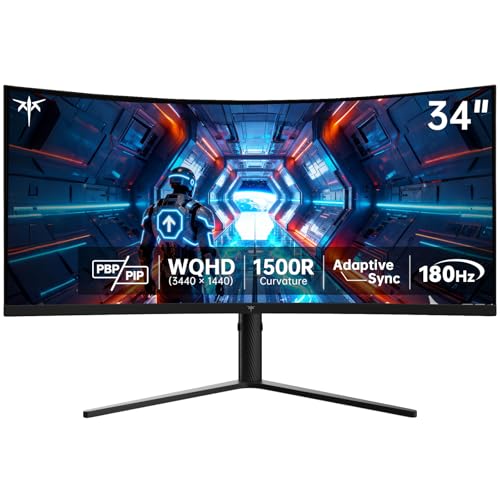
KTC H34S5 34″ UWQHD Curved 180Hz Ultrawide Monitor
The Details Behind The Selections
The AOC C27G2Z is a 27-inch 1080p curved monitor built around a VA panel, which tends to deliver deeper blacks than the IPS panels you see on a few of the other picks on this list. Response time (how fast a pixel can change from one color to another) is listed at 0.5ms MPRT (Moving Picture Response Time, a measure of how long a frame stays visible), and the 240Hz refresh rate (how many times per second the image redraws) is the headline spec for esports-minded players.
FreeSync Premium support keeps frame tearing in check when your GPU pushes past the monitor’s ceiling. The 1500R curve (a measurement of how tightly the screen bends, with lower numbers meaning a deeper wrap) is gentle enough to feel natural at a typical desk distance. For competitive shooters and MOBAs running on mid-range GPUs, this display covers the bases without overcomplicating your setup.
What Stands Out
- 240Hz refresh ceiling handles fast-paced shooters and battle royales.
- VA panel typically produces stronger contrast than the IPS options in this lineup.
- FreeSync Premium reduces tearing across a wide frame-rate range.
- 0.5ms MPRT response keeps motion blur to a minimum during quick flicks.
- 1500R curvature feels natural at standard desk viewing distance.
Worth Noting
- 1080p on 27 inches means pixel density is modest; text looks slightly soft compared to QHD screens.
- VA panels can show minor smearing in dark transitions, depending on the title.
- HDR performance is entry-level rather than transformative.
Feature Snapshot
Right Fit For
Esports and competitive FPS players who already run a system that can push 200-plus frames at 1080p.
Consider Something Else When
You want crisper text and more desktop real estate; the ASUS TUF Gaming VG27WQ3B offers QHD resolution at a similar size.
Step up from 1080p to 2560 x 1440 and the difference shows immediately: sharper text, more visible detail in shadows, and breathing room for side-by-side windows. The ASUS TUF Gaming VG27WQ3B pairs that QHD resolution (roughly 78% more pixels than 1080p) with a 180Hz refresh rate and 0.5ms GTG (gray-to-gray) response, plus Extreme Low Motion Blur (ELMB), ASUS’s backlight-strobing technology that sharpens fast motion.
The 1500R curve, 90% DCI-P3 color coverage (a wider color space than the standard sRGB, useful for richer, more lifelike hues), and DisplayWidget software make this a versatile middle-ground option. It handles single-player RPGs and immersive sims just as well as it handles ranked Valorant sessions, which is part of why it lands high on this list.
Noteworthy Benefits
- QHD resolution adds noticeable clarity over the 1080p picks.
- 90% DCI-P3 coverage supports richer color in games and movies.
- ELMB reduces perceived blur during high-speed camera turns.
Points To Keep In Mind
- You may find 180Hz modest compared to 240Hz competitors if you mainly play competitive FPS.
- QHD demands more GPU horsepower, so frame rates may drop at max settings on mid-range cards.
Best Suited To
Gamers who split time between immersive single-player titles and competitive multiplayer.
A Better Fit Elsewhere
Hardcore esports players chasing maximum refresh should look at the MSI MAG 274CF X24 for 240Hz FHD speed.
Big, curved, and quick. The KTC H32S17F stretches a 240Hz panel across 32 inches of 1080p real estate, which works well for couch gaming, console play, or anyone who prefers their games to fill more of their peripheral vision. A 1ms response time keeps input lag (the delay between your action and what appears on screen) low, and Adaptive Sync (a variable refresh technology that syncs the display’s refresh rate to your GPU’s frame output, eliminating tearing) helps smooth out frame drops in demanding scenes.
Compared to the AOC C27G2Z, you trade pixel density for screen size, which is a fair exchange if you sit further from the display. The curve helps keep the edges within a comfortable viewing angle, and VESA mount compatibility (a standard hole pattern on the back that lets you attach the screen to aftermarket arms or wall mounts) makes it friendly to custom setups.
Everyday Wins
- 240Hz refresh on a 32-inch panel for a cinematic, smooth feel.
- Adaptive Sync helps prevent tearing when frame rates fluctuate.
- VESA mount support opens up monitor-arm and wall-mount options.
Trade Offs
- 1080p across 32 inches means fine text and UI elements look softer up close.
- Less ideal for small desks; the 32-inch footprint demands space.
Feature Snapshot
Who It Suits Best
Console and couch gamers, or anyone who wants a big, fast display without stepping up to 4K pricing.
Not Your Match When
You need sharp text for productivity; the KTC H32S5 with QHD resolution serves that role better.
Not every setup needs 240Hz. The KTC H32S17C trims to 165Hz on a 32-inch curved panel, which still feels notably smoother than standard 60Hz displays, and lands at a friendlier price tier. The 1500R curve wraps gently, and the HVA panel (HVA is KTC’s variant of VA technology, tuned for higher contrast and a slight curve) supports strong contrast for movies and single-player campaigns.
This is the kind of monitor that handles spreadsheets and Netflix during the day, then switches to a 100-hour RPG without skipping a beat. You get the same general use-case as the H32S17F above, just with a calmer refresh ceiling.
Useful Touches
- 165Hz is a noticeable step up from 60Hz for casual and mid-level play.
- 1500R curve is comfortable for long sessions at desk distance.
- HVA panel supports deeper blacks than typical IPS screens.
Honest Caveats
- Not the choice for serious esports players who want maximum frame rate headroom.
- 1080p on a 32-inch screen means you may notice individual pixels when sitting close.
Quick Facts
Made For
Households sharing one display between work, streaming, and casual gaming.
Look Elsewhere When
You want faster response for ranked play; the AOC C27G2Z delivers 240Hz in a smaller form factor.
The MSI MAG 274CF X24 targets competitive players with a 240Hz refresh rate, 0.5ms response, and AMD FreeSync Premium. The 27-inch FHD panel keeps pixel density reasonable, so text and HUD elements stay readable. MSI positions this display for FPS, RPG, and flight/racing genres, which gives you a sense of where it shines.
HDR (High Dynamic Range, expanded brightness and color range for more lifelike images) readiness, tilt adjustment, and both HDMI and legacy VGA inputs add a layer of flexibility. It’s a no-nonsense option for gamers who care more about motion clarity than color depth.
Positive Points
- 240Hz and 0.5ms response keep competitive gameplay crisp.
- FreeSync Premium support smooths frame-rate fluctuations.
- VESA mount and tilt adjustment make positioning easy.
Some Limits To Know
- HDR Ready is not the same as full HDR certification; expect modest impact.
- VGA port is included for legacy use but limits modern bandwidth.
Perfect Match For
Esports and competitive FPS players who prioritize motion clarity over resolution.
Swap It Out When
You want a bigger, more immersive screen; the KTC H32S17F offers a 32-inch 240Hz alternative.
The KTC H32S25E steps up in two ways that matter: a 1000R curve, the most aggressive wrap in this roundup, and QHD resolution at 240Hz. The tighter curve pulls the edges of the screen closer to your peripheral vision, which sim racers and flight-sim fans tend to love. Meanwhile, 2560 x 1440 gives you the pixel density to read small HUD text without scaling.
A 4000:1 contrast ratio and 122% sRGB coverage (sRGB is the standard color space used across most web content and games; exceeding 100% means richer, more saturated colors) suggest punchy colors, and Adaptive Sync handles frame-rate matching. Tilt adjustment and VESA compatibility round out the build.
Everyday Perks
- 1000R curve delivers a deeply immersive field of view.
- QHD at 240Hz balances sharpness and motion clarity.
- High contrast ratio supports vivid, layered visuals.
Possible Compromises
- The aggressive curve may feel too tight for productivity tasks like spreadsheets.
- QHD at 240Hz demands a strong GPU to fully leverage the panel.
Feature Card
Who Will Love This
Sim racing and flight-sim enthusiasts who want maximum immersion from a single screen.
Where Another Pick Suits Better
Players who prefer a gentler curve for mixed use should consider the KTC H32S5 with a milder 1500R wrap.
For players who measure monitors in hertz, the KTC H32C5 pushes a 240Hz native refresh rate that overclocks to 280Hz, the highest figure on this list. Pair that with a 1ms MPRT response and Adaptive Sync, and you get a display aimed squarely at fast-twitch titles like Valorant, CS2, and Apex Legends.
The 1500R curve and 32-inch FHD format work for desk or couch use, though, as with the other 1080p 32-inchers, pixel density is the trade. A low-blue-light mode and tiltable stand with VESA mount support make it friendly to long sessions.
A Strong Showing
- 280Hz overclocked refresh for maximum motion fluidity.
- Adaptive Sync reduces stutter and tearing.
- Low-blue-light mode helps reduce eye fatigue during marathon sessions.
Worth Bearing In Mind
- 1080p at 32 inches means text and UI elements look less sharp up close.
- 280Hz requires a high-end GPU to fully exploit; mid-range cards may cap at lower frame rates.
Whose Shelf It Belongs On
Competitive players running top-tier GPUs who want the smoothest possible motion from a curved screen.
Skip It When
You’d benefit more from a sharper image; the KTC H32S5 offers QHD at a similar size.
The KTC H32S5 splits the difference: QHD resolution on a curved 32-inch panel, with a 180Hz native refresh rate that overclocks to 185Hz. For most players, 180Hz feels plenty smooth, and the QHD pixel count makes spreadsheets, browser tabs, and game HUDs look noticeably crisper than 1080p alternatives at this size.
The 1500R curvature is mild enough for productivity work, and the panel leaves room for both single-player immersion and online sessions. It is a sensible all-rounder for someone who wants one display to handle work, streaming, and gaming.
Practical Pluses
- QHD resolution delivers sharper text and UI elements at 32 inches.
- 180Hz refresh (overclockable to 185Hz) keeps motion smooth for most genres.
- 1500R curve balances immersion with comfort for long sessions.
Things To Weigh
- Not the pick for hardcore esports players chasing 240Hz-plus.
- QHD demands more from your GPU than 1080p at the same frame rate.
Right Fit For
Anyone running a single display for work, content, and mid-to-high-tier gaming.
Another Choice May Suit
Competitive FPS players who value raw speed; the KTC H32C5 pushes 280Hz for that crowd.
Small desk, big ambitions. The KTC H24S17P crams a 240Hz refresh rate and 1ms response into a compact 24-inch curved panel. That size pairs naturally with tight setups: dorm rooms, second workstations, and bedrooms where a 32-inch display would dominate the wall.
The 1500R curve adds immersion despite the smaller screen, and the 3000:1 contrast ratio keeps visuals punchy. It is a focused tool for players who care about pixel-for-pixel speed over screen real estate.
Why It Works Well
- 240Hz in a 24-inch form factor fits smaller desks and tight spaces.
- 1500R curve adds immersion even on a smaller screen.
- High contrast ratio supports rich, layered visuals.
Where It May Fall Short
- Smaller screen means less room for multitasking and side-by-side windows.
- Compact stands may offer limited height adjustment; check the listing for tilt and swivel range.
Key Product Details
Who Should Grab It
Gamers with limited desk space who still want high-refresh speed in a compact footprint.
Not Your Match When
You want a panoramic workspace; the KTC H34S5 ultrawide fills that role more effectively.
The KTC H34S5 stretches into ultrawide territory with a 3440 x 1440 panel (a wider variant of 1440p that gives you roughly a third more horizontal screen space) at a 21:9 aspect ratio, paired with a 180Hz refresh rate. The 1500R curve and the extra width create a wraparound effect that sim racers, flight enthusiasts, and productivity-focused multitaskers tend to appreciate.
Adaptive Sync keeps frame rates in step with your GPU, and PIP/PBP (Picture-in-Picture and Picture-by-Picture, two features that let you display multiple input sources on one screen) modes let you run two input sources side by side. The stand offers tilt, swivel, pivot, and height adjustment, which is rare in this price tier.
The Upside
- Ultrawide 21:9 format supports immersive sims and multitasking workflows.
- 180Hz refresh handles fast-paced games alongside the wider field of view.
- Full ergonomic stand with tilt, swivel, pivot, and height adjustment.
- PIP/PBP modes enable dual-input workflows on one screen.
Factors To Consider
- 34-inch ultrawide demands a wide desk; measure before committing.
- Some older games do not natively support 21:9 and may show black bars on the sides.
Built With In Mind
Sim racing fans and multitaskers who want one screen for work and play.
Reach For A Different Pick When
You want maximum vertical space; a standard 16:9 32-inch monitor like the KTC H32S5 may suit standard productivity layouts better.
What To Weigh Before Choosing A 5ms Gaming Monitor
Panel Type And Color Quality
IPS panels (In-Plane Switching, known for accurate colors and wide viewing angles) and VA panels (Vertical Alignment, known for high contrast and deeper blacks) each have a personality. IPS tends to win on color accuracy and viewing angles, which matters if you also edit photos or watch movies on the same display. VA typically delivers stronger contrast, so dark scenes in horror or space games look richer. The right call depends on what you do besides gaming.
Refresh Rate Versus Response Time
A high refresh rate, like 180Hz or 240Hz, means smoother motion. A low response time, like 0.5ms or 1ms, means less smearing between frames. Both matter, and they work best together. A 240Hz panel with a 5ms response is technically a “5ms gaming monitor,” but the experience leans heavily on the refresh side. Look for both numbers in the spec sheet before deciding.
Resolution And Screen Size Pairings
Pixel density (the number of pixels packed into each inch of screen, measured in pixels per inch or PPI) is the product of resolution and screen size. A 27-inch 1080p monitor looks softer than a 27-inch 1440p monitor. A 32-inch 1080p monitor looks softer still. For productivity, QHD or higher is usually worth the extra GPU cost. For pure competitive FPS, the lower resolution lets your GPU push higher frame rates.
Sync Technology And GPU Match
Adaptive Sync, FreeSync, and G-Sync (NVIDIA’s equivalent variable refresh technology) all work toward the same goal: eliminating screen tearing without the input lag of traditional V-Sync (Vertical Sync, a setting that forces the GPU to wait for the monitor before drawing a new frame). Match the sync standard to your GPU brand when possible. Many FreeSync displays also work with NVIDIA cards through compatibility modes, but native support is cleaner.
Key Considerations Across These Picks
Pitfalls Shoppers Hit
A common trap is chasing the highest refresh rate without checking resolution. A 240Hz 1080p monitor feels incredible in ranked shooters, but the same screen can look coarse in open-world games with dense UI elements. Another slip is ignoring the curve radius: 1500R is comfortable for most desks, while 1000R demands more space and a centered seating position. Always measure your desk depth before choosing an aggressive curve.
Where The Extra Money Goes
Stepping up from a budget panel to a mid-range or premium model typically buys you better color coverage, a sharper panel type, a stronger stand, and a tighter curve. For most gamers, the biggest upgrade is resolution, from 1080p to 1440p, rather than the leap from 240Hz to 280Hz. The extra hertz show up mostly in synthetic benchmarks; the extra pixels show up everywhere.
Frequently Asked Questions
What Does 5ms Response Time Mean In Gaming?
A 5ms response time means each pixel can change color in roughly five milliseconds, which is fast enough to avoid visible smearing in most modern games. Faster responses like 0.5ms or 1ms offer even less motion blur during rapid camera turns.
Is A 5ms Gaming Monitor Good Enough For Competitive Play?
For casual and mid-level competitive play, 5ms is more than adequate. Esports professionals often prefer sub-1ms panels for the absolute lowest input lag, but the difference is marginal for most players.
Do I Need A 240Hz Monitor For 5ms Response?
Refresh rate and response time are related but separate. A 240Hz panel can have a 1ms response, and a 144Hz panel can have a 5ms response. The refresh rate controls motion smoothness, while response time controls pixel transition speed.
What Size Monitor Works Best For A 5ms Gaming Monitor?
Twenty-four to twenty-seven inches suits most desks and competitive setups, while 32 inches is better for immersive single-player and console gaming. Thirty-four-inch ultrawides work well for sim racing and multitasking, but require a wide desk.
Are Curved Monitors Better Than Flat For Gaming?
Curved monitors reduce eye strain at close distances and add peripheral immersion, especially on screens 27 inches and larger. Flat monitors remain popular for multi-display setups and for players who prefer a more traditional viewing experience.
Closing Remarks
Your ideal 5ms gaming monitor depends on the genres you play, the GPU you own, and the space on your desk. Competitive FPS players will lean toward 240Hz-plus panels, while sim and RPG fans get more from QHD resolution and a deeper curve. Match the panel to the games you actually play, and the rest falls into place.


