


Gaming rigs carry a reputation for burning through savings, but the cheap desktop for gaming space has shifted hard. Entry-level GPUs now push 1440p at sensible frame rates, and value-focused builders have trimmed fat from cases and PSUs without gutting performance. The trick is sorting genuine bargains from hidden compromises.
You’ll find nine options below: dedicated gaming towers with discrete graphics, productivity-first desktops that can still game, and one ergonomic accessory that makes any setup more livable. Each pick fits a different budget bracket, so start by deciding which trade-off matters least to your playstyle.
A Quick View Of The Lineup
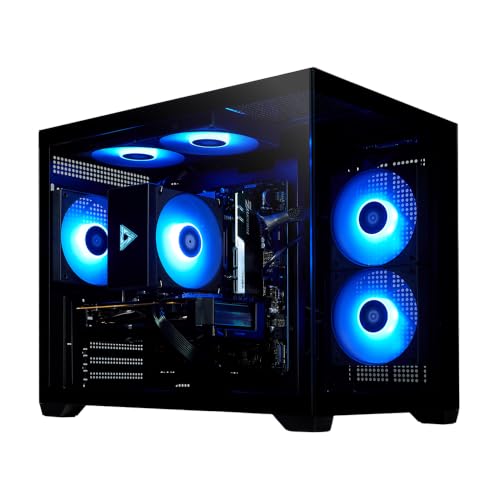
STORMCRAFT Sirius AI Gaming Desktop, Intel i5 14400F, Arc B570 10GB

HP OmniDesk Desktop Computer PC, AMD Ryzen 5, 16GB DDR5

Ultra 50 V3 Gaming PC, RTX 5080, Ryzen 7 9800X3D

EUREKA ERGONOMIC PC Stand Height Adjustable Black

Lenovo Legion Tower 5i Gaming PC, RTX 5070 Ti
HP OmniDesk Desktop Computer PC, 64GB DDR5, 3TB Storage

HP OmniDesk Desktop Computer PC, 32GB DDR5, 2TB Storage

Lenovo Legion Tower 5i Gaming PC, RTX 5070 Ti, Game Pass
HP OmniDesk Desktop Computer PC, 32GB DDR5, 3TB Storage
A Breakdown Of The Leading Choices
The STORMCRAFT Sirius AI is the kind of build that makes sense for a first dedicated gaming tower. It pairs a 14th-gen Intel Core i5-14400F processor, which uses efficient cores to handle background tasks while game threads run on the performance cores, with Intel’s Arc B570 graphics card carrying 10GB of GDDR6 video memory. That VRAM headroom pays off at 1440p, where textures stay sharp without dipping into stutter.
VR-ready certification means the rig meets the minimum bar for headsets like the Meta Quest Link or Valve Index, provided you’re not chasing maxed-out settings. For shoppers upgrading from a console or an old office PC, this lands as a sensible middle ground: enough muscle for modern AAA titles, without overspending on parts that go unused.
Noteworthy Benefits
- 10GB GDDR6 VRAM keeps 1440p texture settings comfortable in most modern releases.
- 10-core, 16-thread CPU leaves headroom for Discord, OBS, and browser tabs while gaming.
- 1TB NVMe SSD cuts load screens dramatically compared to older SATA drives.
- 16GB DDR4 RGB memory is enough today and straightforward to upgrade later.
- VR-ready certification simplifies headset compatibility decisions.
Things To Consider
- Intel Arc drivers have historically needed occasional updates for new game launches.
- DDR4 memory, while adequate, sits a generation behind the DDR5 kits in some rivals.
Feature Snapshot
Made For
Mainstream gamers moving up from integrated graphics who want 1440p performance without crossing into premium pricing.
Consider Something Else When
The HP OmniDesk 64GB configuration suits shoppers who value multitasking RAM and storage capacity over a discrete GPU.
HP’s OmniDesk lineup leans productivity-first, but this entry configuration still holds its own for casual and esports gaming. The AMD Ryzen 5 8500G is an eight-core processor (six performance cores plus two efficient ones) with integrated Radeon 740M graphics, meaning the chip itself can drive a display without a discrete GPU installed.
That’s perfect for shoppers who game in lighter titles like Valorant, League of Legends, or Stardew Valley, then drop in a dedicated graphics card later. The quad-monitor support and Wi-Fi 6 networking make it a flexible workhorse for hybrid setups, and the included wireless keyboard and mouse save you a separate trip through product listings.
Good Reasons To Consider
- DDR5 memory at 16GB gives you a modern platform that won’t feel dated in two years.
- Quad-monitor support is a genuine perk for productivity users who dabble in gaming.
- Wi-Fi 6 and Bluetooth 5.4 keep wireless peripherals responsive with minimal latency.
- Bundled wireless keyboard and mouse remove a common add-on cost.
Points To Note
- Integrated Radeon 740M graphics handle esports but struggle with demanding AAA releases.
- 1.5TB of mixed SSD and HDD storage splits fast and slow tiers, which can confuse file management for new owners.
Right Fit For
Esports players, students, and home office users who game lightly and want a tidy, modern-platform desktop with room to grow.
Look Elsewhere When
Enthusiasts chasing high frame rates in modern AAA games will find the dedicated GPU on the STORMCRAFT Sirius AI a stronger match.
The Ultra 50 V3 sits at the ceiling of this roundup, and the spec sheet explains why. The Ryzen 7 9800X3D uses AMD’s 3D V-Cache technology, which stacks extra cache memory on top of the processor die to accelerate game performance, paired with an NVIDIA RTX 5080 carrying 16GB of next-generation GDDR7 video memory. Together, they target 1440p ultra settings and 4K gaming at smooth frame rates.
An 850W Gold-rated power supply, addressable RGB fans, and 2TB of Gen4 NVMe storage round out a build that doesn’t ask you to add anything. The case is designed to breathe, which matters when components run hot during marathon sessions. If you want the most headroom this roundup offers, this is it.
Where It Delivers
- RTX 5080 with 16GB GDDR7 supports frame generation and high-refresh 4K output.
- Ryzen 7 9800X3D’s 3D V-Cache architecture is widely recognized for gaming-leading CPU performance.
- 32GB of DDR5 at 6000MHz matches the memory speed most modern AM5 builds target.
- 2TB Gen4 SSD leaves room for sizable modern game installs.
- ARGB fans and clean cable management give the build a presentable look out of the box.
Trade Offs
- This is a flagship-tier investment, so budget-conscious shoppers will want to weigh the step up from the STORMCRAFT Sirius AI carefully.
- High-end components generate more heat, so plan for a well-ventilated desk space.
Quick Facts
Best Suited To
Hardcore gamers and content creators who want a future-proofed rig for high-refresh 1440p and 4K play without building it themselves.
Skip It When
Casual players will find more sensible value in the Lenovo Legion Tower 5i, which still carries a capable GPU at a lower tier.
The EUREKA ERGONOMIC PC stand isn’t a gaming rig, but no roundup is complete without addressing the physical side of a desktop setup. This mobile cart holds a full-size ATX tower off the floor, which matters: dust bunnies collect in case fans fast, and concrete floors transmit vibrations that can slowly fatigue mechanical hard drives.
Six gear heights ranging from roughly 23 to 33 inches let you slide the tower under most desks or beside a workstation, while smooth-rolling casters make repositioning painless. The two-tier layout also gives you a spot for a printer, an external drive, or a stack of game cases.
What It Does Well
- Steel frame supports full-size ATX cases without flex.
- Six height settings make under-desk and beside-desk placement equally comfortable.
- Locking casters keep the cart steady once positioned.
- Two-tier shelf doubles as storage for accessories or a printer.
Some Limits To Know
- Wide cases with non-standard feet may not sit flush on the upper platform.
- Casters can dull on carpet over time, so periodic cleaning helps maintain smooth rolling.
Who It Suits Best
Anyone running a tower on carpet or in a room where floor placement collects dust faster than weekly cleaning can keep up.
Reach For A Different Pick When
If your tower is small enough to live on the desk itself, you don’t need a stand. The STORMCRAFT Sirius AI review covers the tower side of the equation.
Lenovo’s Legion Tower 5i brings serious gaming credentials to a familiar tower form factor. The Intel Core Ultra 7 265F processor leans on a hybrid core layout, pairing high-performance cores with efficiency cores that handle background tasks while gaming. The NVIDIA GeForce RTX 5070 Ti brings ray tracing and DLSS (an AI-driven upscaling technology that renders frames at lower resolution and reconstructs them) to the table, which makes modern AAA titles playable at high settings without tanking frame rates.
Bundling the Legion K510 Mini Pro mechanical keyboard softens the total cost a bit. The keyboard’s 75% layout, which omits the numpad to save desk space while keeping arrow and function keys, appeals to gamers who want mechanical switches without a full-size footprint.
Everyday Wins
- RTX 5070 Ti supports real-time ray tracing and DLSS frame generation.
- 32GB of memory handles modern games and streaming software simultaneously.
- 1TB SSD gives a usable starting point for a modest library.
- Included mechanical keyboard removes a typical add-on purchase.
- Legion Coldfront cooling keeps thermals manageable during long sessions.
Honest Caveats
- 1TB fills up fast once you install a few modern AAA releases, so plan on adding storage.
- The K510 keyboard’s 75% layout takes adjustment for those used to full-size boards.
Details At A Glance
Who Will Love This
Gamers who want a polished prebuilt experience with a capable mid-to-high tier GPU and don’t mind expanding storage later.
Where Another Pick Suits Better
Shoppers focused on value over peak GPU power may prefer the STORMCRAFT Sirius AI, which lands at a lower tier without skimping on core performance.
HP’s top-tier OmniDesk configuration flips the script on the entry model. The same AMD Ryzen 5 8500G processor and Radeon 740M integrated graphics show up, but the memory jumps to 64GB of DDR5 and storage stretches to 3TB, split across a 2TB SSD and a 1TB HDD. That’s a workstation-leaning build dressed in gaming-friendly clothing.
For streamers running OBS, creators editing video, or anyone juggling dozens of browser tabs alongside their game, the extra RAM is the real story. The integrated GPU still constrains AAA frame rates, but for esports, indie titles, and strategy games, this configuration punches well above its weight. Quad-monitor support turns the desk into a command center.
Points In Its Favor
- 64GB DDR5 RAM outclasses most prebuilt gaming towers at this tier.
- 3TB total storage across SSD and HDD balances speed and capacity.
- Quad-monitor support enables efficient multitasking layouts.
- Wi-Fi 6 and Bluetooth 5.4 keep wireless accessories responsive.
Worth Bearing In Mind
- Radeon 740M integrated graphics limit demanding AAA performance, so plan on adding a discrete GPU for high-refresh play.
- Hybrid storage requires some file management to keep games on the faster SSD.
Perfect Match For
Content creators, streamers, and power users who value RAM and storage headroom over raw GPU horsepower.
Not Your Match When
Gamers who want a discrete graphics card out of the box should look at the Lenovo Legion Tower 5i configurations instead.
Sitting between the 16GB and 64GB OmniDesk variants, this mid-tier configuration offers the most balanced spread. You get 32GB of DDR5 RAM, which is the sweet spot for gaming, streaming, and creative work without overspending, and 2TB of total storage split between a 1TB SSD for the operating system and games, plus a 1TB HDD for media and archives.
The AMD Ryzen 5 8500G and Radeon 740M integrated graphics remain unchanged from the other OmniDesk models. For most casual and mid-tier gamers, this configuration hits the practical sweet spot. The included wireless keyboard and mouse are a thoughtful touch for shoppers furnishing a home office or dorm.
What Pays Off
- 32GB DDR5 strikes a balance between future-proofing and value.
- 2TB dual-drive storage supports a sizable game library plus media.
- Quad-monitor support is rare at this tier.
- Bundled wireless peripherals reduce setup friction.
Possible Compromises
- Integrated graphics hold back high-refresh AAA gaming.
- HDD portion adds bulk and weight without contributing to speed.
Who Should Grab It
Home office users, students, and casual gamers who want modern specs in a tidy prebuilt and aren’t chasing top frame rates.
Swap It Out When
Gamers focused on raw frame rates will find the STORMCRAFT Sirius AI a more natural fit thanks to its discrete GPU.
The sibling to the keyboard-bundled Legion Tower 5i, this configuration trades the K510 keyboard for three months of PC Game Pass, Microsoft’s subscription service that grants access to a rotating library of hundreds of games. For someone who just unboxed their first gaming PC, that’s an instant starter library without extra steps.
Under the hood, the same Intel Core Ultra 7 265F and NVIDIA GeForce RTX 5070 Ti pairing handles modern AAA releases with ray tracing and DLSS support. The 32GB of RAM and 1TB SSD match the keyboard-bundled model, so the choice between this and Pick 5 really comes down to whether you value a mechanical keyboard or a game subscription more at the start.
Practical Advantages
- Three-month Game Pass subscription gives immediate access to a wide game catalog.
- RTX 5070 Ti handles ray tracing and frame generation smoothly at 1440p.
- Legion Coldfront cooling manages thermals during extended sessions.
- 32GB of memory supports streaming and creative workloads alongside gaming.
Where It Is Less Suited
- 1TB SSD fills up quickly on modern titles, so external or secondary storage will become useful.
- Game Pass value depends on how many included titles match your taste.
Built With In Mind
New gaming PC owners who want a turnkey experience with a ready-made game library to explore from day one.
A Better Fit Elsewhere
Shoppers who already own a library on other platforms and just want raw power may prefer the STORMCRAFT Sirius AI’s lower price-to-performance ratio.
The 3TB OmniDesk variant keeps the same 32GB DDR5 memory tier as the previous model but bumps storage up by an extra terabyte, swapping a 1TB SSD for a 2TB unit while keeping the 1TB HDD. That extra SSD headroom matters for anyone with a bulging game library, a sizable media collection, or large creative project files.
The AMD Ryzen 5 8500G and Radeon 740M integrated graphics continue to limit demanding AAA performance, so realistic expectations matter here. For most shoppers, this is a productivity-first machine that happens to handle casual and esports gaming well, especially when paired with a 1440p productivity monitor and a low-input-lag mouse.
Real Benefits
- 3TB total storage, with 2TB on SSD, accommodates large modern game installs.
- 32GB DDR5 supports multitasking and creative apps with comfortable headroom.
- Quad-monitor support is uncommon at this configuration level.
- Wireless peripherals included out of the box.
What To Weigh
- Integrated Radeon 740M graphics cap frame rates in graphically demanding titles.
- The chassis design prioritizes office aesthetics over gaming flair.
Whose Shelf It Belongs On
Media hoarders, hybrid work-and-play users, and anyone who wants generous storage in a quiet, compact tower.
Where A Sibling Pick Shines
For pure gaming horsepower at a similar memory tier, the Lenovo Legion Tower 5i with its discrete GPU makes more sense.
What To Weigh Before Choosing A Gaming Desktop
The cheapest desktop for gaming isn’t always the cheapest total cost. A cheap tower with a weak GPU may force an upgrade within a year, while a balanced build with a slightly stronger graphics card can stretch across multiple console generations. The biggest decision is whether you want a discrete GPU, which is a separate graphics card dedicated to rendering, or are willing to start with integrated graphics and add a card later.
Match the system to your actual games, not the ones on your wishlist. Esports titles like Counter-Strike 2 and Valorant run on integrated graphics at playable frame rates, but anything tagged as a “AAA” release typically needs a dedicated card. Resolution matters too: 1080p gaming is far less demanding than 1440p, which is far less demanding than 4K.
Storage often gets overlooked, but modern game installs regularly cross 100GB. A 1TB SSD sounds generous until you load up three or four recent releases. Look for systems that either offer a larger primary drive or include a secondary HDD for media and archives. RAM is similar: 16GB is the minimum, 32GB is the comfortable sweet spot, and 64GB is only necessary for video editing or running virtual machines alongside games.
Cooling and noise are real ownership concerns. A well-cooled system lasts longer, runs quieter, and throttles less during long sessions. Look for mentions of case airflow, fan count, and rated PSU efficiency, which indicates how much heat the power supply generates. Don’t forget physical setup: a floor-bound tower benefits enormously from a stand like the EUREKA ERGONOMIC option, both for dust management and vibration isolation.
Smart Spending Across These Picks
Where Shoppers Go Wrong
One common trap is paying for RAM and storage that goes unused. A 64GB configuration sounds impressive, but unless you’re editing video or running virtual machines, that headroom sits idle. Matching specs to actual workloads saves real money.
Another mistake is overlooking the GPU in favor of CPU-heavy spec sheets. For gaming, the graphics card drives frame rates more than any other component, so a balanced build with a stronger GPU and modest CPU typically outperforms the reverse.
When Paying More Pays Off
Higher-tier picks like the Ultra 50 V3 and the Lenovo Legion Tower 5i RTX 5070 Ti configurations earn their cost through longer useful life. A flagship GPU purchased today will still handle demanding games three to four years from now, while entry-level cards often need replacement sooner.
The upgrade also includes build quality, cooling, and warranty support, which matter more as systems get pricier. Premium prebuilts tend to use better case airflow and quieter fans, which owners commonly appreciate during long sessions.
Frequently Asked Questions
What specs matter most in a cheap gaming desktop?
The graphics card drives frame rates in games, so prioritize a discrete GPU over extra RAM or storage. After that, look for at least 16GB of system memory and a solid-state drive for the operating system and active games.
Can a cheap desktop handle 1440p gaming?
Yes, but the GPU needs to be the focus. Cards like the Intel Arc B570 or NVIDIA RTX 5070 Ti can push 1440p at high settings in many modern titles, while older or integrated graphics solutions typically cap out at 1080p.
Is 16GB of RAM enough for gaming in 2026?
16GB remains the minimum for modern titles, but 32GB gives breathing room for streaming, browser tabs, and background apps. Anything beyond 32GB only matters for content creation workloads.
Should I buy a prebuilt or build my own gaming PC?
Prebuilts save time, include warranty support, and avoid compatibility guesswork. Self-built rigs cost slightly less and let you choose every part, but require research and assembly confidence.
How long does a budget gaming desktop typically last?
Most budget gaming desktops remain relevant for three to five years before needing a GPU or storage upgrade. Higher-tier builds stretch that window thanks to more powerful components and better cooling.
Bottom Line
Picking a cheap desktop for gaming really comes down to which trade-off you can live with: integrated graphics now with room to add a discrete card later, or a stronger GPU today with modest storage and memory. The STORMCRAFT Sirius AI is a sensible default for 1440p-focused shoppers, the Lenovo Legion Tower 5i configurations serve those wanting more power, and the OmniDesk variants fill the productivity-plus-light-gaming niche. The EUREKA stand rounds out the picture by keeping whichever tower you choose clean, mobile, and properly positioned. Trust the spec sheet, match it to the games you actually play, and the rest falls into place.


